
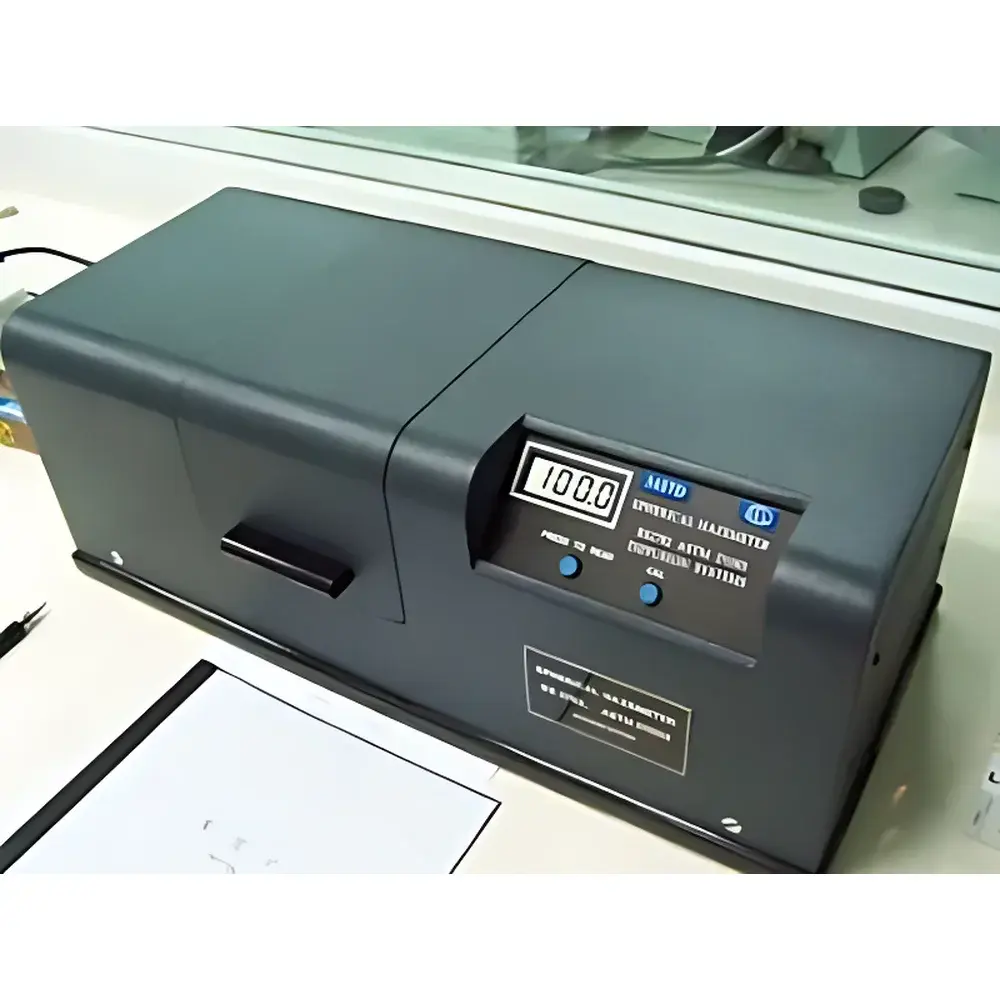
Diffusion M57D Haze and Transmittance Meter
| Brand | Diffusion |
|---|---|
| Origin | United Kingdom |
| Model | M57D |
| Type | Manual Benchtop Instrument |
| Haze Range | 0–30% |
| Total Transmittance Range | 0–100% |
| Haze Repeatability | ±0.1% |
| Transmittance Repeatability | ±0.1% |
| Optical Geometry | 0° Illumination / Diffuse Viewing (Compliant with ASTM D1003 and BS 2782) |
| Spectral Response | CIE Illuminant A & C |
| Sample Port Diameter | 22 mm |
| Transmission Aperture | 15 mm |
| Source–Detector Gap | 90 mm |
| Warm-up Time | 1 min |
| Zero Drift | <0.1 unit within 5 min after warm-up |
| Operating Temperature | 5–50 °C |
| Storage Temperature | −10–65 °C |
| Dimensions (H×W×D) | 200 × 530 × 240 mm |
| Weight | 12 kg |
| Shipping Weight | 14 kg |
| Optional Accessories | RS-232 Interface, Liquid Cell Holder, Taber Abrasion Adapter |
Overview
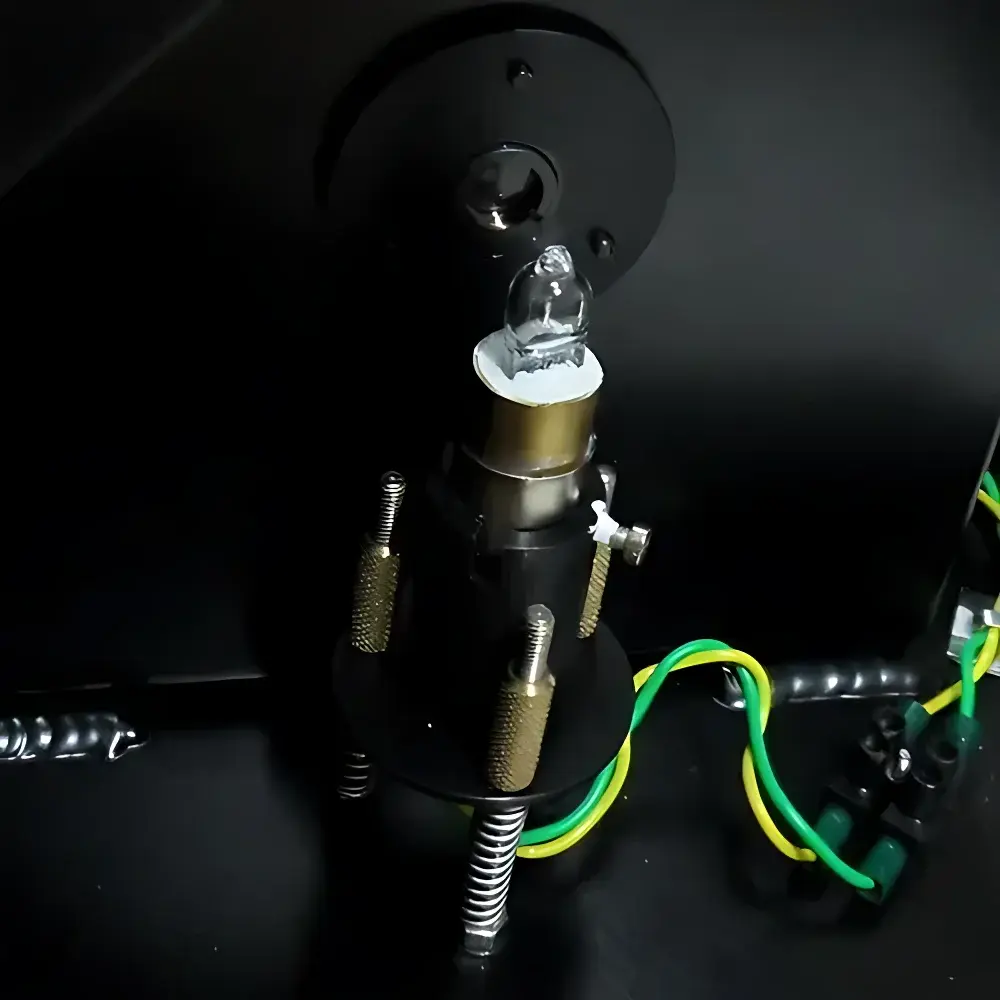
The Diffusion M57D Haze and Transmittance Meter is a precision optical instrument engineered for the quantitative assessment of haze and total luminous transmittance in transparent and semi-transparent materials. It operates on the principle of 0° illumination with diffuse viewing geometry—fully compliant with ASTM D1003 and BS 2782 standards—enabling direct, traceable measurement of both haze (%) and total transmittance (%). Unlike integrating sphere-based systems requiring mechanical rotation or complex alignment, the M57D employs a fixed-source, fixed-detector architecture with a 90 mm axial separation between lamp and photoreceptor. This design eliminates mechanical drift, enhances long-term stability, and accommodates samples up to 90 mm in thickness without reconfiguration. The instrument’s optical path is fully light-tight during measurement, eliminating ambient interference and ensuring high reproducibility across laboratory and production-floor environments.
Key Features
- Fixed 0°/diffuse optical geometry—no moving parts, no sphere rotation, minimal maintenance
- Automatic zero and calibration routines initiated via single-button operation (“Press to Read”)
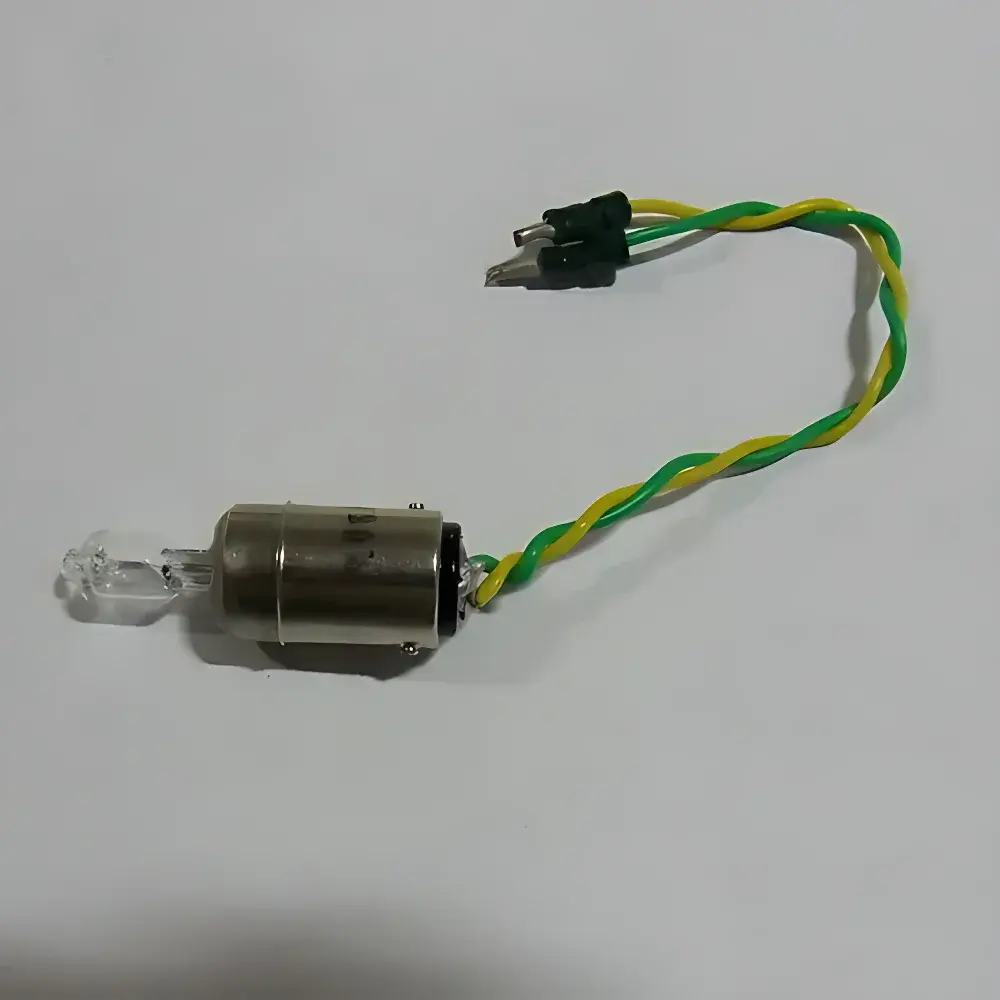
- High-stability tungsten-halogen source with CIE A and C spectral response, calibrated against NPL-traceable standards
- Integrated sample chamber with 22 mm diameter measurement port and 15 mm transmission aperture
- Robust benchtop housing (530 mm width) optimized for stable placement on vibration-damped surfaces
- Low thermal drift: zero-point shift <0.1 unit within 5 minutes post 1-minute warm-up
- Wide operating temperature range (5–50 °C), suitable for QC labs and controlled manufacturing zones
- Modular accessory support including liquid cell holder, Taber abrasion adapter, and RS-232 serial interface for data logging
Sample Compatibility & Compliance
The M57D accepts rigid and flexible planar specimens—including plastic sheets, laminated glass, coated films, and liquid-filled cuvettes—without requiring custom fixtures. Its 90 mm source–detector gap permits evaluation of thick molded components (e.g., automotive headlamp lenses, safety glazing) and multi-layer composites. For liquids, an optional NPL-calibrated glass cell ensures consistent path length and refractive index compensation. All measurements are traceable to the UK’s National Physical Laboratory (NPL), satisfying ISO/IEC 17025 requirements for accredited testing laboratories. The instrument meets ASTM D1003 Section 8 (Method A, 0°/diffuse) and BS 2782 Part 4, making it suitable for regulatory submissions in pharmaceutical packaging (USP ), medical device transparency validation, and automotive OEM material specifications (e.g., SAE J576).
Software & Data Management
While the M57D operates as a standalone meter with immediate analog readout, its optional RS-232 interface enables integration into validated QA/QC workflows. When connected to host software, the device supports timestamped data export (CSV), automated pass/fail flagging against user-defined limits, and audit-trail generation compliant with FDA 21 CFR Part 11 requirements—provided the host system implements electronic signatures, secure user authentication, and immutable record retention. No proprietary software is bundled; instead, the meter outputs ASCII-formatted strings compatible with LabVIEW, MATLAB, or LIMS platforms. Calibration history, operator ID, and environmental metadata (temperature, humidity if externally logged) can be appended to each dataset for full GLP/GMP traceability.
Applications
- Quality control of injection-molded polycarbonate and acrylic components in automotive interiors and lighting systems
- Batch release testing of pharmaceutical blister packaging films per USP haze thresholds
- Evaluation of anti-fog coating efficacy on greenhouse films and food-grade PET containers
- Quantification of turbidity-induced haze in cosmetic emulsions and topical ointments
- Validation of cleaning agent performance on architectural glass and display cover lenses
- Assessment of weathering-induced opacification in outdoor PVC profiles and solar panel encapsulants
- Monitoring clarity degradation in optical adhesives used in touch-panel lamination
FAQ
Does the M57D require annual recalibration by an accredited lab?
Yes—while internal zeroing and reference checks are performed daily, NPL-traceable recalibration is recommended annually or after any physical impact, major environmental shift, or observed deviation exceeding ±0.15% haze or ±0.2% transmittance against certified reference standards.
Can the M57D measure curved or textured surfaces?
No—it is designed exclusively for flat, parallel-surface specimens. Curved lenses or embossed films must be evaluated using alternative methods (e.g., imaging haze analyzers or goniophotometers) per ISO 13468-2.
Is the liquid cell holder supplied with path-length certification?
Yes—the optional quartz-glass cell includes NPL-issued certificate of path length (10.00 ± 0.02 mm) and refractive index correction factors for water, ethanol, and glycerol-based solutions.
What power supply configuration is required for global deployment?
The M57D features auto-ranging 110–230 VAC, 50–60 Hz input; no external transformers or voltage converters are needed for operation in EU, North America, APAC, or Middle East regions.



