
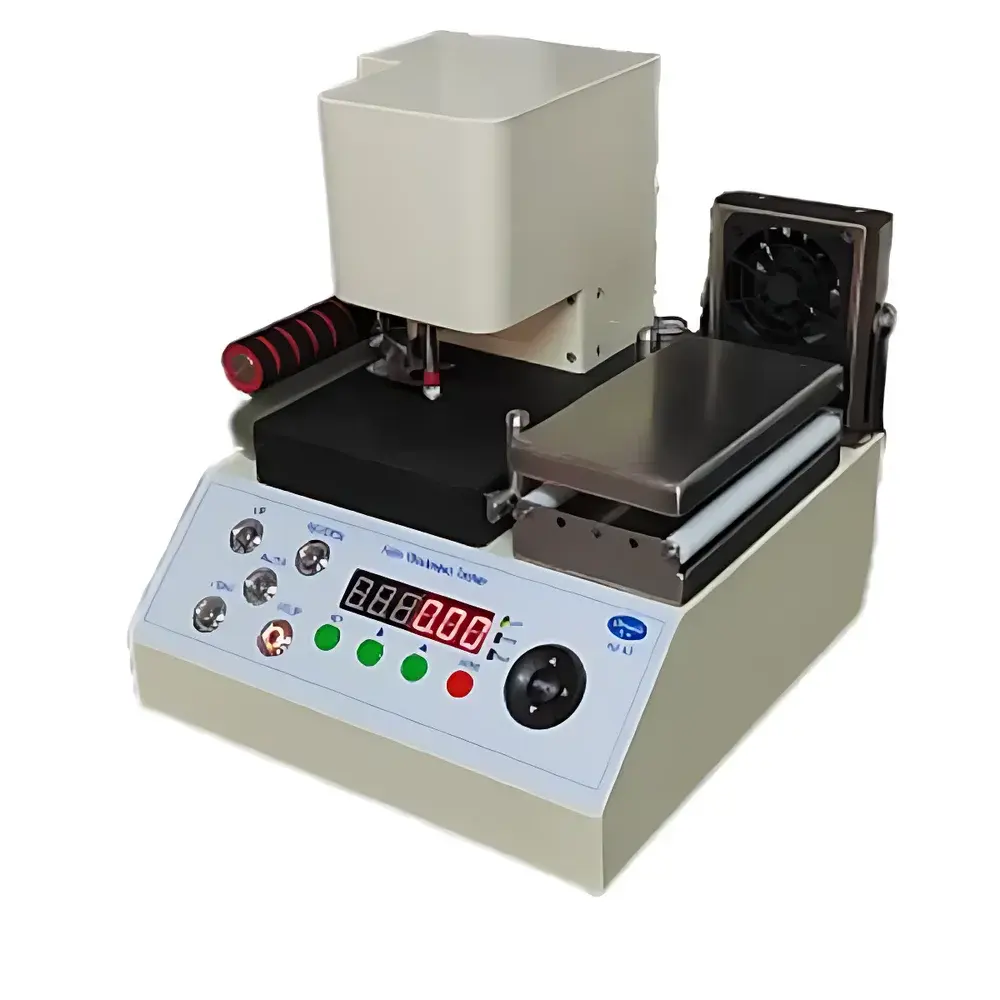
SHANG ZHUN DM49-85 Precision Film Thickness Gauge
| Brand | SHANG ZHUN |
|---|---|
| Origin | Guangdong, China |
| Manufacturer Type | Authorized Distributor |
| Country of Origin | China |
| Model | DM49-85 |
| Display Type | LED + PC Interface |
| Operating Temperature | 10–40 °C |
| Measurement Range | 0–2000 µm (with 0.1 µm standard resolution, 0.01 µm high-resolution mode) |
| Resolution | 0.1 µm / 0.01 µm (selectable) |
| Accuracy | ±0.3% of reading |
| Repeatability | ≤0.1 µm (under controlled conditions) |
| Measurement Speed | Up to 20 measurements/min (automated pneumatic mode), manual mode unrestricted |
| Response Time | 15 ms |
| Probe Type | Dual-contact probe (flat + radius-tipped) |
| Base Platform | Grade-0 granite surface plate (270 × 260 × 282 mm, customizable) |
| Elevation Mechanism | Pneumatic-vacuum actuated lift |
| Air Supply Pressure | 0.2–1.0 MPa |
| Power Input | AC 115–230 V, 50–60 Hz / DC 24 V, 2 A |
| Enclosure Rating | IP54 |
| Net Weight (platform only) | 13 kg |
| Data Export | CSV/Excel-compatible output |
| Software Compliance | Audit-trail enabled, user-role-based access control (admin/operator), GLP/GMP-ready data logging |
Overview
The SHANG ZHUN DM49-85 Precision Film Thickness Gauge is a non-destructive, contact-type metrology instrument engineered for high-reproducibility thickness measurement of flexible and rigid thin films across industrial R&D, quality control, and production environments. It operates on the principle of high-stability inductive displacement sensing—leveraging a calibrated German-sourced LVDT (Linear Variable Differential Transformer) probe to convert mechanical deflection into precise analog voltage signals, digitized at 24-bit resolution. The system integrates a grade-0 granite base platform to minimize thermal drift and mechanical deformation, ensuring sub-micron positional stability over extended operation cycles. Designed for ISO/IEC 17025-aligned laboratories and FDA-regulated manufacturing facilities, the DM49-85 delivers traceable, repeatable measurements compliant with ASTM D6988 (Standard Test Method for Thickness of Plastic Film by Mechanical Gauging) and ISO 4593:2022 (Plastics — Film and Sheet — Determination of Thickness by Mechanical Scanning).
Key Features
- High-resolution dual-mode sensing: configurable 0.1 µm standard resolution or enhanced 0.01 µm resolution for ultra-thin polymer films, metallized foils, and coated substrates.
- Automated pneumatic-vacuum probe elevation system enabling consistent contact force (±0.05 N tolerance), eliminating operator-induced variability in manual gauging.
- Grade-0 granite work surface (270 × 260 × 282 mm) certified per GB/T 20428–2006 (equivalent to DIN 876-1), providing long-term dimensional stability and corrosion resistance.
- Modular probe assembly with interchangeable flat and radius-tipped measuring caps (R1.5 mm, R3 mm, R5 mm options available), supporting thickness evaluation on planar, curved, and edge-transitioned samples.
- Real-time statistical engine computing mean, min/max, standard deviation, Cp/Cpk indices, and trend-based process capability metrics directly on-device or via PC interface.
- Embedded microcontroller with dual-channel synchronization ensures 15 ms response latency between probe contact and displayed value—critical for inline sampling in roll-to-roll processes.
Sample Compatibility & Compliance
The DM49-85 accommodates films ranging from 5 µm polyimide tapes to 2 mm laminated composites, including PET, BOPP, PE, PVC, aluminum foil, silicon-coated release liners, and multi-layer barrier structures. Its low-force contact design (≤0.3 N nominal load) prevents indentation or creep deformation in soft thermoplastics. All measurement data are timestamped, user-annotated (batch ID, lot number, operator ID), and stored with full metadata—including environmental sensor logs (ambient temperature/humidity if external sensors integrated). Software architecture supports 21 CFR Part 11-compliant electronic signatures, audit trails with immutable records, and exportable .csv/.xlsx reports meeting ISO 9001:2015 clause 8.5.2 requirements for documented evidence of conformity.
Software & Data Management
The proprietary SHANG ZHUN ThicknessSuite v3.2 software provides a validated Windows-based interface with three-tier permission levels (Administrator, Supervisor, Operator), enforcing role-specific restrictions on calibration access, report generation, and database deletion. Measurement sessions auto-generate SPC-compliant X-bar/R charts and deviation heatmaps. Historical datasets are indexed by sample ID, date/time, operator, and equipment ID, enabling full traceability across shifts and production lines. Raw data files include embedded checksums and SHA-256 hash verification for integrity assurance. Backups support network-attached storage (NAS) or SQL Server deployment, with optional integration into MES/ERP systems via OPC UA or RESTful API endpoints.
Applications
- Quality assurance of extruded and cast polymer films in packaging and electronics substrate manufacturing.
- Thickness uniformity validation of functional coatings (anti-reflective, conductive, hydrophobic) on optical films and display components.
- In-process monitoring of lithium-ion battery separator films (e.g., PE/PP microporous membranes) during slitting and rewinding.
- Verification of adhesive layer thickness in pressure-sensitive tapes and medical transdermal patches.
- Research-grade characterization of nanolaminates and vapor-deposited thin-film stacks in academic and corporate materials labs.
- Supplier qualification testing per IATF 16949 Clause 8.4.2.2 (type approval of incoming material dimensional attributes).
FAQ
What standards does the DM49-85 comply with for film thickness measurement?
It conforms to ASTM D6988, ISO 4593:2022, and GB/T 6672–2001, with traceability to NIM (National Institute of Metrology, China) via accredited calibration certificates.
Can the system be integrated into an automated production line?
Yes—via RS-232/RS-485 serial interface or Ethernet TCP/IP, supporting Modbus RTU/TCP protocols for PLC synchronization and real-time pass/fail feedback.
Is calibration required before each use?
No—factory calibration is stable for 12 months under normal operating conditions; however, daily zero-point verification using certified gauge blocks (supplied) is recommended per ISO 10012.
Does the software support multi-language UI and report localization?
Yes—English, Simplified Chinese, Japanese, and Korean language packs are included; report templates are fully customizable for regional regulatory formatting.
How is measurement uncertainty quantified and reported?
Expanded uncertainty (k=2) is calculated per GUM (JCGM 100:2008) incorporating repeatability, probe hysteresis, temperature coefficient, and reference standard uncertainty—automatically appended to every exported report.




