
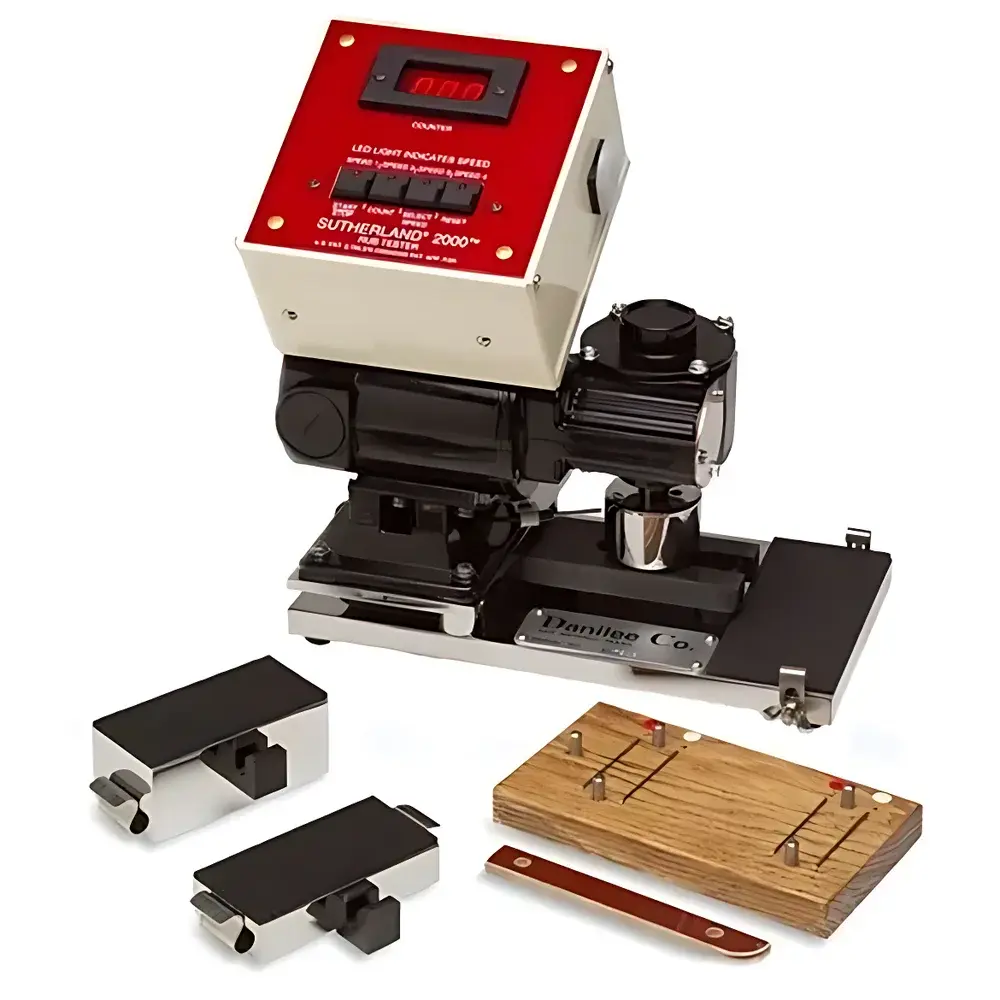

Danilee Sutherland 2000 Abrasion Tester
| Brand | Danilee |
|---|---|
| Origin | USA |
| Manufacturer Status | Authorized Distributor |
| Origin Category | Imported |
| Model | Sutherland 2000 |
| Price | ¥80,000 |
| Speed Settings | 21, 42, 85, 106 cycles/min |
| Load Options | 0.9 kg (2 lb), 1.8 kg (4 lb), optional 20 N weight |
| Display | LCD showing preset/remaining cycles |
| Compliance | ASTM D5264–92, GB/T 7705–2008 |
| Dimensions | 381 × 381 × 305 mm |
| Power Supply | 220 V, 50/60 Hz, single-phase, 2 A |
| Net Weight | 42 lbs |
| Auto-shutdown | Yes |
| Pre-stored test count memory | Yes |
Overview
The Danilee Sutherland 2000 Abrasion Tester is a precision-engineered, motor-driven instrument designed for quantitative evaluation of ink rub resistance on printed substrates—including paper, cardboard, corrugated board, and flexible packaging films. Based on the standardized Sutherland rub test principle, it applies controlled linear reciprocating motion under defined normal force to simulate mechanical wear encountered during handling, stacking, transport, or finishing processes. The instrument operates via a cam-driven mechanism that moves a weighted abrasive stylus across the printed surface along a fixed arc path—mimicking real-world tangential contact conditions. Its measurement output—typically expressed as degree of ink transfer, color density loss (ΔE), or visual rating per ASTM D5264–92—is directly correlated with ink adhesion quality, binder formulation efficacy, and substrate surface energy compatibility. As a legacy platform developed over seven decades by Danilee (USA), the Sutherland 2000 remains a globally recognized reference method in print quality assurance laboratories, prepress validation workflows, and packaging R&D environments.
Key Features
- Four programmable reciprocating speeds: 21, 42, 85, and 106 cycles per minute—enabling precise control over test severity and enabling low-cycle “wet” or short-duration protocols previously impractical on legacy two-speed units.
- LCD interface displaying preset cycle count, real-time remaining cycles, and operational status—supporting unattended testing with audible and visual end-of-test notification.
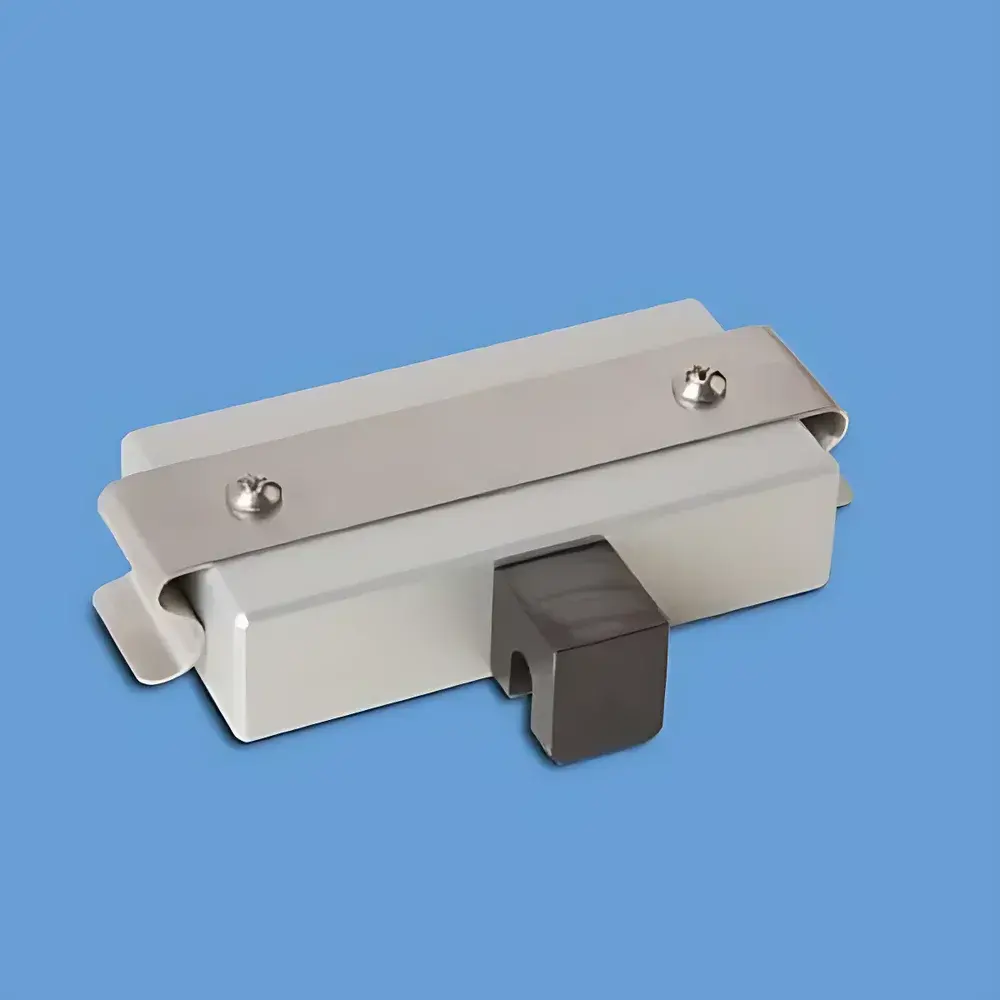
- Dual standard weights included: 0.9 kg (2 lb) and 1.8 kg (4 lb), compliant with ASTM D5264–92; optional 20 N weight available for alignment with GB/T 7705–2008 requirements for offset decorative printing products.
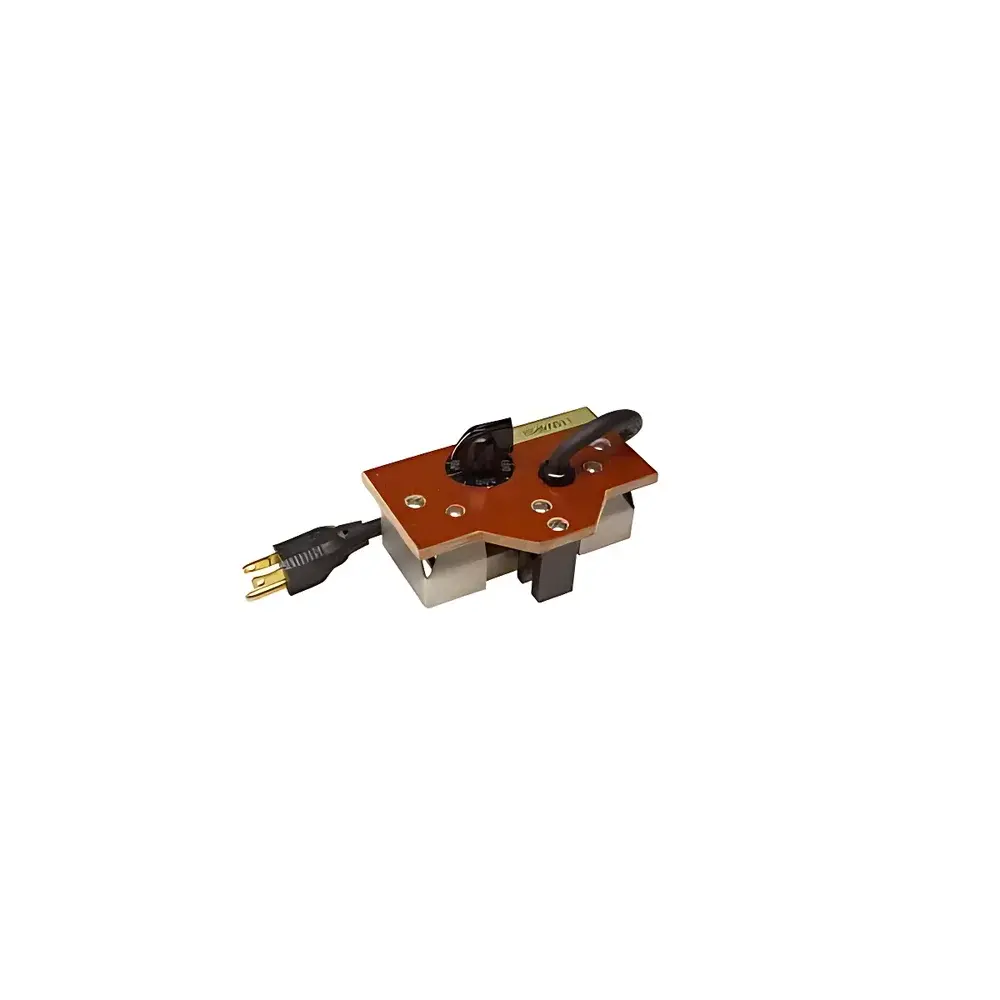
- Modular load configuration: Compatible with heated weights (for thermal-assisted rub testing) and custom-mass accessories to support application-specific force calibration.
- Robust cast-aluminum frame and precision-ground cam assembly ensure long-term mechanical stability and repeatability across thousands of test cycles.
- Auto-shutdown function activates upon completion of programmed cycles—reducing operator dependency and minimizing risk of over-testing.
Sample Compatibility & Compliance
The Sutherland 2000 accommodates flat, rigid, or semi-rigid specimens up to 150 mm × 150 mm (6″ × 6″), including coated/uncoated papers, folding cartons, label stocks, metallized films, and laminated composites. Specimen clamping is achieved via spring-loaded vacuum-free fixture, eliminating substrate distortion and ensuring consistent contact pressure distribution. All test configurations adhere strictly to ASTM D5264–92 (“Standard Test Method for Determining Rub Resistance of Printed Matter Using the Sutherland Rub Tester”) and are traceable to NIST-certified mass standards. For regulatory submissions in China, the optional 20 N weight enables full compliance with GB/T 7705–2008, which mandates 20 N loading for gravure and offset printed packaging materials. The instrument’s mechanical design supports GLP-compliant documentation when integrated with external data logging systems.
Software & Data Management
While the Sutherland 2000 operates as a standalone electromechanical tester without embedded firmware or network connectivity, its deterministic cycle control and repeatable mechanical actuation make it fully compatible with third-party digital imaging and spectrophotometric analysis platforms. Users commonly pair the instrument with X-Rite Ci7800, Konica Minolta CM-3600A, or Datacolor 600 spectrophotometers to quantify ΔL*, Δa*, Δb*, and ΔE00 before and after abrasion. Cycle count logs can be exported manually from the LCD display into LIMS or Excel-based QA tracking templates. For audit readiness, the device supports 21 CFR Part 11–compliant workflows when used alongside validated electronic lab notebooks (ELNs) that capture operator ID, timestamp, weight selection, speed setting, and specimen ID per test run.
Applications
- Quantitative assessment of ink set-off resistance in high-speed web and sheetfed offset printing.
- Evaluation of UV-curable ink adhesion on synthetic substrates under dry, damp, or solvent-wet rub conditions.
- Validation of aqueous coating integrity on pharmaceutical blister card stock prior to blister lidding.
- Comparative testing of pigment dispersion stability in flexographic inks subjected to post-print conveyance stress.
- Pre-shipment qualification of retail packaging graphics exposed to warehouse handling abrasion.
- Root-cause analysis of scuffing defects in premium beverage cartons during palletization.
FAQ
What standards does the Sutherland 2000 comply with?
ASTM D5264–92 is the primary international standard supported natively; GB/T 7705–2008 compliance is enabled via the optional 20 N weight.
Can the Sutherland 2000 perform wet abrasion tests?
Yes—it is routinely used with controlled moisture application (e.g., cotton swab dampened with IPA or water) to simulate condensation or cleaning exposure scenarios.
Is calibration certification provided with the instrument?
The unit ships with factory verification of cycle timing accuracy and mechanical stroke consistency; NIST-traceable weight calibration certificates are available upon request.
Does the instrument support variable stroke length or pressure profiling?
No—stroke geometry and cam profile are fixed per ASTM specification to ensure inter-laboratory comparability; only normal force and cycle rate are user-adjustable parameters.
What maintenance is required for long-term reliability?
Annual inspection of cam follower lubrication, stylus tip wear, and drive belt tension is recommended; no routine recalibration is needed due to purely mechanical motion transmission.





