
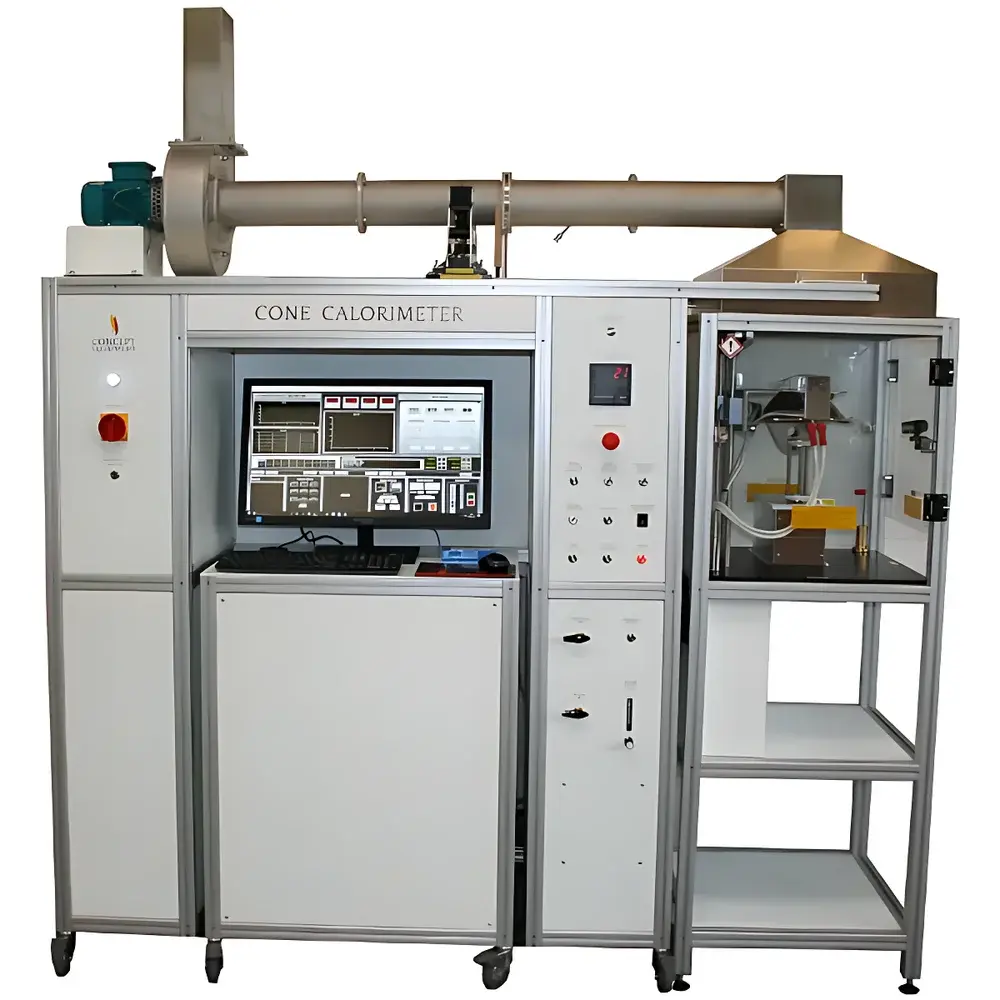
Concept Cone Calorimeter ISO 5660-1 Compliant
| Brand | Concept |
|---|---|
| Origin | United Kingdom |
| Model | Cone Calorimeter |
| Standards Compliance | ISO 5660-1, ASTM E1354, ASTM E1550, ASTM E1740, ASTM D5485, ASTM D6113, BS 476-15, NFPA 271, NFPA 264, CAN/ULC-S135 |
| Heat Flux Range | 0–75 kW/m² (CNC-machined conical heater, uniform irradiance) |
| Mass Loss Resolution | 0.01 g (high-precision load cell) |
| Oxygen Analyzer | Paramagnetic, 0–25% v/v range |
| CO₂ Analyzer | NDIR, dual-range (0–10% and 0–1.0% v/v) |
| Smoke Measurement | HeNe laser-based extinction system with auto-calibration |
| Data Acquisition Rate | ≥4 Hz (minimum scan interval: 250 ms) |
| Exhaust System | Stainless steel ducting, conical hood, annular sampling probe, and variable-speed exhaust blower |
| Ignition | Automated spark igniter with software-actuated shutter |
| Operating Environment | 10–35 °C ambient temperature |
| Electrical Supply | 230 V / 50 Hz / 32 A or 115 V / 60 Hz / 50 A single-phase |
| Dimensions (H×W×D) | 2420 × 2140 × 700 mm |
Overview
The Concept Cone Calorimeter is a bench-scale fire testing instrument engineered for precise, repeatable measurement of fire growth parameters in solid materials under controlled radiant heat exposure. Based on the oxygen consumption calorimetry principle—where heat release rate (HRR) is calculated from the measured mass flow rate and oxygen depletion in the combustion effluent—it delivers internationally recognized fire performance data aligned with ISO 5660-1, ASTM E1354, and other key regulatory standards. The apparatus subjects horizontally oriented specimens to adjustable incident heat fluxes (0–75 kW/m²), simulating real-world fire exposure conditions ranging from piloted ignition to flashover progression. Critical outputs include time-to-sustained-ignition (TTI), peak HRR, total heat released (THR), mass loss rate (MLR), effective heat of combustion (EHC), smoke production rate (SPR), and specific optical density (Ds). Its design reflects decades of fire science refinement, enabling laboratories to generate reproducible, audit-ready datasets essential for material development, regulatory submission, and fire modeling validation.
Key Features
- CNC-machined conical heater delivering highly uniform irradiance up to 75 kW/m² with ±2% spatial variation across the test area
- Integrated high-resolution load cell (0.01 g resolution) for accurate real-time mass loss tracking
- Automated spark ignition system with software-controlled shutter and flame detection logic
- Stainless steel combustion chamber, exhaust ducting, annular sampling probe, and conical hood—designed for corrosion resistance and long-term thermal stability
- Dual-range NDIR CO₂ analyzers (0–10% and 0–1.0% v/v) supporting both flaming and smoldering phase quantification
- Paramagnetic oxygen analyzer (0–25% v/v) with temperature-compensated signal processing and drift-stabilized calibration
- HeNe laser-based smoke measurement system with automatic alignment verification and extinction coefficient normalization
- Real-time data acquisition at ≥4 Hz (250 ms minimum scan interval), capturing transient combustion events with high temporal fidelity
- Intuitive control software enabling programmable heat flux ramps, ignition timing, and safety interlock configuration
Sample Compatibility & Compliance
The Concept Cone Calorimeter accommodates standard specimen dimensions (100 mm × 100 mm × variable thickness, typically ≤50 mm), with optional sample holders for irregular geometries and layered composites. It supports non-metallic materials including thermoplastics, thermosets, foams, textiles, coatings, and building products. All hardware and firmware comply with ISO/IEC 17025 requirements for testing laboratories, and data output formats meet GLP/GMP traceability expectations—including full audit trails, electronic signatures, and timestamped raw channel logs. Instrument validation protocols align with ASTM E1354 Annex A1 and ISO 5660-1 Annex B, ensuring metrological integrity across global regulatory submissions (e.g., EU Construction Products Regulation CPR, US CPSC, NFPA compliance reports).
Software & Data Management
The integrated Windows-based control and analysis suite provides closed-loop operation, automated calibration routines (oxygen, CO₂, laser baseline), and configurable test templates. Raw analog and digital signals—including thermocouple voltages, gas concentrations, mass loss, and laser transmittance—are logged synchronously with millisecond-level timestamps. Export functionality includes native CSV, MATLAB-compatible .mat files, and Microsoft Excel workbooks with prebuilt formulas for HRR, SPR, Ds, and CO yield calculations. Users may define custom metrics, generate multi-parameter overlays (e.g., HRR vs. MLR), and produce standardized reports compliant with ASTM E1354 Section 12 and ISO 5660-1 Clause 11. The software architecture supports 21 CFR Part 11-compliant user access controls, electronic record retention, and change history logging for regulated environments.
Applications
- Fire hazard assessment of polymeric materials used in transportation interiors (automotive, rail, aerospace)
- Development and qualification of flame-retardant additives and intumescent formulations
- Validation of computational fire models (e.g., CFD-based FDS simulations)
- Comparative evaluation of fire performance between conventional and bio-based composites
- Regulatory testing for construction products under EN 13823 (SBI) and EN 13501-1 classification schemes
- Smoke toxicity screening via concurrent CO/CO₂ ratio analysis and Ds evolution profiling
- Quality assurance of batch-to-batch consistency in flame-inhibited cable jacketing and insulation materials
FAQ
What standards does this cone calorimeter fully support?
It is fully compliant with ISO 5660-1, ASTM E1354, ASTM E1550, ASTM E1740, ASTM D5485, ASTM D6113, BS 476-15, NFPA 271, NFPA 264, and CAN/ULC-S135.
Is the system suitable for GLP or GMP-regulated laboratories?
Yes—the software supports 21 CFR Part 11 requirements, including role-based access, electronic signatures, and immutable audit trails for all calibration, test, and reporting activities.
Can the instrument measure both flaming and smoldering combustion phases?
Yes, through dual-range CO₂ detection, paramagnetic O₂ analysis, and continuous smoke extinction monitoring—even during low-heat-flux, oxygen-starved smoldering regimes.
What maintenance intervals are recommended for critical sensors?
Oxygen and CO₂ analyzers require quarterly zero/span verification; the HeNe laser alignment should be validated before each test series; the conical heater surface should be inspected annually for oxidation or warping.
Does the system provide uncertainty estimates for reported HRR values?
Yes—uncertainty budgets per ISO/IEC Guide 98-3 (GUM) are embedded in the reporting module, incorporating contributions from mass loss resolution, gas concentration accuracy, flow meter calibration, and irradiance uniformity.



