
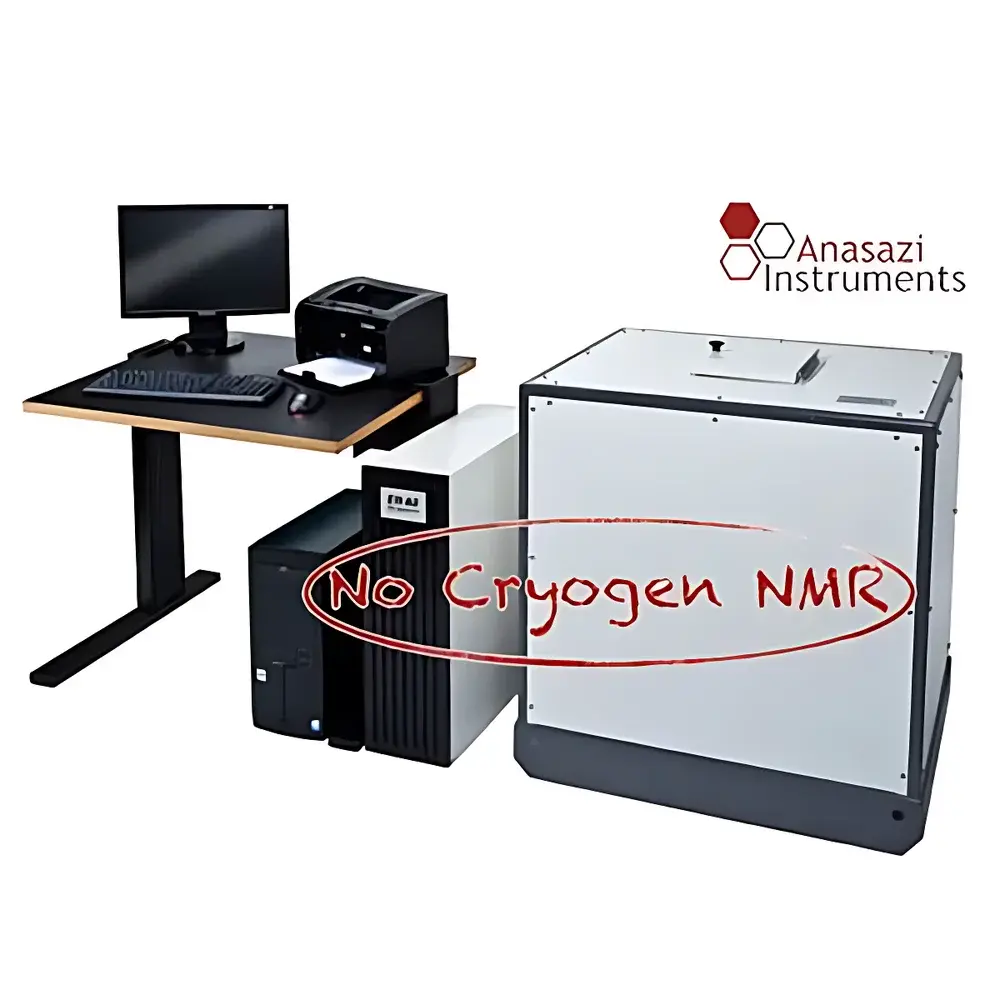
Anasazi EFT-60/90 Benchtop Permanent-Magnet NMR Spectrometer
| Brand | Anasazi |
|---|---|
| Origin | USA |
| Model | EFT-60 / EFT-90 |
| Instrument Type | Benchtop High-Field NMR Spectrometer |
| Operating Frequency | 60 MHz / 90 MHz (¹H) |
| Sample Type | Liquid Solutions |
| Resolution | < 0.5 Hz (full width at half maximum, FWHM, for 1% ethylbenzene in CDCl₃) |
| Sensitivity | ≤ 0.001 mmol/L (for ¹H, single-scan, standard 5 mm tube) |
| Magnet System | AlNiCo permanent magnet with active temperature stabilization |
| Nuclei Supported | ¹H, ¹³C, ¹⁹F, ³¹P, ²³Na, ⁵⁹Co, ²⁹Si, and other quadrupolar/nuclear spin-½ nuclei |
| Software Platform | EFT-NMR v5.x with pulse sequence library and GLP-compliant audit trail |
| Compliance | Designed to support ISO/IEC 17025, ASTM E2823, and USP <724> method validation workflows |
Overview
The Anasazi EFT-60 and EFT-90 are compact, cryogen-free benchtop nuclear magnetic resonance (NMR) spectrometers engineered for routine structural elucidation, reaction monitoring, and quantitative analysis in academic laboratories, pharmaceutical QC labs, and materials science research groups. Unlike conventional superconducting NMR systems requiring liquid helium and nitrogen infrastructure, the EFT series employs a high-stability AlNiCo permanent magnet system with integrated active temperature control, eliminating cryogen dependency while maintaining field homogeneity suitable for high-fidelity ¹H and multinuclear spectroscopy. The instruments operate at proton Larmor frequencies of 60 MHz and 90 MHz respectively—sufficient to resolve complex coupling patterns in organic molecules, distinguish diastereotopic protons, and acquire quantitative ¹H, ¹³C, and heteronuclear correlation spectra with reproducible line shapes. Field stability is maintained within ±0.05 ppm/h over 24 hours under ambient lab conditions (20–25 °C), enabling unattended overnight acquisitions and long-term kinetic studies without shimming intervention.
Key Features
- Zero-cryogen operation: No liquid helium or liquid nitrogen required—reduces annual operating costs by approximately USD $14,000 (based on regional cryogen pricing and maintenance contracts)
- Passive vibration isolation and built-in thermal regulation: Enables stable performance on standard lab benches without dedicated concrete pads or HVAC-controlled rooms
- High-resolution capability: Achieves <0.5 Hz linewidth (FWHM) on the 1% ethylbenzene standard under routine conditions—comparable to mid-field superconducting systems for small-molecule applications
- Multi-nuclear support: Dual-channel console architecture supports simultaneous or sequential acquisition of ¹H, ¹³C, ¹⁹F, ³¹P, ²³Na, ⁵⁹Co, and ²⁹Si spectra without hardware reconfiguration
- Integrated pulse programming: Preloaded sequences include 1D ¹H/¹³C, COSY, HETCOR, DEPT-135, inversion-recovery (T₁), CPMG (T₂), solvent suppression (WET), and BAPR-based peak registration
- Real-time spectral preview and parameter optimization: Students and non-specialist users can adjust acquisition parameters—including pulse angle, relaxation delay, and number of transients—via intuitive GUI before initiating acquisition
Sample Compatibility & Compliance
The EFT-60/90 accepts standard 5 mm outer-diameter NMR tubes (Wilmad 528-PP or equivalent) and accommodates sample volumes from 0.3 mL to 0.6 mL. Solvent compatibility includes CDCl₃, DMSO-d₆, acetone-d₆, methanol-d₄, and D₂O-based buffers. For regulatory environments, the instrument’s software platform implements role-based user access control, electronic signature capture, and full audit trail logging per FDA 21 CFR Part 11 requirements. Data files are stored in vendor-neutral JCAMP-DX format and comply with ASTM E2823-18 (Standard Practice for NMR Data Acquisition and Processing) and ISO/IEC 17025:2017 clause 7.7 (Ensuring Validity of Results). All factory calibration procedures follow traceable reference standards certified to NIST SRM 1993a (ethylbenzene in CDCl₃).
Software & Data Management
EFT-NMR v5.x provides a unified interface for instrument control, pulse sequence editing, Fourier transformation, phasing, baseline correction, integration, and peak picking. Raw FID data and processed spectra are archived with metadata including timestamp, operator ID, shim history, temperature log, and pulse sequence parameters. Batch processing supports automated integration across multi-sample trays using user-defined region-of-interest (ROI) templates. Export options include PNG, SVG, CSV, and MestReNova (.mnova) formats. For laboratory information management system (LIMS) integration, the software supports HL7 and ASTM E1467-compliant data exchange protocols. All software updates undergo internal verification against IUPAC-recommended NMR testing protocols prior to release.
Applications
- Organic synthesis verification: Rapid confirmation of product identity and purity via ¹H chemical shift, J-coupling, and integration ratios
- Natural product structure assignment: Correlation spectroscopy (COSY, HETCOR) enables unambiguous connectivity mapping in terpenoids, alkaloids, and polyphenols
- Pharmaceutical excipient characterization: Quantitative ¹H NMR (qNMR) compliant with USP for assay and impurity profiling
- Materials chemistry: ²⁹Si and ³¹P NMR for siloxane network analysis and phosphor-based battery electrolyte composition
- Reaction kinetics: Time-resolved ¹H acquisition with automated triggering supports in situ monitoring of esterification, hydrolysis, and polymerization reactions
- Teaching laboratories: Modular curriculum packages—including pre-built experiments on conformational analysis, tautomerism, and hydrogen bonding—are available for undergraduate instruction
FAQ
Does the EFT-60/90 require external cooling water or compressed air?
No—thermal management is fully self-contained via solid-state Peltier elements and passive heat dissipation.
Can the system be upgraded from EFT-60 to EFT-90 post-purchase?
No—the magnet assemblies and RF probes are model-specific; upgrade requires replacement of core hardware components.
Is ¹³C direct detection feasible on the EFT-90?
Yes—using the optional dual-channel probe and ≥16 k transients, natural-abundance ¹³C spectra of small molecules (e.g., ibuprofen, caffeine) are routinely acquired in under 30 minutes.
What is the minimum sample concentration for reliable ¹H quantitation?
For ±2% RSD in triplicate integrations, concentrations ≥0.01 mmol/L (in 0.5 mL volume) are recommended with 16–64 scans.
How is field homogeneity maintained over time?
The AlNiCo magnet incorporates a temperature-compensated design and is coupled to a closed-loop thermal controller that stabilizes magnet housing temperature to ±0.02 °C.
Are pulse sequences modifiable by the user?
Yes—users may edit existing sequences or write new ones using the embedded Python-based pulse programming environment, subject to hardware timing constraints.
Does the system support variable temperature experiments?
No—temperature control is limited to ambient stabilization; VT capability is not implemented in this benchtop configuration.




