
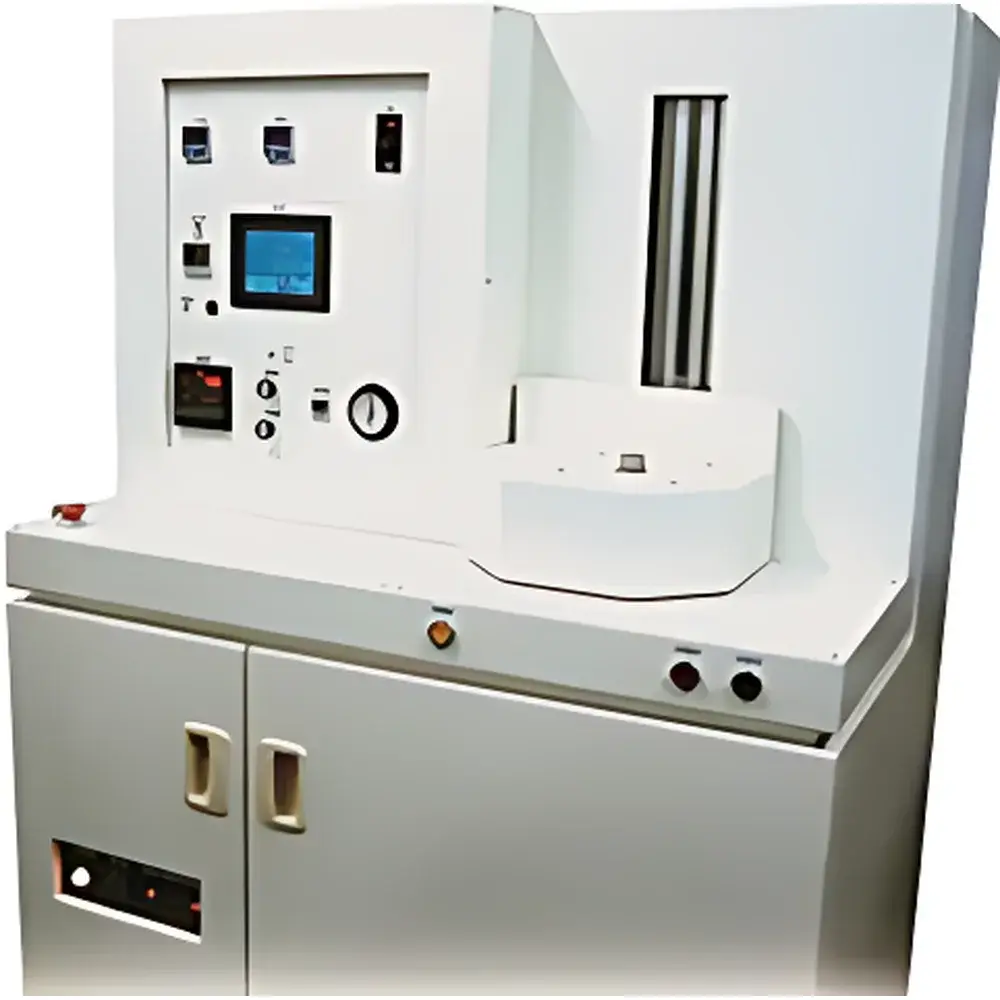
ADVANCE RIKO Transmaster-III Automatic Phase Transformation Point Measurement System
| Brand | ADVANCE RIKO |
|---|---|
| Origin | Japan |
| Heating Methods | Infrared & High-Frequency Induction |
| Temperature Range | −150 °C to 1350 °C |
| Sample Geometry | Ø3 mm × 10 mm (cylindrical) |
| Max. Heating Rate | 100 °C/s (RT → 1350 °C) |
| Max. Cooling Rate | −80 °C/s (1350 °C → 400 °C, He gas quench) |
| Sub-ambient Capability | Liquid nitrogen cooling to −150 °C |
| System Footprint | ~1300 mm W × 1000 mm D × 1700 mm H |
| Compliance | Designed for ASTM E831, ISO 11357-6, and JIS Z 2247 thermal expansion–based phase transition analysis |
Overview
The ADVANCE RIKO Transmaster-III Automatic Phase Transformation Point Measurement System is a precision thermo-mechanical analyzer engineered for the quantitative determination of solid-state phase transitions in metallic alloys through real-time dilatometric monitoring. It operates on the fundamental principle that crystalline phase transformations—such as austenite-to-ferrite, martensite start (Ms), bainite formation, or precipitation reactions—are accompanied by discrete, measurable changes in linear dimension due to lattice reorganization and density variation. By integrating high-resolution linear variable differential transformer (LVDT) displacement sensing with programmable rapid heating and controlled gas-quench cooling, the system captures dimensional strain vs. temperature/time profiles with sub-micrometer resolution. This enables fully automated detection of transformation onset, completion, and reversal temperatures under precisely defined thermal histories—including continuous cooling, isothermal holds, and interrupted quench protocols—forming the experimental foundation for constructing continuous cooling transformation (CCT) and time–temperature–transformation (TTT) diagrams per ASTM E1266 and ISO 11357-6.
Key Features
- Multi-mode thermal actuation: Selectable infrared radiant heating for uniform surface energy delivery or high-frequency induction heating for volumetric, contactless excitation—optimized for conductivity-sensitive metallic samples.
- Extended cryogenic capability: Integrated liquid nitrogen cooling circuit enables stable operation from −150 °C to room temperature, supporting low-temperature martensitic transformation studies in metastable stainless steels and Ti alloys.
- High-fidelity dilatometry: LVDT-based displacement transduction with ≤0.1 µm resolution and <0.5 µm repeatability over full stroke, calibrated traceably to NIST standards.
- Rapid thermal response: Programmable heating rates up to 100 °C/s and helium-gas-assisted cooling rates up to 80 °C/s enable simulation of industrial thermal cycles such as welding, heat treatment, and additive manufacturing solidification.
- Modular furnace architecture: Interchangeable sample holders accommodate cylindrical specimens (Ø3 mm × 10 mm standard), with optional fixtures for thin-sheet or wire geometries.
- Robust environmental control: Sealed chamber with inert gas purge (Ar/N2) minimizes oxidation during high-temperature testing; optional vacuum compatibility available upon request.
Sample Compatibility & Compliance
The Transmaster-III is validated for use with ferrous and non-ferrous metallic materials including carbon steels, alloy steels, stainless steels, aluminum alloys, titanium alloys, and nickel-based superalloys. Sample preparation follows ASTM E831 guidelines for specimen geometry, surface finish, and mounting integrity to ensure mechanical decoupling from thermal drift artifacts. Data acquisition and reporting comply with ISO/IEC 17025 requirements for testing laboratories, and software audit trails support GLP/GMP environments per FDA 21 CFR Part 11 when configured with electronic signature modules. All thermal calibration procedures are traceable to national metrology institutes (NMI-Japan, NIST, PTB), and system validation includes as-found/as-left checks using certified reference materials (e.g., SRM 735a Invar).
Software & Data Management
The proprietary Transmaster Analysis Suite provides end-to-end workflow automation—from thermal program definition (ramp/hold/quench sequences) to real-time strain visualization, derivative analysis (dL/dT), and transformation temperature extraction via tangent-intersection or inflection-point algorithms. Raw data are stored in HDF5 format with embedded metadata (operator ID, timestamp, calibration status, gas flow parameters). Export options include CSV, Excel, and XML for integration into LIMS or statistical process control platforms. The software supports multi-curve overlay, baseline correction, thermal expansion coefficient calculation, and automated CCT/TTT diagram generation using user-defined transformation criteria (e.g., 1% volume change threshold). Audit logs record all parameter modifications, data exports, and report generations with ISO 27001-compliant encryption.
Applications
- Determination of critical transformation temperatures (Ac1, Ac3, Ar1, Ms, Mf) in heat-treatable steels and cast irons.
- Construction of material-specific CCT and TTT diagrams for process optimization in quenching, annealing, and normalizing operations.
- Quantification of retained austenite stability and transformation kinetics in TRIP and Q&P steels.
- Evaluation of aging behavior and precipitate coarsening in Al-Cu and Ni-Cr-Fe alloys under isothermal conditions.
- Validation of thermodynamic databases (e.g., Thermo-Calc, JMatPro) against experimental transformation pathways.
- Support for failure analysis investigations involving thermal history reconstruction in service-exposed components.
FAQ
What sample geometries are supported beyond the standard Ø3 mm × 10 mm cylinder?
Custom holders for flat sheet specimens (up to 1.5 mm thickness) and wire samples (Ø0.5–2.0 mm) are available as factory options. All fixtures maintain axial alignment and minimize bending moments during thermal expansion.
Can the system operate under vacuum or reactive atmospheres?
Standard configuration includes inert gas purging (N2/Ar); vacuum-compatible variants (10−3 mbar base pressure) and sealed quartz tube reactors for controlled oxidizing/reducing environments are offered as configurable upgrades.
How is thermal calibration performed, and what traceability documentation is provided?
Each system ships with a Certificate of Calibration referencing NMI-Japan-certified reference materials (Invar, Cu, Al), including temperature deviation curves and LVDT linearity reports. Annual recalibration services are available with ISO/IEC 17025-accredited certificates.
Is the software compliant with FDA 21 CFR Part 11 for regulated pharmaceutical or medical device manufacturing?
Yes—when deployed with optional 21 CFR Part 11 add-on module, the software enforces role-based access control, electronic signatures, and immutable audit trails meeting ALCOA+ data integrity principles.
What maintenance intervals are recommended for the high-frequency generator and cooling subsystems?
Preventive maintenance is scheduled every 12 months, including HF coil inspection, helium circuit leak testing, LN2 dewar level sensor verification, and LVDT zero-drift compensation—all documented in the integrated service log.
Related Products



