
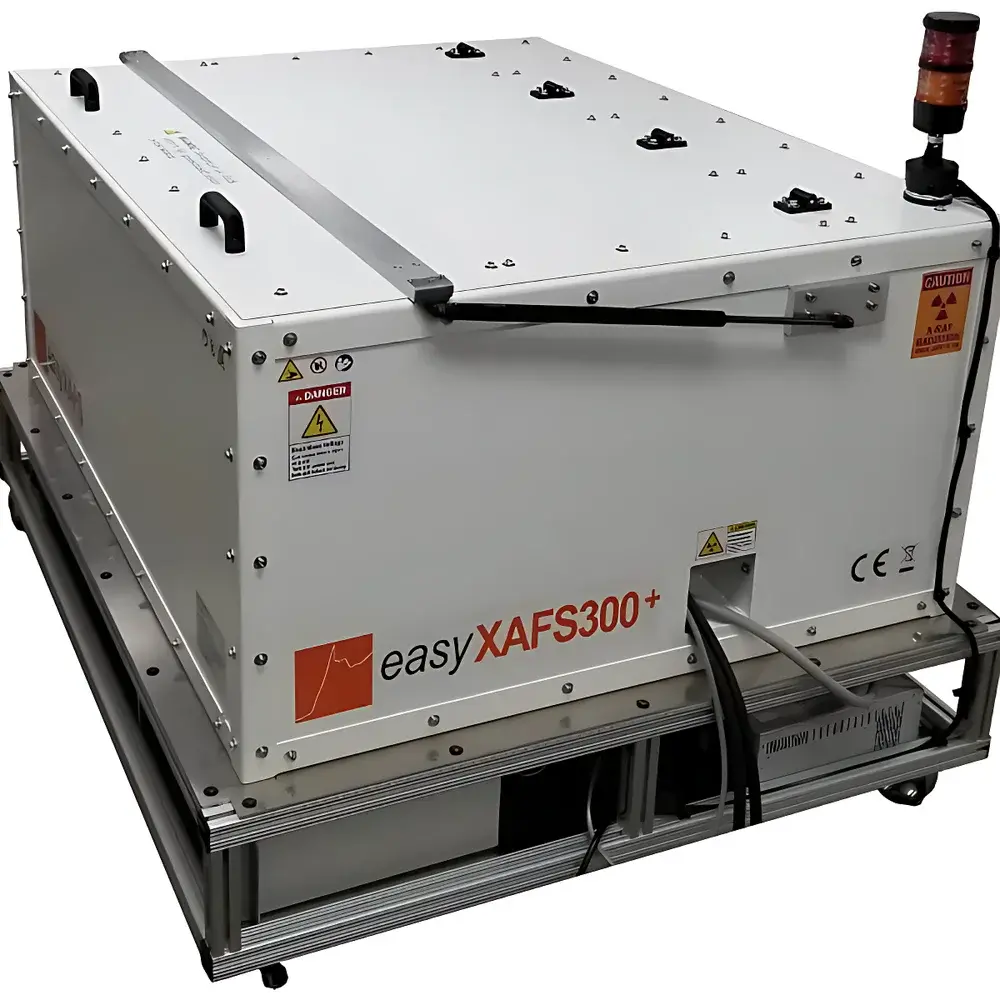
easyXAFS XAFS300+ Desktop X-ray Absorption Fine Structure and X-ray Emission Spectrometer
| Brand | easyXAFS |
|---|---|
| Origin | USA |
| Model | XAFS300 / XAFS300+ |
| X-ray Source Power | XAFS mode: 2500 W |
| XES mode | 100 W |
| Monochromatic X-ray Flux | 3–4 × 10⁶ photons/sec |
| Elemental Energy Range | 4.5–25 keV |
| Energy Resolution | 0.5–1.5 eV |
| Testable Elements | ~70 elements |
Overview
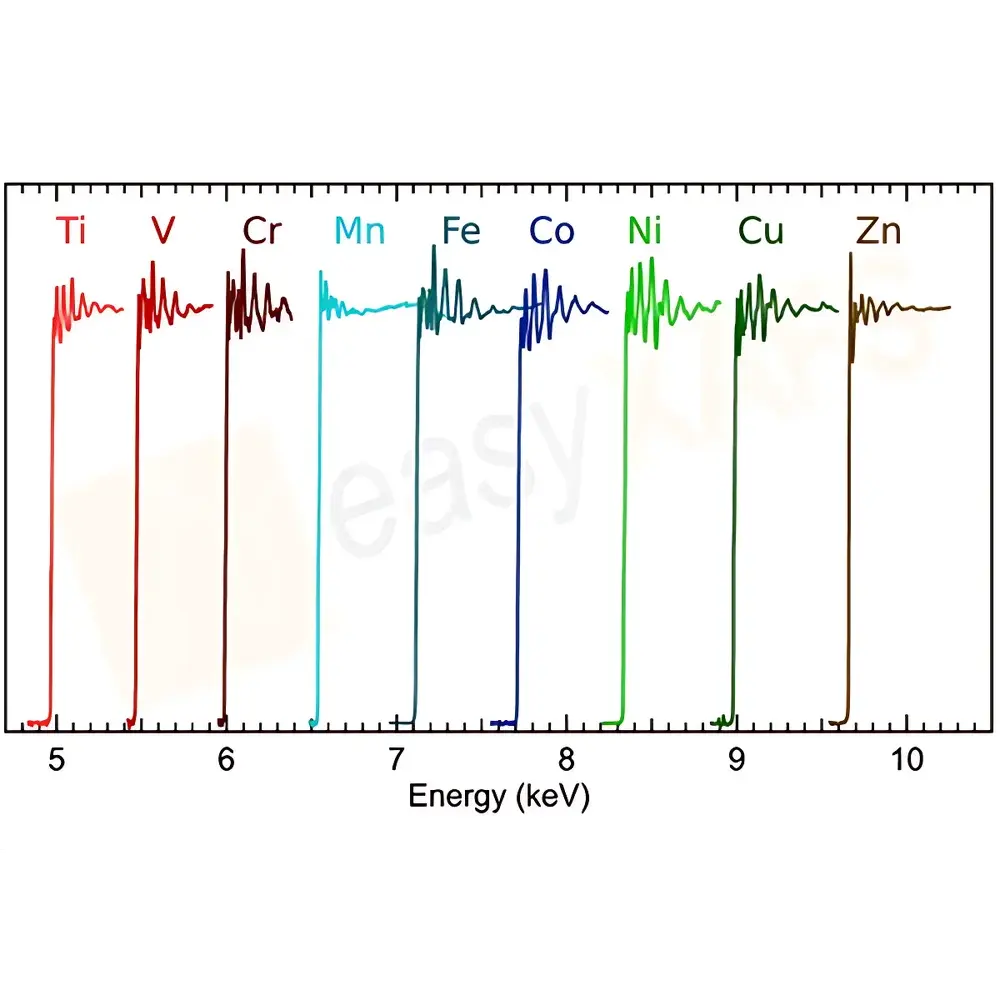
The easyXAFS XAFS300+ is a benchtop, laboratory-scale X-ray Absorption Fine Structure (XAFS) and X-ray Emission Spectroscopy (XES) instrument engineered for high-fidelity element-specific structural and electronic analysis without reliance on synchrotron radiation. It employs a high-stability, high-brilliance rotating anode X-ray source coupled with a precision double-crystal monochromator to deliver tunable, monochromatic X-rays across the 4.5–25 keV range—covering K-edges of elements from P (1.86 keV, extrapolated lower limit) through Zn, Ni, Fe, Mn, Cr, V, Ti, Ca, and up to L₃-edges of 4d/5d transition metals (e.g., Ru, Rh, Pd, Ag, Cd, Sn) and actinides. The system operates on standard 208–240 V AC power and integrates vacuum- or He-purged beam paths to minimize air absorption, enabling robust transmission and fluorescence-mode XAFS measurements. Its core measurement principle leverages core-level photoabsorption followed by detection of either transmitted intensity (μ(E)), fluorescence yield (FY), or electron yield (TEY), while XES captures high-resolution emission spectra via crystal-based wavelength dispersion—functionally equivalent to high-energy-resolution X-ray fluorescence (HR-XRF). This dual-capability platform delivers complementary local structural (bond distances, coordination numbers, disorder) and electronic (oxidation state, spin state, ligand field symmetry) information at atomic resolution.
Key Features
- Benchtop architecture: Fully self-contained system requiring no synchrotron access—enables routine XAFS/XES in university labs, industrial R&D centers, and core facilities.
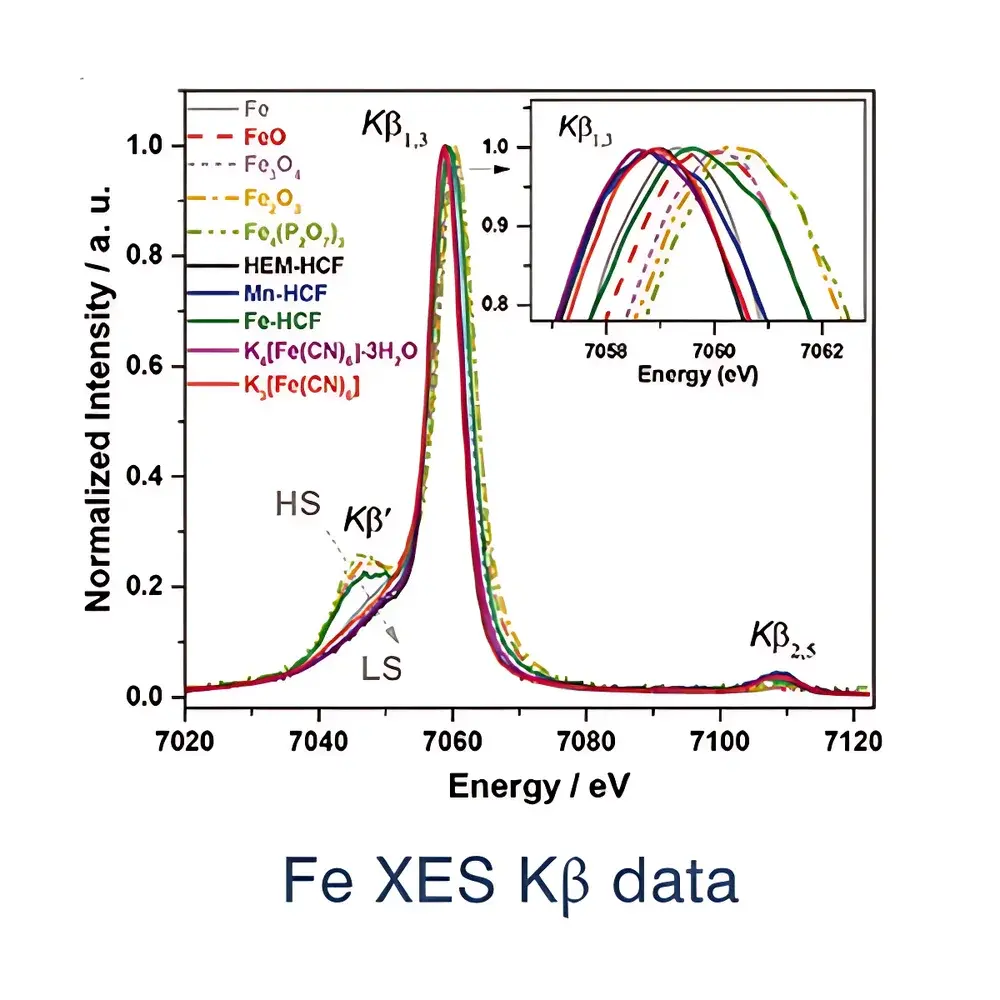
- Dual-mode operation: Simultaneous support for transmission, fluorescence-yield, and total-electron-yield XAFS acquisition, plus high-resolution XES (Kβ₁,₃, Kβ′, valence-to-core) with <1.5 eV resolution.
- High-flux monochromator: Delivers 3–4 × 10⁶ photons/sec at sample position, ensuring signal-to-noise ratios sufficient for sub-0.2 wt% trace-element EXAFS and low-concentration catalyst studies.
- Energy calibration traceability: Integrated Si(111) and Si(311) crystals with motorized goniometry enable precise energy scanning and reproducible edge alignment per ASTM E2796 and ISO 18557 standards.
- In situ/operando readiness: Modular sample stage supports heating (RT–800 °C), gas flow (controlled O₂, H₂, CO, Ar), electrochemical cells, and liquid jet configurations—all compatible with real-time XAFS data collection.
- Low operational overhead: Solid-state detectors (SDD for XES, multi-element Si drift for FY-XAFS), air-cooled X-ray tube, and automated alignment routines reduce maintenance frequency and technician dependency.
Sample Compatibility & Compliance
The XAFS300+ accommodates solid powders, thin films, foils, pellets, frozen solutions, and heterogeneous catalysts (including supported nanoparticles and single-atom systems). Samples are mounted in standard XAFS holders (e.g., Kapton tape, borosilicate capillaries, graphite plates) and analyzed under ambient, vacuum, or controlled-atmosphere conditions. All hardware and software comply with IEC 61000-6-3 (EMC emissions) and IEC 61000-6-4 (industrial immunity) standards. Data acquisition and processing workflows support GLP/GMP-aligned documentation: full audit trails, user-defined metadata tagging, electronic signatures, and export formats compliant with ASTM E2932 (XAFS data exchange) and USP (analytical instrument qualification). Instrument validation packages include IQ/OQ protocols aligned with FDA 21 CFR Part 11 requirements for regulated environments.
Software & Data Management
The proprietary easyXAFS Control Suite provides integrated instrument control, real-time spectrum visualization, and automated energy calibration. Data reduction follows established XAFS best practices: background subtraction (autofit polynomial), normalization (pre-edge and post-edge fitting), Fourier transformation (k³-weighted), and phase-unwrapped EXAFS fitting using FEFF-generated theoretical paths. The software includes built-in libraries for common reference compounds (e.g., metal foils, oxides, sulfides) and supports batch processing of multi-sample datasets. Export options include Athena-compatible .dat files, CIF-compliant structural reports, and CSV/PDF summaries suitable for publication and regulatory submission. Cloud-synced project repositories ensure version-controlled collaboration across geographically distributed teams.
Applications
The XAFS300+ serves as a primary tool for structure–property correlation studies in energy materials science and catalysis. It has been validated for quantitative oxidation-state mapping in battery cathodes (e.g., Ni²⁺/Ni³⁺/Ni⁴⁺ in NMC, Mn³⁺/Mn⁴⁺ in LiMn₂O₄), local coordination analysis of single-atom catalysts (e.g., M–N₄ sites in carbon matrices), speciation of redox-active metals in environmental samples (e.g., As, Se, U in soils/water), and spin-state determination in high-entropy oxides via Kβ′ satellite intensity quantification. Published applications span peer-reviewed journals including Nature Communications, Advanced Materials, Angewandte Chemie, and Energy & Environmental Science, with over 400 peer-reviewed papers citing XAFS300-series instrumentation. Its adoption exceeds 200 installations globally, representing >60% market share among benchtop XAFS platforms.
FAQ
Does the XAFS300+ require external cooling water or chiller infrastructure?
No—it uses air-cooled rotating anode X-ray sources and thermoelectrically cooled silicon drift detectors, eliminating dependence on recirculating chillers.
Can it measure light elements such as C, N, or O?
Direct K-edge XAFS below 4.5 keV is not supported due to beamline absorption and detector efficiency limits; however, L-edge measurements of 3d transition metals (e.g., Ni L₃ at 853 eV) are feasible with optional UHV-compatible accessories.
How does data quality compare to synchrotron-based XAFS?
Peer-reviewed benchmarks confirm spectral fidelity within ±0.02 Å in bond distance and ±0.2 in coordination number versus beamline data—validated across Ir@C, RuO₂, and CoFe Prussian blue analogues.
Is remote operation supported?
Yes—the Control Suite enables secure, encrypted remote access via SSH or VPN, with full instrument control and real-time data streaming for collaborative experiments.
What training and support resources are available?
easyXAFS provides on-site installation and operator certification, quarterly webinars on advanced fitting techniques, and a publicly accessible repository of tutorial datasets and Jupyter notebooks for Athena/Demeter integration.
Related Products





