
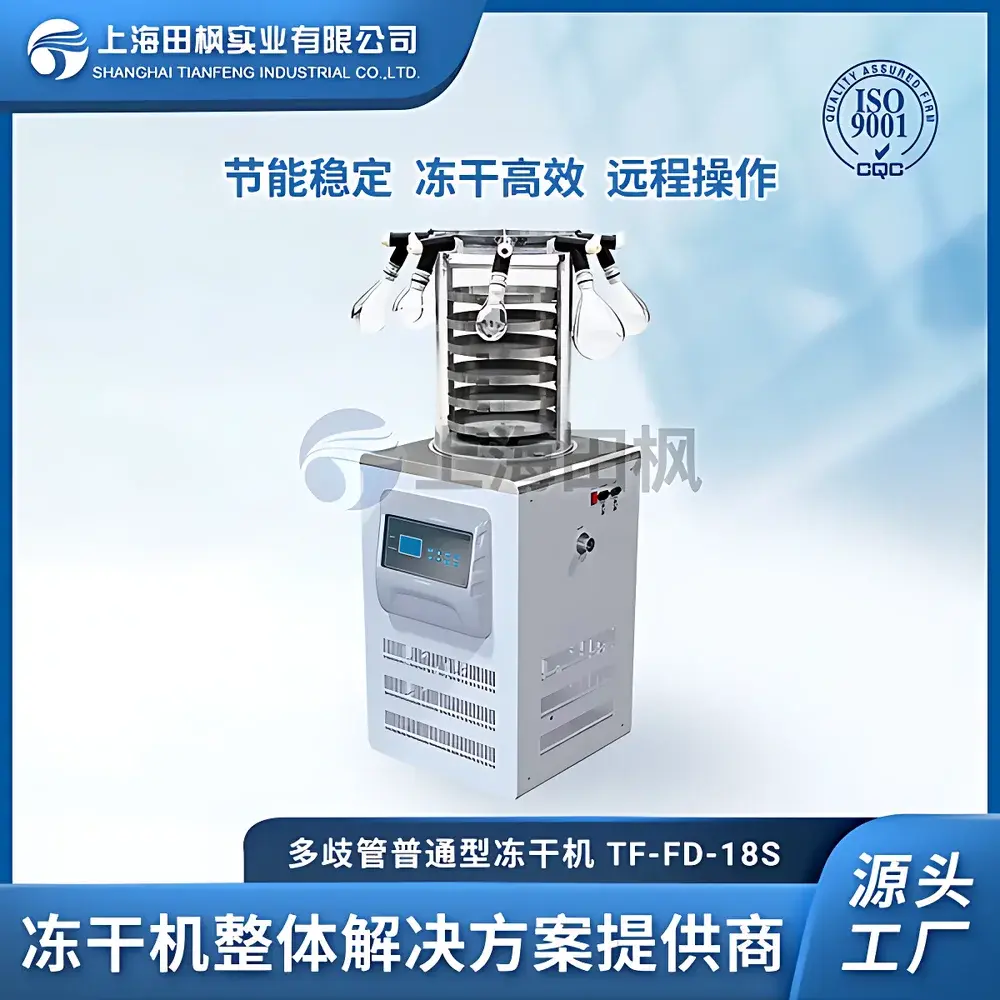
Tianfeng TF-FD-18S Multi-Manifold Laboratory Freeze Dryer
| Brand | Tianfeng |
|---|---|
| Origin | Shanghai, China |
| Manufacturer Type | Direct Manufacturer |
| Equipment Type | Multi-Manifold Freeze Dryer |
| Application Scope | Laboratory R&D and Small-Batch Production |
| Shelf Area | 0.18 m² |
| Ultimate Vacuum | <15 Pa (empty chamber) |
| Condenser Temperature | ≤−60 °C |
| Ice Capacity | 6 kg/24 h |
| Power Supply | 220 V, 50 Hz |
| Rated Power | 1700 W |
| Dimensions (W×D×H, excl. drying chamber) | 550 × 550 × 960 mm |
| Sample Tray | Φ240 mm × 4 layers |
| Flask Compatibility | 50–1000 mL round-bottom flasks (8 positions) |
| Control Interface | Touchscreen LCD with real-time shelf temperature & vacuum curve logging |
| Heating System | Electrically heated shelves with programmable ramp/soak profiles |
| Construction | 304 stainless steel condenser & chamber interior |
| Optional Features | Inert gas backfill valve, co-lyophilization point detection kit, data logger compliance with 21 CFR Part 11 audit trail requirements |
Overview
The Tianfeng TF-FD-18S is a multi-manifold laboratory freeze dryer engineered for precise, reproducible lyophilization of heat-sensitive biopharmaceuticals—including peptides, monoclonal antibodies, vaccines, enzymes, and plasma-derived therapeutics. It operates on the fundamental principle of sublimation: aqueous samples are first frozen solid at cryogenic temperatures (≤−60 °C), then subjected to high vacuum (<15 Pa), enabling ice to transition directly from solid to vapor without passing through the liquid phase. This preserves native conformation, biological activity, and structural integrity—critical for regulatory-compliant development of sterile injectables and reference standards. Unlike tray-based systems requiring manual loading, the TF-FD-18S’s multi-manifold configuration enables parallel processing of up to eight individually sealed flasks, supporting method development across variable formulations, excipients, or container types while maintaining batch-to-batch consistency under GLP-aligned workflows.
Key Features
- Stainless steel condenser and internal chamber fabricated from electropolished 304 stainless steel—resistant to corrosion from organic solvents (e.g., acetonitrile, tert-butanol) and compatible with rigorous cleaning validation protocols.
- Electrically heated, temperature-controlled shelves with ±1 °C uniformity (measured across surface), enabling precise primary drying control via programmable heating ramps and hold steps—essential for optimizing collapse temperature (Tc) and maximizing residual moisture control per ICH Q5C.
- Real-time graphical display of shelf temperature, chamber pressure, and condenser temperature on a 7-inch industrial touchscreen; data logged internally with timestamped CSV export capability.
- Integrated inert gas backfill valve (N2 or argon) for controlled reconstitution atmosphere—minimizing oxidation of labile compounds during final chamber venting.
- Optically transparent acrylic drying chamber with front-access door—enabling unobstructed visual monitoring of cake formation, sublimation front progression, and potential melt-back events.
- Self-contained air-cooled dual-stage refrigeration system—no external chiller required—designed for stable operation in ambient environments up to 30 °C.
Sample Compatibility & Compliance
The TF-FD-18S accommodates standard round-bottom flasks (50–1000 mL) mounted directly onto the manifold ports, eliminating need for transfer vials and reducing contamination risk. Its −60 °C condenser provides sufficient cold sink capacity for aqueous buffers and low-concentration organic solvent mixtures (e.g., <10% v/v ethanol or acetone). The system meets core mechanical and operational prerequisites outlined in ISO 22042:2017 (freeze-drying equipment performance testing) and supports alignment with FDA 21 CFR Part 11 when configured with optional audit-trail-enabled data logging software. All wetted surfaces comply with USP material classification for pharmaceutical contact components.
Software & Data Management
The embedded controller records time-stamped process variables at user-defined intervals (1–60 seconds), storing ≥30 days of continuous data onboard. Exported logs include shelf setpoint vs. actual, chamber pressure (Pirani gauge), condenser temperature, and elapsed cycle time—structured for direct import into LIMS or statistical process control (SPC) platforms. Optional firmware upgrade enables electronic signature support, user role-based access control, and automatic generation of IQ/OQ-ready test reports compliant with Annex 11 and EU GMP guidelines.
Applications
This instrument serves as a scalable platform for formulation screening, stability study execution, and clinical-phase batch production of lyophilized drug products. Typical use cases include: optimization of mannitol/sucrose/trehalose-based bulking agents for peptide stability; comparative drying kinetics evaluation of buffer pH and ionic strength variants; terminal sterilization compatibility studies using pre-filled syringe or vial configurations; and long-term storage qualification of reference standards per ICH Q5D. Academic labs utilize it for preserving microbial cultures, plant extracts, and nanocarrier suspensions without aggregation or denaturation.
FAQ
What is the maximum allowable solvent concentration for safe operation?
The condenser is rated for ≤10% v/v low-boiling organic solvents (e.g., methanol, acetonitrile) when dried at ≤−40 °C shelf temperature. Higher concentrations require optional −80 °C condenser upgrade.
Can the system be validated for GMP manufacturing?
Yes—when equipped with calibrated PT100 shelf sensors, Class A vacuum transducer, and 21 CFR Part 11-compliant data logger, it satisfies baseline qualification requirements for non-sterile API intermediate drying.
Is shelf temperature uniformity verified per ISO 22042?
Uniformity is factory-tested at three points per shelf layer using NIST-traceable probes; certificate of conformance provided with each unit.
What maintenance intervals are recommended?
Oil change every 2000 operating hours; refrigerant leak check annually; Pirani gauge calibration every 6 months; O-ring inspection prior to each critical batch.
Does the system support remote monitoring via Ethernet or USB?
Standard model includes USB-C port for local data download; optional Ethernet module enables Modbus TCP integration with building SCADA or centralized lab monitoring systems.



