
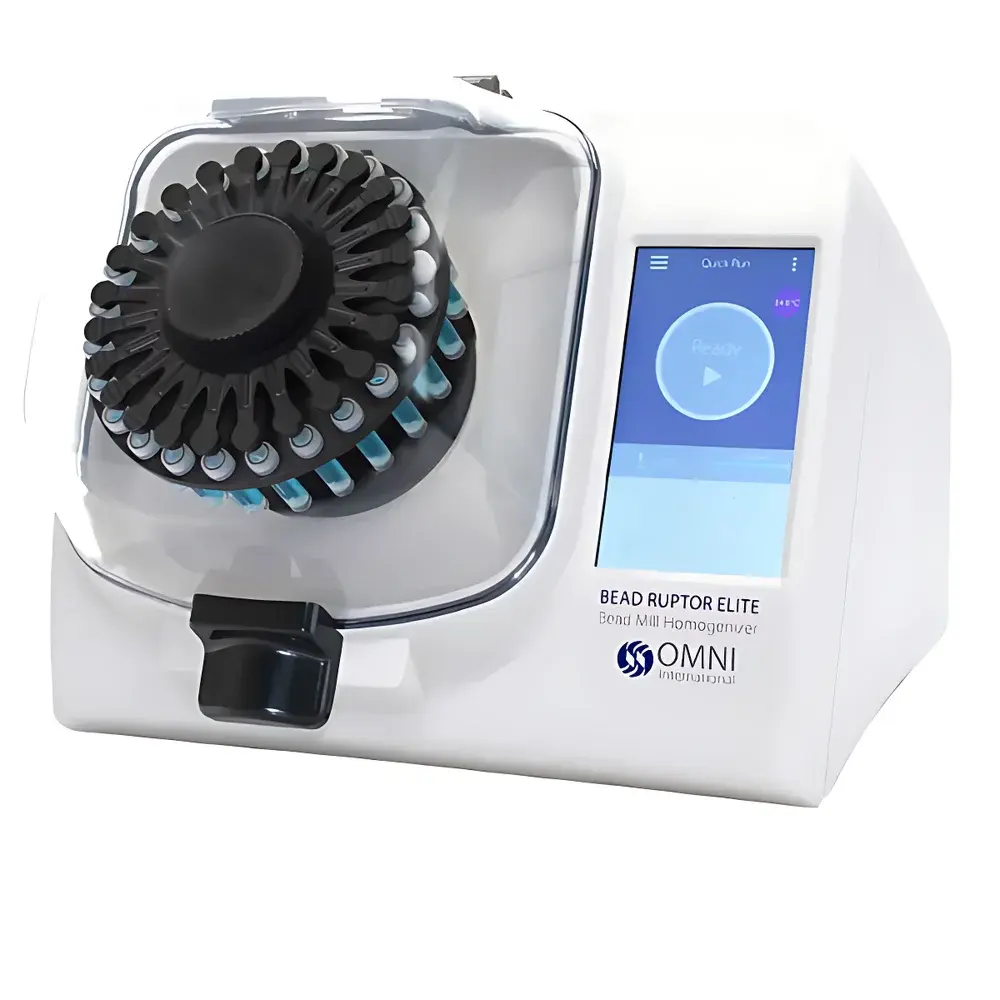
OMNI Bead Ruptor Elite High-Performance Bead-Based Homogenizer
| Brand | OMNI International |
|---|---|
| Origin | USA |
| Instrument Type | Bead Mill Homogenizer |
| Dimensions (W×D×H) | 381 × 431.8 × 330 mm |
| Sample Volume Range | 0.1–50 mL |
| Operating Speed | 0.8–8 m/s (adjustable in 0.15 m/s increments) |
| Cycle Programming | Up to 10 cycles per program |
| Runtime | 1 s–9 min 59 s (1 s resolution) |
| Pause Time | 0–9 min 59 s (1 s resolution) |
| Display | 7-inch full-color LCD touchscreen |
| Memory | 16 GB internal storage (≥1 million programs) |
| Safety Features | Overtemperature protection, lid interlock, anti-slip threaded cap retention |
| Certifications | CE, ISO 9001:2008 |
| Power Supply | 100–230 VAC, 50–60 Hz |
| Weight | 29 kg |
Overview
The OMNI Bead Ruptor Elite is a high-throughput, bead-based mechanical homogenizer engineered for rapid, reproducible lysis and homogenization of diverse biological matrices—including mammalian and plant tissues, microbial cells (bacteria, yeast, spores), fibrous materials (hair, bone), environmental samples (soil, feces), and clinical specimens. It operates on the principle of high-frequency three-dimensional orbital vibration coupled with inert grinding beads (e.g., stainless steel, ceramic, or silica), generating intense shear, impact, and collision forces within sealed tubes. This mechanism ensures efficient cell disruption while minimizing thermal degradation—critical for preserving labile biomolecules such as intact RNA, native proteins, and metabolites. Unlike rotor-stator or ultrasonic systems, the Bead Ruptor Elite delivers uniform energy input across all sample positions without requiring tube balancing, enabling true walk-away automation for multi-sample workflows in molecular biology, proteomics, microbiome, and biopharmaceutical development laboratories.
Key Features
- Three-axis high-frequency vibration platform (0.8–8 m/s, adjustable in 0.15 m/s increments) optimized for maximal bead kinetic energy transfer and minimal heat generation
- Simultaneous processing of up to 48 × 2 mL/1.5 mL/0.5 mL tubes, 24 × 2 mL tubes, 12 × 7 mL or 15 mL tubes, 6 × 30 mL tubes, or 3 × 50 mL tubes—configurable via interchangeable adapters
- Universal threaded cap retention system eliminates vacuum seal dependency; prevents tube ejection and ensures secure positioning during high-speed operation
- Intuitive Optimate™ software interface on a 7-inch capacitive touchscreen—supports creation, storage, and recall of ≥1 million user-defined protocols (up to 10 cycles per program)
- No-balance, plug-and-play tube loading: tubes mount directly into adapter blocks without centering or counterweighting
- Real-time monitoring of chamber temperature and program progress; programmable pause/resume functionality for in-process visual inspection
- Integrated safety architecture including lid-interlocked motor cutoff, overtemperature shutdown, and automatic deceleration upon lid opening
- Front-hinged access door enables ergonomic loading/unloading—reducing repetitive strain during high-volume runs
- Compatible with standard conical-bottom centrifuge tubes (0.5 mL to 50 mL), eliminating proprietary consumable lock-in and lowering cost-per-sample
- Immediate restart capability: no cooldown delay between consecutive runs—maximizing instrument uptime in time-sensitive applications
Sample Compatibility & Compliance
The Bead Ruptor Elite accommodates a broad spectrum of sample types and viscosities—from viscous bacterial pellets and frozen tissue fragments to granular soil suspensions and keratin-rich hair shafts. Its mechanical lysis approach avoids enzymatic bias or sonication-induced shearing, supporting consistent recovery of high-molecular-weight DNA (>50 kb), full-length transcripts, and functionally active enzymes. The system complies with ISO 9001:2008 quality management standards and carries CE marking for conformity with EU health, safety, and environmental requirements. When integrated into regulated environments (e.g., GLP-compliant toxicology labs or GMP-aligned QC workflows), its audit-ready protocol logging, electronic signature support (via optional networked data export), and deterministic cycle repeatability align with expectations for instrument qualification under FDA 21 CFR Part 11 and ISO/IEC 17025 frameworks.
Software & Data Management
The embedded Optimate™ operating system provides full local control and traceability. Each protocol stores timestamped metadata—including speed, duration, pause intervals, adapter configuration, and operator ID—directly to the instrument’s 16 GB internal flash memory. Protocols can be exported via USB or Ethernet to LIMS or ELN platforms for long-term archival. Optional firmware updates maintain compatibility with evolving laboratory informatics standards. For labs requiring enhanced data integrity, the system supports configurable user roles, password-protected method editing, and immutable run logs—facilitating compliance with ALCOA+ (Attributable, Legible, Contemporaneous, Original, Accurate, Complete, Consistent, Enduring, Available) principles in regulated research settings.
Applications
- High-yield genomic DNA isolation from Gram-positive bacteria and fungal cell walls
- RNA extraction with preserved integrity for downstream qRT-PCR and RNA-seq library preparation
- Proteome solubilization from recalcitrant tissues (e.g., brain, liver, muscle) without denaturants
- Microbiome sample homogenization for 16S rRNA and metagenomic sequencing
- Pre-analytical processing of FFPE tissue sections prior to nucleic acid extraction
- Cell lysis for intracellular metabolite profiling (LC-MS/MS)
- Homogenization of environmental samples (soil, sediment, biofilm) for pathogen detection
- Preparation of antigen extracts for immunoassay development
FAQ
What types of grinding beads are compatible with the Bead Ruptor Elite?
Standard bead sets include stainless steel (0.1–2.0 mm), zirconium oxide (0.1–0.5 mm), and silica (0.5 mm), selected based on sample hardness and desired lysis efficiency. Bead size and material must be matched to tube volume and biological matrix to avoid incomplete lysis or excessive foaming.
Can the instrument be validated for use in GMP environments?
Yes—the Bead Ruptor Elite supports IQ/OQ documentation packages, and its deterministic performance, electronic audit trail, and firmware-controlled parameter locking meet baseline requirements for equipment qualification in pharmaceutical QC labs.
Is cryogenic cooling required for RNA work?
While not mandatory, the optional BR-Cryo system (liquid nitrogen or dry ice–cooled compressed air delivery) is recommended for RNA isolation from thermolabile samples (e.g., adipose tissue, certain blood fractions) to suppress RNase activity during lysis.
How is cross-contamination prevented between samples?
Each sample is processed in a physically isolated, single-use tube; the absence of shared fluid paths or rotating blades eliminates carryover risk. Tube adapters are autoclavable, and the chamber interior is accessible for routine decontamination with ethanol or RNase-away solutions.
Does the system support remote monitoring or integration with lab automation?
The instrument includes Ethernet and USB ports for external control and data export. While it does not feature native robotic arm interfaces, its protocol export functionality enables synchronization with third-party scheduling software and central lab data repositories.



