
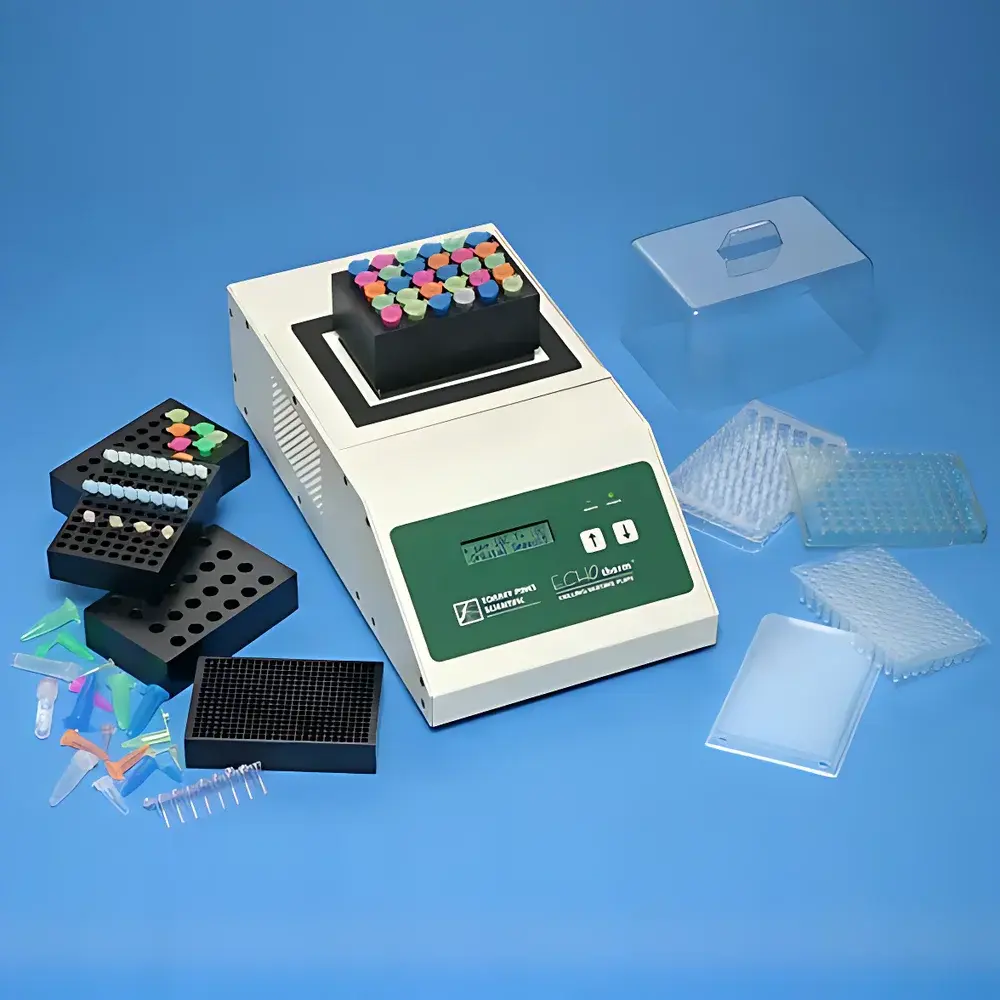
Torrey Pines IC/SC Series Peltier-Based Metal Block Thermostatic Bath
| Brand | Torrey Pines |
|---|---|
| Origin | USA |
| Model | IC/SC |
| Temperature Range | −20 to 100°C |
| Temperature Accuracy | ±0.5°C |
| Heating/Cooling Time (to 37°C from 25°C) | ≤3 min |
| Dimensions (W×D×H) | 18 × 13 × 26 cm |
| Net Weight | 5 kg |
| Compliance | UL, CSA, CE |
| Interface | RS232 |
| Calibration | Electronic, User-Adjustable |
| Timer Function | Up to 30 days |
| Alarm | Visual and Audible |
Overview
The Torrey Pines IC/SC Series Peltier-Based Metal Block Thermostatic Bath is an engineered solution for precise, rapid, and maintenance-free temperature control of small-volume biological and chemical samples. Unlike traditional water baths, this instrument employs solid-state thermoelectric (Peltier) modules for bidirectional thermal regulation—enabling both active cooling below ambient and heating up to 100°C within a single compact unit. Its aluminum alloy heating block ensures exceptional thermal conductivity and uniformity across sample positions, minimizing radial and axial temperature gradients. Designed for benchtop use in molecular biology labs, clinical diagnostics, and pharmaceutical QC environments, the IC/SC series delivers high reproducibility in applications requiring strict thermal fidelity—such as enzyme kinetics, nucleic acid hybridization, cell viability assays, and cryopreserved specimen stabilization.
Key Features
- Peltier-based thermoelectric system with no moving parts, compressors, or liquid coolant—eliminating routine maintenance, evaporation concerns, and contamination risks associated with water baths.
- High thermal uniformity: ±0.3°C across the block surface (measured at 37°C), ensuring consistent incubation conditions for parallel sample processing.
- Rapid thermal response: reaches target temperature from ambient in ≤3 minutes (e.g., 25°C → 37°C), significantly reducing experimental downtime.
- Digital microprocessor control with RS232 serial interface for remote monitoring, data logging, and integration into LIMS or automated lab workflows.
- Electronic calibration capability allows users to perform on-site verification and adjustment against traceable reference standards—supporting GLP/GMP documentation requirements.
- Programmable timer with up to 30-day duration and configurable audible/visual alarms for endpoint notification or safety alerts (e.g., door open, temperature deviation >±1.0°C).
- Robust aluminum housing with low-profile footprint (18 × 13 × 26 cm) and 5 kg net weight—optimized for space-constrained hoods, biosafety cabinets, and mobile lab configurations.
Sample Compatibility & Compliance
The IC/SC platform supports interchangeable, application-specific aluminum heating blocks—including formats for 0.2 mL PCR tubes, 96-well plates (V/U-bottom and flat), 1.5/2.0 mL microcentrifuge tubes, 10–20 mm diameter test tubes, 15–50 mL conical tubes, and specialized modules for slides, scintillation vials, and deep-well plates. All modules are precision-machined to ISO 9001-certified tolerances and thermally characterized per ASTM E220–21 guidelines for thermal uniformity testing. The device complies with UL 61010–1 (Laboratory Equipment Safety), CSA C22.2 No. 61010–1, and CE marking under the EU Machinery Directive 2006/42/EC and EMC Directive 2014/30/EU. It meets essential performance criteria for use in FDA-regulated environments where audit trails and electronic record integrity are required under 21 CFR Part 11—when paired with validated third-party data acquisition software.
Software & Data Management
While the IC/SC operates as a standalone instrument with intuitive front-panel controls, its RS232 interface enables bidirectional communication with host PCs running custom or vendor-supplied terminal software. Users can remotely set temperature profiles, initiate timers, query real-time block temperature, and retrieve event logs—including alarm triggers, calibration timestamps, and power-on history. When integrated into validated laboratory systems, the bath supports timestamped data export in CSV format, facilitating compliance with ALCOA+ principles (Attributable, Legible, Contemporaneous, Original, Accurate, Complete, Consistent, Enduring, Available). Optional firmware updates maintain alignment with evolving IEC 62304 medical device software lifecycle standards.
Applications
- Controlled-temperature enzymatic reactions (e.g., restriction digests at 37°C, ligase incubations at 16°C, phosphatase inactivation at 65°C).
- Long-term storage of sensitive reagents at sub-ambient temperatures (−20°C for RNA stocks; +4°C for antibodies).
- Thermal equilibration of PCR master mixes prior to cycling; pre-chilling of reaction vessels to minimize premature extension.
- Oocyte and embryo culture support at tightly regulated physiological temperatures (e.g., 37°C for mammalian IVF media; 17°C for amphibian oocyte preservation).
- Standardized thermal denaturation studies for protein stability assessment (e.g., DSC pre-screening via incremental ramp protocols).
- Quality control of temperature-sensitive diagnostics—such as lateral flow assay reagent stability testing per ISO 13485 Annex A.3.
FAQ
Does the IC/SC series support programmable temperature ramps?
Yes—the IC models feature multi-segment programmable profiles (up to 10 steps per program, 5 programs stored internally), enabling linear or stepwise temperature transitions over user-defined durations.
Can the unit maintain −20°C continuously in a typical lab environment (22–25°C ambient)?
Yes, the Peltier architecture achieves stable −20°C operation without external chillers, provided ambient humidity remains below 80% RH and ventilation clearance ≥5 cm is maintained around all sides.
Is NIST-traceable calibration documentation available?
Torrey Pines provides optional factory calibration certificates (NIST-traceable, ISO/IEC 17025 accredited) upon request; field calibration is supported via the built-in electronic offset function using certified reference thermometers.
Are heating blocks interchangeable between IC and SC models?
Yes—all IC/SC-compatible modules (e.g., 96-well, 0.2 mL PCR, 15 mL Falcon) share identical mounting geometry and thermal interface specifications, ensuring full cross-model compatibility.
What is the maximum allowable load mass per block to preserve thermal accuracy?
For optimal performance, total sample mass should not exceed 300 g per standard block; heavier loads may extend stabilization time but do not compromise final accuracy beyond ±0.5°C specification.



