
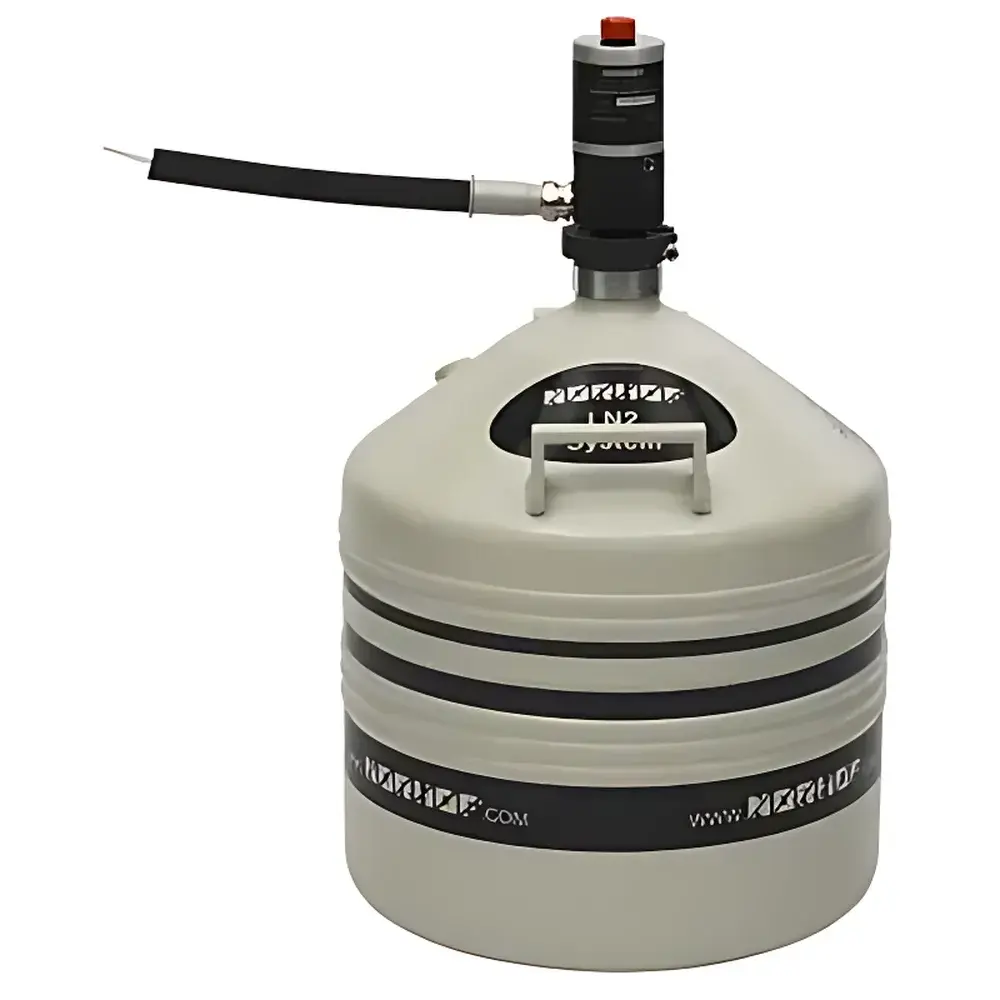
Norhof 608 Fully Automated Liquid Nitrogen Micro-Dispensing System
| Brand | Norhof |
|---|---|
| Country of Origin | Netherlands |
| Model | 608 |
| Supply Voltage | 115/230 V AC or 12–24 V AC/DC |
| Power Consumption | 10 W (avg.), 50 W (during dispensing) |
| Static Evaporation Rate | <0.5 L/day |
| Working Pressure | <300 mbar |
| Precooling Time (1.6 m tubing) | ±1 min |
| Tubing | PTFE, OD 6.25 mm / ID 4 mm, insulated with 32 mm foam jacket |
| LN₂ Tank Options | 35 L / 50 L / 100 L |
| Tank Dimensions (Ø × H) | 480 × 791 mm / 500 × 875 mm / 500 × 1235 mm |
| Empty/Full Weight | 13/41.5 kg / 17/57.5 kg / 32/113 kg |
| Dispensing Control | Timer-based auto-fill (1 level sensor) or external 5 V TTL / RS232 trigger |
| Software Interface | PC-based monitoring suite with real-time pump status, event logging, and configurable alarms |
| Safety Protections | Mechanical overpressure relief valve, low-LN₂ (≤5 L) alert, empty-tank detection, sensor failure alarm, freeze detection |
| Optional Accessories | Bruker FTIR detector adapter, Shimadzu AIM-8800 adapter, 5-wheel mobile base (10 cm height), LN₂ pump mounting bracket, custom sensor mounting fixtures |
Overview
The Norhof 608 Fully Automated Liquid Nitrogen Micro-Dispensing System is an engineered solution for uninterrupted, low-disturbance cryogenic operation of Fourier Transform Infrared (FTIR) spectrometers equipped with liquid nitrogen-cooled detectors—specifically optimized for Bruker Vertex 70/80 and Shimadzu AIM-8800 platforms. Unlike manual refilling or high-flow bulk transfer systems, the 608 employs a precision-controlled, low-pressure (<300 mbar), low-velocity dispensing architecture based on regulated pressure differential and thermally stabilized PTFE delivery tubing. This design minimizes thermal shock to the detector dewar, eliminates mechanical vibration and acoustic noise during fill cycles, and prevents splashing or boil-off spikes that compromise spectral stability. The system operates without solenoid valves or external control cabinets—reducing heat ingress pathways and simplifying integration into ISO 17025-compliant analytical workflows. Its static evaporation rate of less than 0.5 L/day reflects superior insulation integrity and long-term standby efficiency, making it suitable for unattended overnight or 24-hour continuous acquisition protocols in QC laboratories, pharmaceutical R&D, and academic spectroscopy facilities.
Key Features
- Zero-tool installation and field-deployable compatibility with major FTIR detector interfaces—including Bruker Vertex series and Shimadzu AIM-8800—via optional certified adapters
- True plug-and-play automation: preconfigured timer-based dispensing eliminates manual intervention while preserving detector vacuum integrity and thermal equilibrium
- PTFE-lined, foam-insulated delivery line (1.6 m standard length) ensures minimal conductive/convective heat transfer and consistent flow dynamics
- Integrated level sensing with dual-threshold alarm logic: triggers visual/audible alerts at ≤5 L remaining and tank-empty conditions, supporting GLP traceability
- No active valves or external controllers—reducing failure points, power load, and electromagnetic interference near sensitive IR optics
- Low-power electronics (10 W average, 50 W peak) compatible with both mains (115/230 V AC) and low-voltage DC (12–24 V) lab infrastructure
- Real-time PC software interface with timestamped event logging, pump cycle history, and configurable alarm thresholds per ASTM E2500-13 guidelines
Sample Compatibility & Compliance
The Norhof 608 is designed exclusively for use with liquid nitrogen-cooled MCT (Mercury Cadmium Telluride) and InSb (Indium Antimonide) detectors in mid- and far-IR spectrometers. It does not interface with sample chambers, cryostats, or biological storage vessels. All hardware components—including pressure-regulated pump head, PTFE tubing, and stainless-steel fittings—comply with EU PED 2014/68/EU for low-pressure fluid systems and meet RoHS 2011/65/EU material restrictions. The embedded firmware supports audit-trail generation per FDA 21 CFR Part 11 requirements when used with validated PC software configurations. No modifications to original equipment manufacturer (OEM) detector housings are required; mechanical integration preserves factory calibration validity and warranty eligibility.
Software & Data Management
The included Windows-compatible monitoring application provides local GUI access to system status, pump activation logs, sensor health diagnostics, and alarm history with exportable CSV reports. Each dispensing event is stamped with date/time, duration, estimated volume dispensed (derived from pressure decay kinetics), and ambient temperature reading (if external probe connected). The software supports automated backup to network drives and integrates with laboratory information management systems (LIMS) via standardized COM port or TCP/IP socket communication. All configuration changes—including timer schedules, alarm thresholds, and user permissions—are recorded with operator ID and timestamp, fulfilling ALCOA+ data integrity principles. Remote monitoring via SSH-enabled gateways is supported in enterprise deployments under IT security review.
Applications
- Uninterrupted FTIR spectral acquisition for polymer crystallinity analysis requiring multi-hour scans
- Pharmaceutical raw material identification under USP spectroscopic validation protocols
- Environmental microplastic characterization using attenuated total reflectance (ATR) with extended dwell times
- Academic research on low-temperature reaction intermediates monitored by time-resolved FTIR
- Quality control labs performing routine identity testing where detector uptime directly impacts batch release timelines
FAQ
Is the Norhof 608 compatible with non-Bruker or non-Shimadzu FTIR systems?
Yes—mechanical adaptability depends on detector neck geometry and flange dimensions. Custom mounting solutions are available upon submission of OEM technical drawings.
Does the system require periodic calibration of the liquid nitrogen level sensor?
No—capacitive level sensing is factory-calibrated and drift-compensated via thermal reference algorithms; recalibration is not user-serviceable.
Can the 608 be integrated into a building management system (BMS)?
Yes—through optional RS232-to-Modbus RTU gateway modules, enabling status polling and emergency shutdown signaling.
What maintenance is required for long-term reliability?
Annual inspection of PTFE tubing integrity and foam jacket adhesion; no lubrication or filter replacement is specified in the maintenance schedule.
Is remote firmware update capability supported?
Firmware updates are performed locally via USB stick following Norhof’s controlled release process and require documented change control per ISO/IEC 17025 Clause 7.6.
Related Products





