
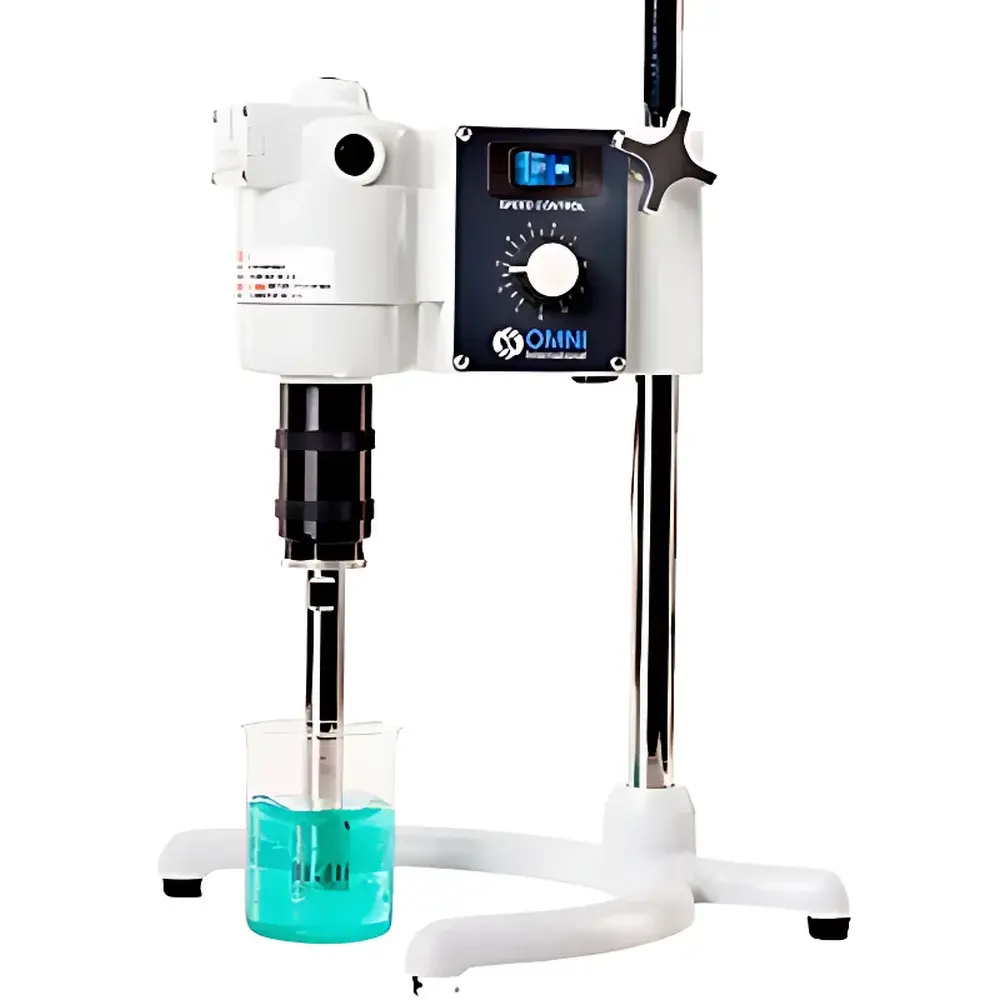
OMNI International OMNI Mixer Desktop Homogenizer
| Brand | OMNI International |
|---|---|
| Origin | USA |
| Model | Mixer |
| Instrument Type | Probe-type Rotor-Stator Homogenizer |
| Dimensions (W×D×H) | 254 × 254 × 610 mm |
| Processing Volume Range | 0.25–10,000 mL |
| Motor Power | 600 W |
| Speed Range | 500–18,000 rpm |
| Sound Pressure Level | <68 dB(A) |
| Weight | 9.5 kg |
Overview
The OMNI International OMNI Mixer Desktop Homogenizer is a high-performance, probe-based rotor-stator homogenizer engineered for reproducible mechanical disruption of biological, chemical, and pharmaceutical samples in laboratory environments. Operating on the principle of high-shear fluid dynamics—where rapid rotation of a precision-machined stainless-steel probe within a fixed stator generates intense localized turbulence, cavitation, and hydraulic shear—the system achieves efficient cell lysis, emulsification, dispersion, and particle size reduction across a broad viscosity and volume spectrum. Designed for benchtop use in QC/QA labs, academic research facilities, and bioprocessing development units, the OMNI Mixer delivers consistent energy input control without requiring external cooling or vacuum systems. Its robust cast-aluminum housing, sealed induction motor, and thermal overload protection ensure stable operation during extended duty cycles—critical for routine sample preparation workflows compliant with GLP and ISO/IEC 17025 frameworks.
Key Features
- 600 W brushless induction motor delivering stable torque across the full speed range (500–18,000 rpm), enabling precise adjustment to match sample rheology and target homogenization intensity
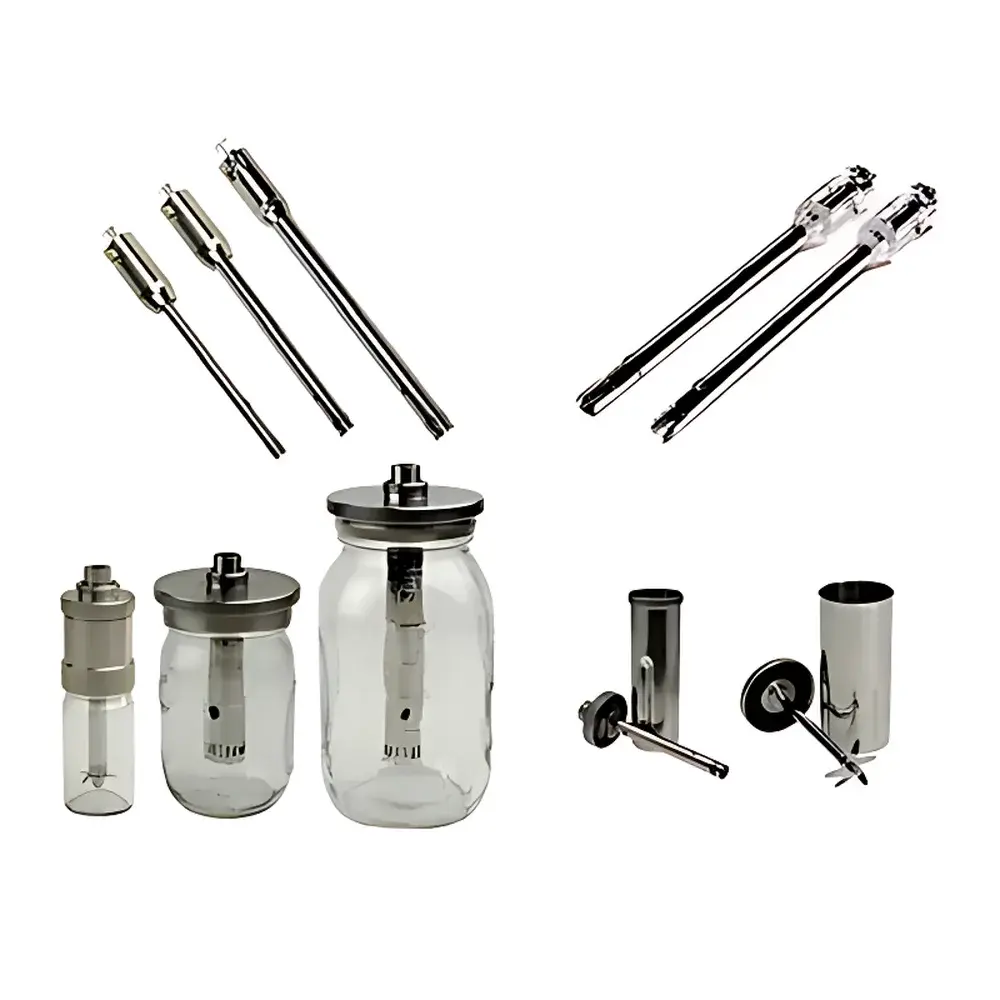
- Modular probe architecture supporting interchangeable stainless-steel generator probes (10 mm, 20 mm, and 30 mm diameters) with multiple length options (95 mm to 195 mm) and two blade geometries: standard and wide-window configurations for differential shear profiles
- Low-noise design (<68 dB[A] at 1 m) achieved via vibration-damped mounting and optimized airflow, suitable for shared lab spaces and noise-sensitive environments
- Integrated digital speed controller with LED display, soft-start functionality, and momentary/timed operation modes for protocol repeatability
- Comprehensive accessory ecosystem including glass, polycarbonate (PC), and stainless-steel homogenizing cups (13–1892 mL capacity), each validated for compatibility with specific probe types and working volumes
- Ergonomic vertical stand with adjustable height and clamping mechanism for secure probe alignment and hands-free operation
Sample Compatibility & Compliance
The OMNI Mixer accommodates diverse sample matrices—including mammalian and bacterial cell suspensions, tissue homogenates, polymer solutions, nanoparticle dispersions, and food emulsions—across viscosities up to 10,000 cP. All wetted components comply with USP Class VI and FDA 21 CFR Part 110 material requirements. Glass homogenizing cups meet ASTM E438 Type I, Class A specifications for volumetric accuracy; stainless-steel probes are electropolished to Ra ≤ 0.4 µm and pass ASME BPE surface finish validation. The system supports audit-ready documentation when paired with optional time-stamped logging modules, aligning with GMP Annex 11 and ISO 13485 traceability expectations for regulated life science applications.
Software & Data Management
While the base OMNI Mixer operates via standalone hardware controls, it is compatible with OMNI’s optional PC-based OMNI-Link™ software suite (v3.2+), which enables remote parameter setting, real-time RPM monitoring, run-time logging, and CSV export for LIMS integration. The software supports user-defined method templates with password-protected access levels, electronic signature capture, and automatic generation of audit trails meeting FDA 21 CFR Part 11 requirements. All firmware updates are digitally signed and verified prior to installation to maintain system integrity.
Applications
- Pre-analytical sample preparation for downstream assays (e.g., DNA/RNA extraction, ELISA, HPLC, LC-MS)
- Homogenization of frozen or fibrous tissues (liver, muscle, plant roots) using cryo-compatible stainless-steel cups
- Manufacturing-scale batch dispersion of nanomaterials and active pharmaceutical ingredients (APIs) in suspension formulations
- Quality control testing of emulsion stability, droplet size distribution, and viscosity consistency in cosmetic and food R&D
- Microbial lysis optimization studies under varying shear stress conditions for strain-specific protocol development
FAQ
What is the minimum recommended sample volume for the 10 mm probe?
The 10 mm probe is validated for reliable homogenization starting at 1.5 mL in appropriate cup configurations; processing below this volume may result in insufficient submergence and inconsistent shear delivery.
Can the OMNI Mixer be used with corrosive solvents such as chloroform or TCA?
Stainless-steel probes and glass cups are chemically resistant to most organic solvents; however, prolonged exposure to strong oxidizers (e.g., concentrated nitric acid) or halogenated solvents at elevated temperatures requires post-run decontamination per OMNI Technical Bulletin TB-027.
Is calibration required before first use or after probe replacement?
No factory calibration is needed—the speed control system is factory-trimmed to ±1% accuracy across the operating range; users should verify rotational speed using a non-contact tachometer during initial setup and annually thereafter per ISO/IEC 17025 Section 6.4.
How does the wide-window probe differ functionally from the standard probe?
The wide-window geometry increases fluid throughput and reduces localized heating during high-volume processing (>500 mL), while the standard probe provides higher tip velocity and finer particle size reduction in low-volume, high-viscosity applications.
Does OMNI provide validation support for IQ/OQ protocols?
Yes—OMNI International supplies vendor-qualified Installation Qualification (IQ) and Operational Qualification (OQ) templates, along with test certificates for motor performance, dimensional verification, and acoustic emission, supporting customer-led PQ execution per ASTM E2500-13 guidelines.



