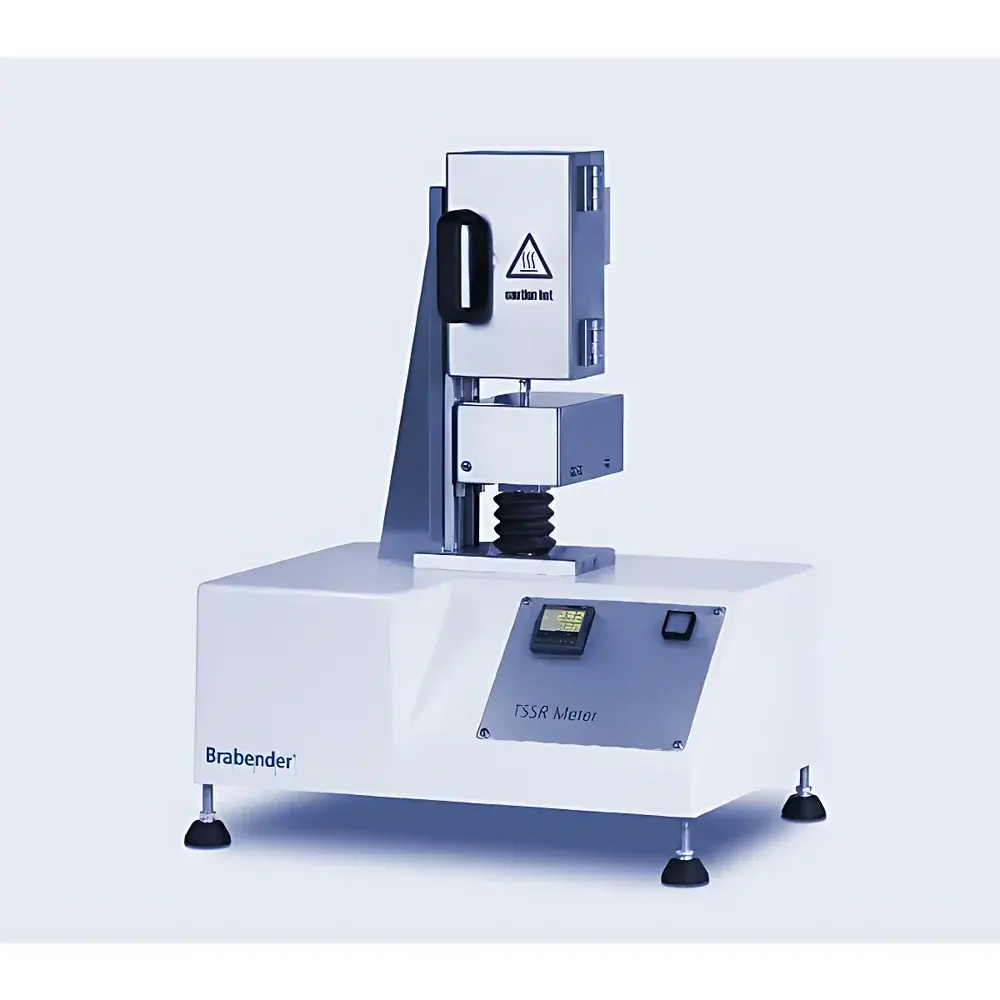
Anton Paar Brabender TSSR Stress Relaxation Spectrometer
| Brand | Anton Paar Brabender |
|---|---|
| Origin | Germany |
| Model | TSSR |
| Application | Isothermal and Non-isothermal Stress Relaxation Testing (TSSR/AISR Method) |
| Compliance Context | ASTM D624, ISO 37, ISO 6982, DIN 53515 |
| Software | Automated real-time data acquisition, spectral evaluation, and GLP-compliant storage |
| Measurement Principle | Torque-based viscoelastic stress decay under constrained strain in rotational rheometric configuration |
Overview
The Anton Paar Brabender TSSR Stress Relaxation Spectrometer is a precision-engineered instrument designed for quantitative characterization of viscoelastic relaxation behavior in thermoplastic, thermoset, and elastomeric materials. It operates on the fundamental principle of controlled-strain stress relaxation: a sample is deformed to a fixed strain level within a defined geometry (typically parallel-plate or cone-and-plate), and the time-dependent decay of restoring torque is measured under isothermal or programmed-temperature conditions. Unlike conventional dynamic mechanical analysis (DMA) or long-duration constant-deformation tests (e.g., traditional DVR methods requiring up to 72 hours), the TSSR implements the Temperature-Scanned Stress Relaxation (TSSR) protocol — a patented non-isothermal approach developed in collaboration with Prof. Vennemann’s group at Osnabrück University of Applied Sciences. This method accelerates characterization by sweeping temperature while maintaining constant strain, enabling construction of a full relaxation spectrum across multiple decades of relaxation time in approximately four hours. The system is calibrated traceably to SI units and integrates torque transduction with high-stability temperature control (±0.1 °C) over a standard range of −40 °C to 200 °C.
Key Features
- Patented TSSR (Temperature-Scanned Stress Relaxation) methodology enabling rapid generation of relaxation spectra — reducing test duration from days to hours without compromising physical fidelity.
- Automated AISR (Adaptive Isothermal/Scanning Relaxation) algorithm embedded in proprietary software, allowing seamless switching between isothermal and non-isothermal modes based on material response thresholds.
- Three user-definable temperature limit markers within the relaxation time spectrum — facilitating identification of critical transitions such as glass transition (Tg), onset of flow, or crosslink decomposition.
- High-resolution torque sensor (resolution < 0.01 µN·m) coupled with closed-loop motor control ensures reproducible strain application and minimal thermal drift during extended measurements.
- Modular geometry support: compatible with standard DIN/ISO-compliant parallel-plate, cone-and-plate, and solid-sample fixtures for uncured rubber compounds, vulcanizates, polymer melts, and filled composites.
- Fully integrated environmental chamber with forced-air or Peltier-based cooling/heating, certified for operation under GLP/GMP-relevant laboratory conditions.
Sample Compatibility & Compliance
The TSSR accommodates raw rubber compounds (NR, SBR, BR, EPDM), cured elastomer sheets (per ASTM D3182), thermoplastic pellets (PP, PE, TPU), and reactive prepolymers. Sample preparation follows ISO 6982 guidelines for specimen conditioning and geometry specification. Data output conforms to ASTM D624 (rubber tear resistance correlation), ISO 37 (tensile properties), and ISO 6982 (rubber testing terminology). The instrument architecture supports audit-ready operation per FDA 21 CFR Part 11 requirements when paired with optional electronic signature and event-logging modules. All calibration certificates are issued with NIST-traceable references and uncertainty budgets compliant with ISO/IEC 17025.
Software & Data Management
The TSSR Control & Evaluation Suite provides real-time visualization of torque decay curves, automatic baseline correction, and model-free spectral inversion using discrete relaxation time distribution (DRTD) algorithms. Raw data files (.tsr) are stored in HDF5 format with embedded metadata (operator ID, timestamp, environmental log, calibration history). Export options include CSV, XML, and PDF reports containing full traceability chains. Software validation documentation (IQ/OQ/PQ protocols) is available upon request. Multi-user access control, role-based permissions, and electronic audit trails meet GLP and internal quality management system (QMS) requirements.
Applications
- Quantification of crosslink density evolution during vulcanization optimization and aging studies.
- Differentiation of network heterogeneity in filled rubber systems via multi-peak relaxation spectra.
- Process window definition for extrusion and injection molding through melt elasticity profiling.
- Comparative analysis of bio-based vs. synthetic elastomers under accelerated thermal protocols.
- Supporting failure analysis in automotive sealing components by correlating relaxation modulus decay with service-life predictions.
- Input parameter generation for finite element modeling (FEM) of viscoelastic deformation in CAE simulations.
FAQ
What distinguishes TSSR from conventional stress relaxation testing?
TSSR replaces static isothermal holds with a controlled temperature ramp under constant strain, enabling efficient mapping of relaxation times across broad thermal domains — significantly reducing total measurement time while preserving thermorheological simplicity.
Can the TSSR be used for uncured rubber compounds?
Yes — the system supports both unvulcanized stock (using low-torque geometries and inert atmosphere options) and fully cured specimens, with appropriate fixture selection and strain amplitude limits per ISO 6982 Annex B.
Is third-party software integration supported?
The instrument exposes RESTful API endpoints for programmatic control and data ingestion into LIMS or MES platforms; MATLAB and Python SDKs are provided for custom spectral analysis workflows.
How is calibration maintained across temperature ranges?
Torque and temperature calibration are performed independently using certified reference standards; automated self-check routines verify system integrity before each test sequence.
Does the system comply with regulatory requirements for pharmaceutical excipient characterization?
While primarily optimized for elastomers and plastics, the TSSR meets foundational mechanical testing criteria referenced in USP for viscoelastic biomaterials — subject to site-specific validation per ICH Q5E and Q5C guidelines.