
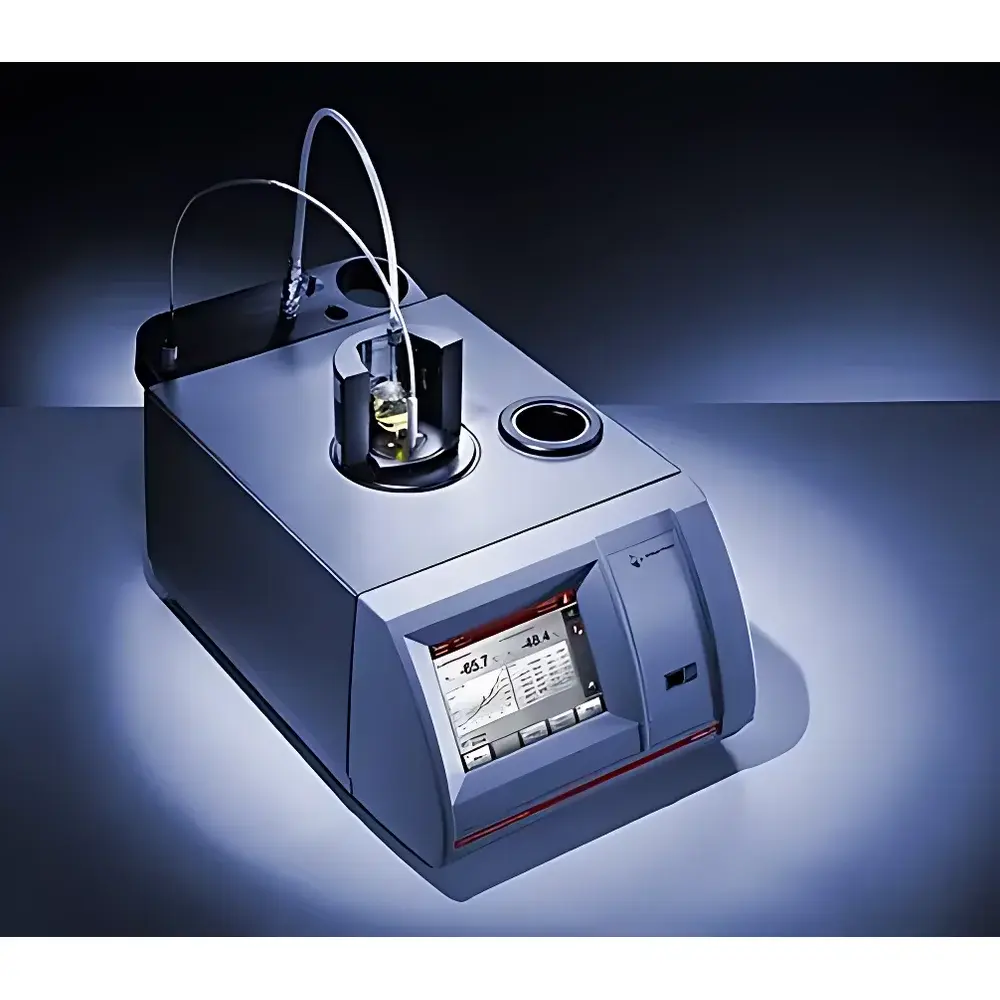
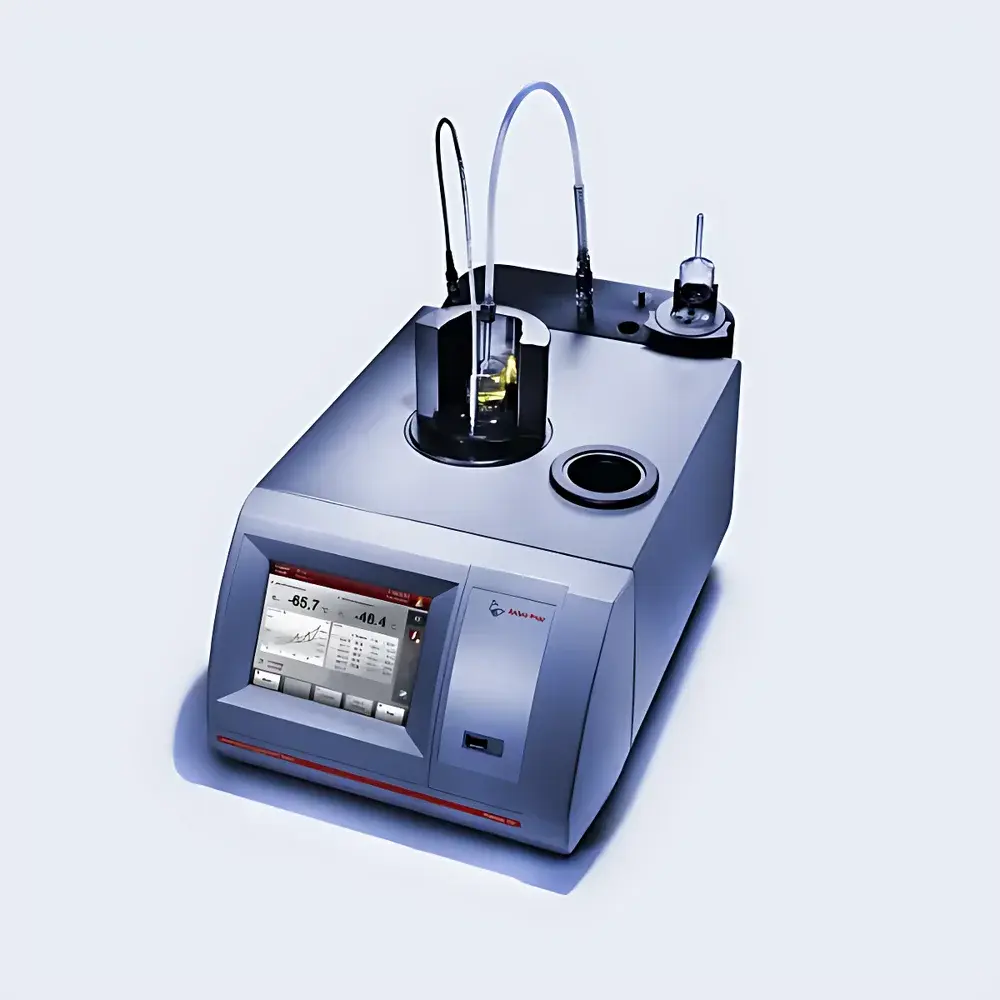
Anton Paar Callisto 100 Cold Filter Plugging Point (CFPP) Analyzer
| Brand | Anton Paar |
|---|---|
| Origin | Germany |
| Manufacturer Type | Manufacturer |
| Origin Category | Imported |
| Model | Callisto 100 |
| Temperature Range | –60 °C to +45 °C |
| Cooling Profile | Programmable stepwise or linear (6–100 °C/h) |
| Calibration | Automated calibration for sample/jacket temperature and vacuum |
| Temperature Accuracy | ±0.1 °C |
| Data Storage | 1000 test results |
| User Programs | Up to 90 customizable methods |
| External Cooling Required | Yes (280 W at –20 °C) |
| Dimensions | 340 × 580 × 310 mm (W × D × H) |
| Weight | 14 kg |
| Power Supply | 100–240 V, 50/60 Hz, 290 VA |
| Interfaces | 4× USB, 1× RS232, 1× LAN, 1× VGA |
| Data Export | XLS, PDF via USB flash drive |
Overview
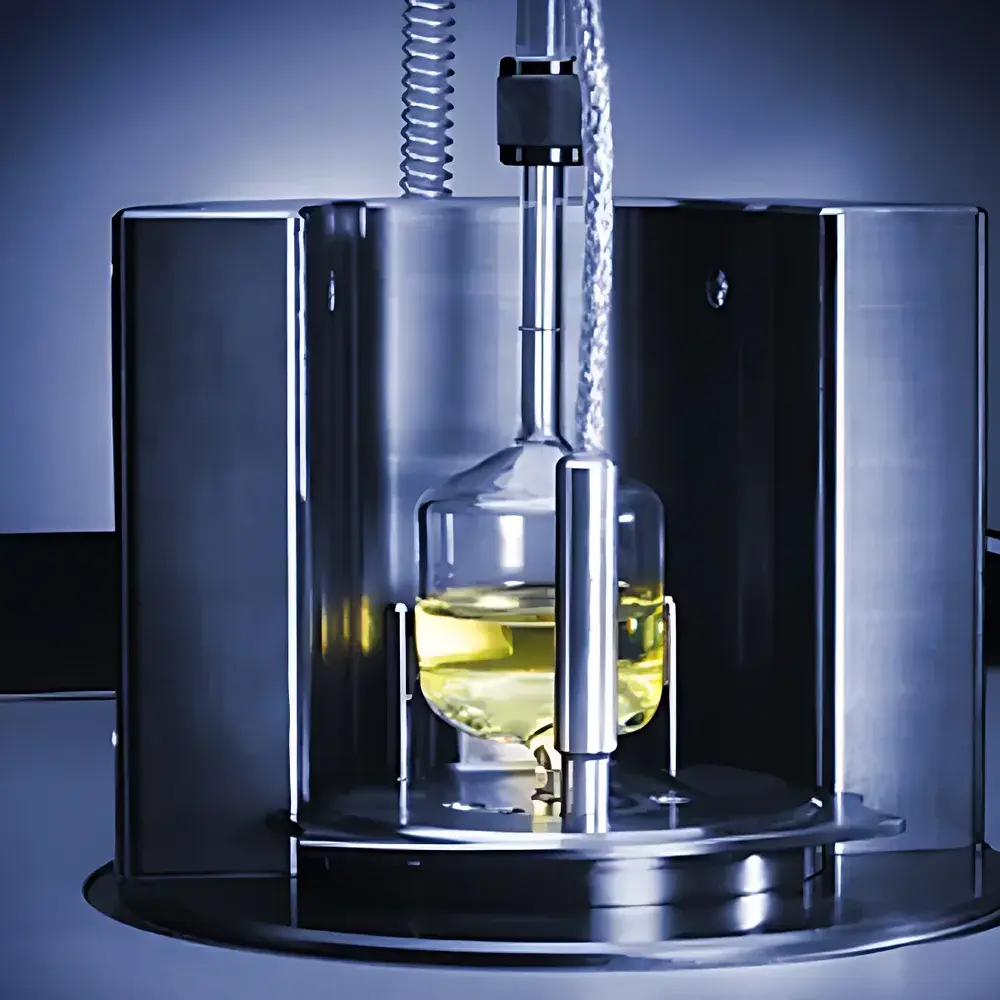
The Anton Paar Callisto 100 Cold Filter Plugging Point (CFPP) Analyzer is a fully automated, standards-compliant instrument engineered for precise and reproducible determination of the cold filter plugging point in diesel fuels, biodiesel blends, diesel/biofuel mixtures, and gas oils. Based on the principle of controlled vacuum-driven filtration through a standardized 45-µm stainless steel mesh under defined thermal conditions, the Callisto 100 implements both the classical stepwise cooling method (ASTM D6371, ISO 3015, EN 116) and the modern linear cooling protocol specified in EN 16329 — an officially recognized alternative method incorporated into EN 590 for European automotive diesel. Its core measurement architecture integrates non-contact infrared detection of filter blockage, eliminating mechanical sensor contact and ensuring consistent optical detection geometry across all tests. This design directly supports high inter-laboratory reproducibility and long-term method robustness required for regulatory compliance and quality control in refinery, blending, and distribution environments.
Key Features
- Non-contact infrared detection system ensures identical optical sensing position for every test, delivering superior repeatability (RSD < 0.5 °C per ASTM D6371 repeatability criteria)
- Modular, tool-free filtration unit assembly with integrated sealing — enables rapid exchange and cleaning without recalibration
- Dual cooling mode support: programmable stepwise (per EN 116) and linear ramp (per EN 16329), both fully configurable in 0.1 °C increments
- Advanced Peltier-based jacket temperature control with uniformity ≤ ±0.05 °C across the cooling surface — critical for accurate CFPP endpoint identification
- Automated calibration routines for sample temperature probe, jacket temperature sensor, and vacuum transducer — traceable to NIST-traceable references
- Large color touchscreen display showing real-time sample/jacket temperature curves, suction/reflux cycle counts, and dynamic status indicators
- Programmable auto-cleaning sequence for pipettes — activated with single button press; eliminates manual solvent handling and operator variability
- Second filtration unit storage slot at rear panel — reduces turnaround time between consecutive tests to < 10 seconds
Sample Compatibility & Compliance
The Callisto 100 is validated for use with petroleum distillates meeting specifications outlined in EN 590, ASTM D975, ASTM D7467 (biodiesel blends), and ISO 8217 (marine fuels). It supports manual execution of related low-temperature parameters including cloud point (ASTM D2500/ISO 2084) and pour point (ASTM D97/ISO 3016) using the same optical detection platform. All firmware and software modules comply with GLP requirements, including full audit trail logging (user actions, method changes, calibration events), electronic signature support, and secure user role management (administrator, operator, reviewer). The instrument meets electromagnetic compatibility (EMC) requirements per EN 61326-1 and safety standards per EN 61010-1. Optional 21 CFR Part 11 compliance packages are available for regulated pharmaceutical or contract testing laboratories requiring electronic record integrity.
Software & Data Management
Embedded firmware provides intuitive menu navigation with multilingual interface support (English, German, French, Spanish, Chinese). Preloaded standard methods include EN 116:2022, EN 16329:2013, ASTM D6371-21, and ISO 3015:2017 — all editable with full parameter transparency. Up to 90 user-defined methods can be stored locally, each with independent settings for cooling rate, vacuum setpoint, hold times, and pass/fail logic. Test data — including raw temperature/vacuum/time series, endpoint determination flags, and operator annotations — are stored in a tamper-evident database supporting 1000 complete test records. Statistical evaluation (min/max/mean/stdev) is automatically generated per method group. Data export is supported via USB 2.0 port to industry-standard formats: CSV for LIMS integration, Excel (.xlsx) for QA reporting, and PDF with embedded digital signature for certificate generation. Network connectivity (LAN) enables remote monitoring and centralized fleet management via Anton Paar’s LabX® software platform.
Applications
- Refinery final product release testing for diesel and biodiesel blends prior to shipment
- Quality assurance in fuel blending terminals verifying compliance with regional cold-weather specifications (e.g., winter-grade EN 590 Class F)
- R&D labs optimizing additive packages for improved low-temperature operability
- Third-party certification bodies conducting accredited CFPP testing per ISO/IEC 17025
- Marine fuel testing labs validating compliance with ISO 8217 Annex A cold flow requirements
- Government metrology institutes performing interlaboratory comparison studies and reference material certification
FAQ
Does the Callisto 100 require an external chiller?
Yes — it operates with an externally supplied recirculating chiller using methanol-free coolant, capable of reaching –67 °C jacket temperature to ensure reliable CFPP measurement down to –45 °C.
Can the instrument perform both CFPP and cloud point measurements?
Yes — while optimized for CFPP per EN 116 and EN 16329, its optical detection module and temperature control architecture support manual cloud point and pour point determinations using standardized visual or automated optical threshold detection protocols.
Is method validation documentation provided with the instrument?
Yes — each unit ships with a Factory Acceptance Test (FAT) report, IQ/OQ documentation templates, and a traceable calibration certificate for all primary sensors (temperature, vacuum, timing).
How is data integrity ensured for regulated environments?
Through configurable audit trails, electronic signatures, user access levels, and optional 21 CFR Part 11-compliant software modules that enforce ALCOA+ principles (Attributable, Legible, Contemporaneous, Original, Accurate, Complete, Consistent, Enduring, Available).





