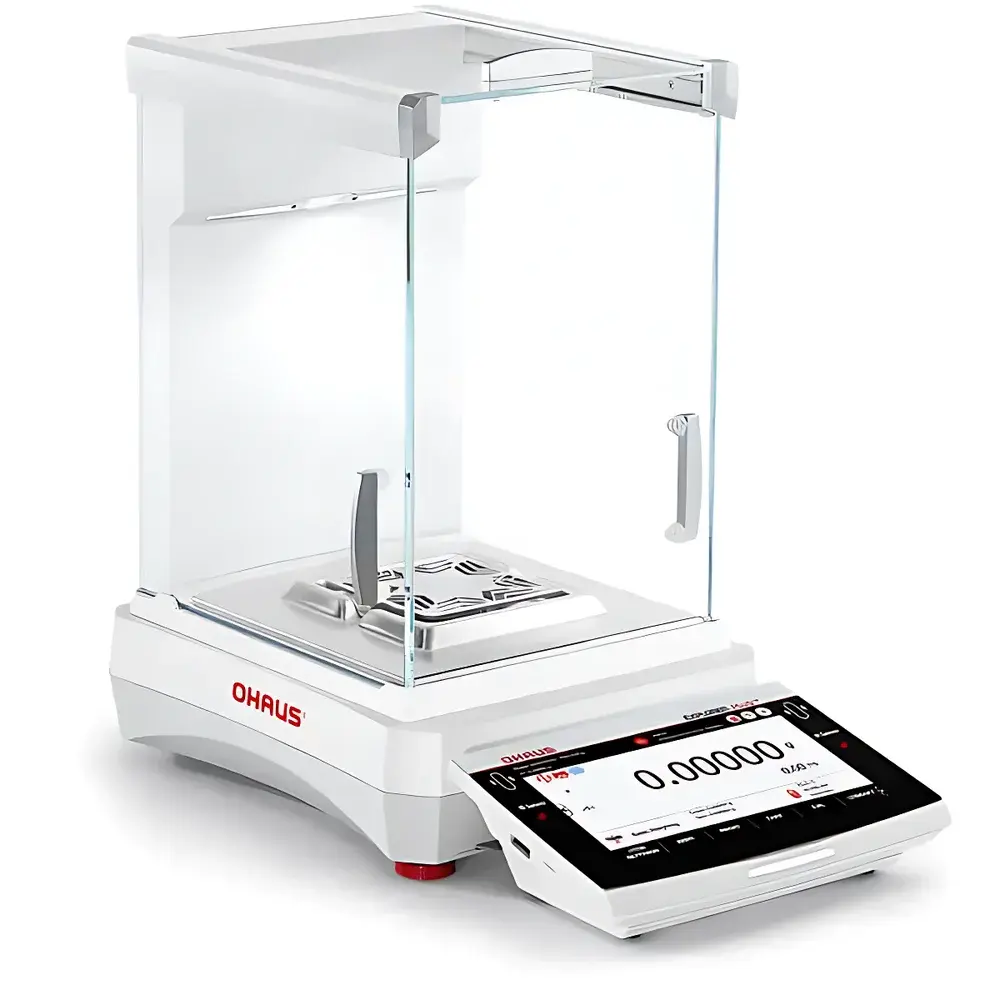
OHAUS Explorer Plus Precision Microbalance EXP225DZH/AD
| Brand | OHAUS |
|---|---|
| Origin | Jiangsu, China |
| Manufacturer Type | Original Equipment Manufacturer (OEM) |
| Product Category | Domestic |
| Model | EXP225DZH/AD |
| Instrument Type | Ultra-Micro Balance |
| Readability | 0.01 mg / 0.1 mg |
| Maximum Capacity | 120 g / 220 g |
| Repeatability (typ.) | 0.1 mg |
| Internal Calibration | Fully Automatic |
| Minimum Weight (USP <41>, 0.1% tolerance, typ.) | 20 mg |
| Stabilization Time (typ.) | 5 s |
| Pan Size | 80 mm × 80 mm |
| Net Weight | 7.8 kg |
| Dimensions (L×H×W) | 408 mm × 372 mm × 229 mm |
| Operating Environment | 10–30 °C, ≤80% RH (non-condensing) |
| Display | 7-inch TFT color touchscreen (16.7M colors), detachable with tempered glass panel |
| Connectivity | Dual USB-A host ports, USB-C device port, RS-232, Ethernet (RJ45), RJ11 |
| Compliance | CPA certified |
Overview
The OHAUS Explorer Plus Precision Microbalance EXP225DZH/AD is an ultra-micro analytical balance engineered for laboratories requiring trace-level mass determination with metrological rigor and regulatory compliance. Utilizing electromagnetic force restoration (EMFR) technology, it delivers high-resolution weighing at 0.01 mg readability across its dual-range capacity (120 g / 220 g), enabling precise quantification of microgram-scale samples in pharmaceutical development, reference standard preparation, catalyst formulation, and nanomaterial characterization. Its robust mechanical architecture—featuring a zinc-alloy weighing pan, die-cast metal base and housing, and anti-static tempered glass draft shield—ensures long-term stability under variable environmental conditions. The integrated auto-leveling system compensates for minor surface irregularities, while the dual non-contact sensors and active ionizer suppress electrostatic interference—a critical factor in low-mass, high-surface-area sample handling.
Key Features
- 7-inch detachable full-color TFT touchscreen with intuitive icon-driven interface and customizable home screen layouts
- Fully automatic internal calibration with real-time drift compensation and scheduled recalibration reminders
- Motorized draft shield with anti-pinch safety mechanism and programmable open/close logic
- Integrated electrostatic neutralizer (ION-100A compatible) and sample illumination LED for visual verification
- Time synchronization via NTP protocol to ensure timestamp accuracy across networked instruments
- Comprehensive user management: 4+1 role-based access levels (Admin, Supervisor, Operator, Guest, Audit) with encrypted password policy
- Internal system log capacity: 100,000 entries with ISO-compliant metadata (user ID, timestamp, action, result, instrument state)
- HID-class USB connectivity—no driver installation required when interfacing with Windows/Linux hosts
Sample Compatibility & Compliance
The EXP225DZH/AD accommodates a broad spectrum of sample types—from volatile organic compounds and hygroscopic powders to static-prone polymers and metallic nanoparticles—thanks to its sealed EMFR sensor chamber, rapid stabilization (<5 s), and configurable draft shield dynamics. It meets national verification requirements under China’s CPA (China Pattern Approval) certification framework. When configured with OHAUS Acquire™ or third-party LIMS-integrated software, the balance supports ALCOA+ data integrity principles and satisfies FDA 21 CFR Part 11 requirements for electronic records and signatures—including audit trail activation, user authentication, and immutable event logging. Its minimum weight validation (20 mg per USP at 0.1% tolerance) ensures method suitability for pharmacopeial applications such as content uniformity testing and assay standardization.
Software & Data Management
Data export and integration are facilitated through native support for CSV, XML, and PDF report generation, with timestamped outputs compliant with GLP documentation standards. The balance stores up to 3,000 sample IDs locally and supports direct transfer to laboratory information management systems (LIMS) or enterprise resource planning (ERP) platforms via TCP/IP or RS-232 protocols. Optional wireless toolkits (LM842) and fingerprint authentication modules (FIN-100A) enable secure, multi-user environments in shared core facilities. All communication ports—including dual USB-A, USB-C, Ethernet, and optional Wi-Fi—support simultaneous connections without conflict, allowing concurrent printer output (SF40A series), remote monitoring, and automated data archiving.
Applications
- Pharmaceutical QC/QA: USP -compliant assay standard preparation, dissolution tablet testing, and volumetric pipette calibration (with EX-series calibration kit)
- Materials science: Catalyst loading verification, thin-film deposition mass tracking, and nanoparticle dispersion quantification
- Academic research: Isotope-labeled compound synthesis, micro-dosing in enzymatic assays, and gravimetric sorption analysis
- Regulatory labs: Reference material certification, forensic trace evidence weighing, and environmental particulate mass fractioning
- Industrial R&D: High-value additive dosing in specialty chemicals, precious metal plating bath control, and battery electrode slurry formulation
FAQ
What is the minimum weight limit for reliable measurement on the EXP225DZH/AD?
The minimum weight is 20 mg when operating under USP criteria (0.1% tolerance), verified using calibrated test weights and documented in the internal calibration log.
Does the balance support 21 CFR Part 11 compliance out of the box?
Hardware-level features (audit trail storage, user roles, electronic signature readiness) are embedded; full Part 11 compliance requires configuration via validated software (e.g., OHAUS Acquire™ or qualified LIMS).
Can the draft shield be operated manually if the motor fails?
Yes—the shield includes a manual override latch for emergency access while preserving structural integrity and draft exclusion performance.
Is external calibration required in addition to internal calibration?
Internal calibration ensures daily operational accuracy; external calibration with traceable standards is recommended annually or per ISO/IEC 17025 accreditation requirements.
How does the auto-leveling system function without user intervention?
Four precision tilt sensors continuously monitor platform inclination; micro-adjustment actuators dynamically reposition the load cell assembly to maintain vertical alignment within ±0.1°.