
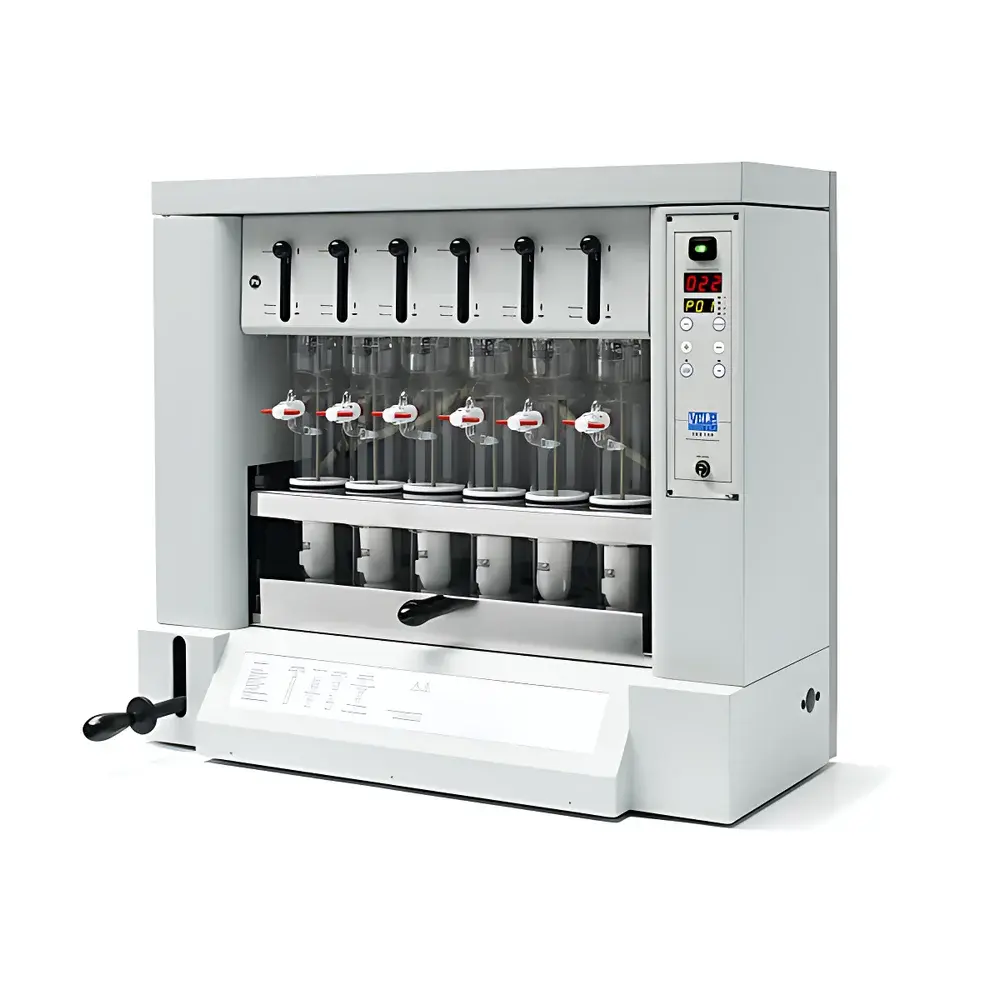
VELP SER148/3 Randall-Style Solvent Extraction Fat Analyzer
| Brand | VELP |
|---|---|
| Origin | Italy |
| Model | SER148/3 |
| Protection Rating | IP55 |
| Compliance | CEI EN 60529, GLP |
| Control System | Dual-zone microprocessor with 29 pre-programmed methods |
| Safety Features | Coolant leak detection alarm |
| Output | Data logging and print capability |
| Sample Capacity | 3 positions per batch |
| Extraction Principle | Sequential Randall extraction (immersion → reflux rinsing → solvent recovery via distillation) |
| Application Scope | Solid and semi-solid matrices |
Overview
The VELP SER148/3 Randall-Style Solvent Extraction Fat Analyzer is an automated, CE-compliant benchtop system engineered for precise, reproducible determination of lipid and other extractable organic compounds in solid and semi-solid samples. Based on the validated Randall extraction principle—a two-stage thermal-solvent process involving direct immersion followed by reflux rinsing—the instrument delivers accelerated extraction kinetics while minimizing solvent consumption and operator intervention. Unlike conventional Soxhlet systems, the SER148/3 integrates a closed-loop solvent recovery stage via controlled distillation, achieving >90% solvent reuse efficiency under standard operating conditions. Its dual-zone temperature control architecture enables independent regulation of extraction chamber and condenser zones, ensuring consistent thermal profiles across all three operational phases: (1) sample immersion in boiling solvent, (2) solvent reflux rinsing of extracted residue, and (3) fractional solvent recovery through vapor condensation and collection. Designed for routine compliance-driven laboratories, the system meets CEI EN 60529 (IP55 ingress protection) and supports Good Laboratory Practice (GLP) documentation requirements through timestamped data logging and optional thermal printer integration.
Key Features
- Dual-zone microprocessor controller with 29 programmable extraction protocols—each configurable for temperature ramp rates, dwell times, and phase transitions
- Three-phase sequential extraction cycle: immersion → reflux rinsing → solvent recovery—reducing total analysis time by up to 50% versus classical Soxhlet
- Integrated coolant leak detection alarm system that halts operation upon loss of cooling water flow, preventing overheating and condenser failure
- IP55-rated enclosure for resistance to dust ingress and low-pressure water jets—suitable for shared analytical lab environments with variable ambient conditions
- Real-time dual-display interface showing current zone temperature and remaining cycle time—enabling unattended overnight operation with traceable parameter monitoring
- Modular design supporting standardized consumables: 25 mm diameter filter paper thimbles (25 per box), compatible with AOAC, ISO 1443, and ASTM D2231 methodologies
Sample Compatibility & Compliance
The SER148/3 accommodates heterogeneous solid and semi-solid matrices without prior homogenization or derivatization. Validated applications include feedstuffs (e.g., animal feed, cereals, oilseeds), environmental solids (soil, sludge, sediment), industrial polymers (plasticizers in PVC, rosin in paperboard), and pharmaceutical excipients. All extractions comply with internationally recognized standards including ISO 1443 (animal and vegetable fats and oils), AOAC Official Method 991.36 (crude fat in pet food), and EPA Method 3541 (solid-phase extraction). The system’s hardware architecture and firmware support audit-ready GLP workflows: each run generates a unique digital log containing method ID, start/end timestamps, temperature profiles, and user identification—exportable via RS232 or stored internally for FDA 21 CFR Part 11–aligned review.
Software & Data Management
While the SER148/3 operates as a standalone unit with embedded firmware, its data output conforms to laboratory information management system (LIMS) ingestion protocols. Extraction logs are timestamped and structured in ASCII format, enabling seamless import into spreadsheet-based QA/QC tracking or validated chromatography data systems (CDS). Optional thermal printer attachment provides hard-copy records compliant with internal SOPs and external accreditation audits (e.g., ISO/IEC 17025). No proprietary software installation is required; configuration and method recall occur exclusively via front-panel navigation. Firmware updates are delivered via secure USB key—validated against checksum integrity checks prior to deployment.
Applications
- Quantification of crude fat in animal feed, dairy products, and cereal grains per AOAC 991.36 and ISO 6496
- Extraction of hydrophobic contaminants—including PCBs, PAHs, organochlorine pesticides—from soil and wastewater sludge per EPA SW-846 Methods 3541 and 3550C
- Recovery of plasticizers (e.g., phthalates, adipates) from polymer matrices prior to GC-MS analysis
- Isolation of natural resins and waxes from pulp and paper products for compositional profiling
- Preparative extraction of lipid fractions from biological tissues for subsequent enzymatic or chromatographic characterization
- Supporting sample preparation workflows for HPLC, GC-FID, and GC-MS analyses requiring clean, solvent-free extracts
FAQ
What extraction solvents are compatible with the SER148/3?
Diethyl ether, petroleum ether (40–60 °C fraction), hexane, and chloroform are routinely used. Solvent selection must align with flash point, boiling point, and matrix compatibility per ISO 6496 Annex A.
Does the system require external cooling water?
Yes—condenser operation depends on continuous tap water or recirculating chiller supply (minimum 15 °C inlet, 2.5 L/min flow rate). The integrated leak sensor disables heating if flow drops below threshold.
Can extraction methods be customized beyond the 29 preset programs?
Yes—users may modify temperature setpoints, phase durations, and transition logic via password-protected engineering mode, with all changes recorded in the audit trail.
Is the SER148/3 suitable for volatile organic compound (VOC) analysis?
It is not designed for headspace or purge-and-trap VOC work; however, it effectively isolates semi-volatile organics (SVOCs) such as pesticides and plasticizers from complex solids prior to instrumental analysis.
How is method validation supported?
Each run stores raw thermal and timing data; reference material recoveries (e.g., NIST SRM 1577c) can be tracked across batches to demonstrate accuracy, precision, and intermediate precision per ICH Q2(R2).



