
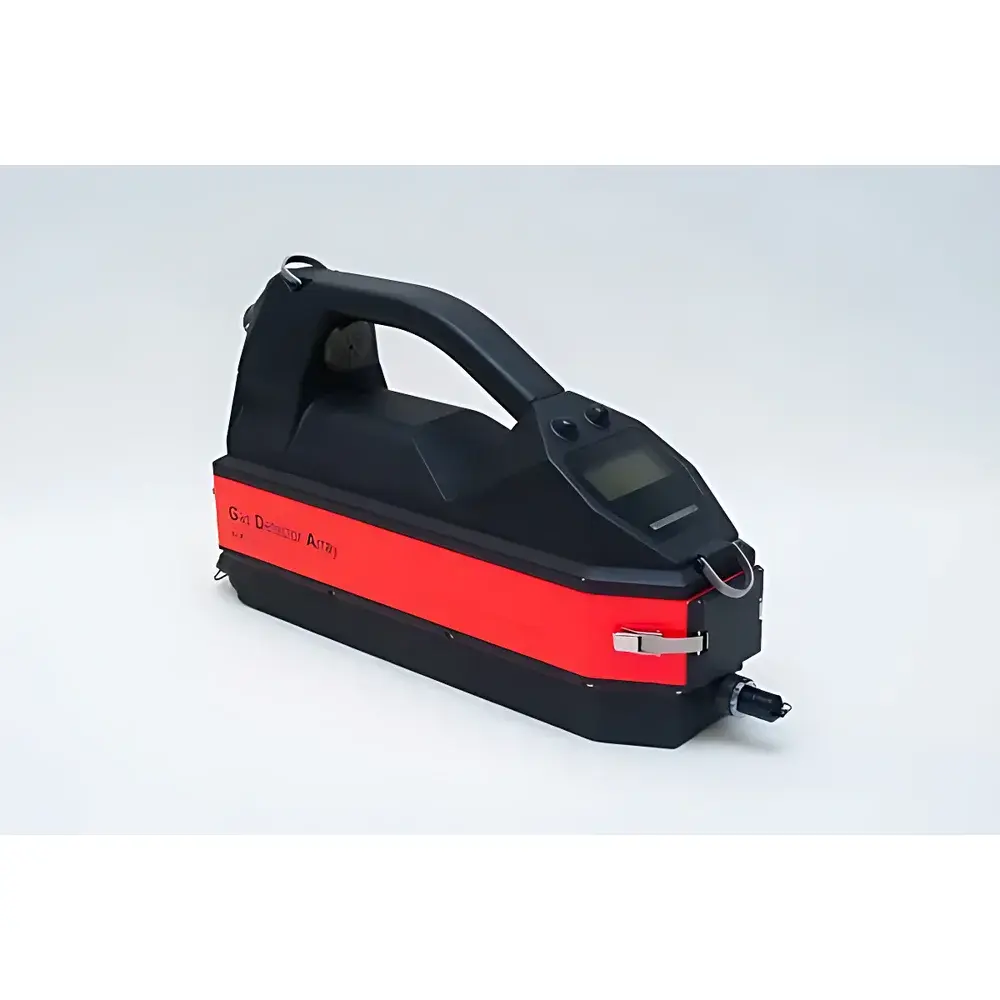
AIRSENSE GDA-FR Portable Industrial Gas Detection System
| Brand | AIRSENSE |
|---|---|
| Origin | Germany |
| Manufacturer Type | Authorized Distributor |
| Origin Category | Imported |
| Model | GDA-FR |
| Pricing | Available Upon Request |
Overview
The AIRSENSE GDA-FR Portable Industrial Gas Detection System is a multi-sensor, field-deployable analytical platform engineered for rapid, reliable identification and quantification of hazardous industrial gases in real time. Unlike single-technology detectors, the GDA-FR employs a fused-sensor architecture integrating four complementary detection principles—Ion Mobility Spectrometry (IMS), Photoionization Detection (PID), Electrochemical (EC) sensing, and Metal Oxide Semiconductor (MOS) technology—distributed across eight independent parallel gas channels. Each channel samples the same air stream simultaneously, generating a multidimensional response vector—a unique “chemical fingerprint”—which is matched against an onboard spectral library using template-based pattern recognition. This approach eliminates reliance on single-signal thresholds, significantly reducing false positives and enhancing discrimination among structurally similar volatiles. Designed for operational readiness in mission-critical environments—including chemical incident response, industrial leak localization, and border security—the GDA-FR operates without mandatory warm-up, achieving functional readiness within seconds of power-on.
Key Features
- Multi-Channel Sensor Fusion: Eight parallel detection channels (dual IMS, dual PID, dual EC, dual MOS) enable simultaneous acquisition of orthogonal signal responses, improving classification confidence and cross-interference rejection.
- Adaptive Dilution Control: Integrated mass-flow-controlled dilution module supports dynamic range extension from sub-ppb to high-ppm concentrations; automatically adjusts dilution ratio during source tracing mode to maintain sensor linearity near emission points.
- Modular Operational Modes: Four context-optimized modes: (1) Source Tracing Mode with auto-dilution ramping, (2) Ambient Monitoring Mode (low-dilution, long-term stability), (3) PID-Referenced Quantification Mode for targeted VOCs using user-defined calibration standards, and (4) Surface Residue Analysis Mode utilizing integrated IR heating element (up to 250 °C) for thermal desorption of semi-volatiles.
- Rugged Field Design: IP65-rated enclosure; operating temperature range −30 °C to +50 °C; relative humidity tolerance 5–95% RH (non-condensing); shock-absorbing housing compliant with MIL-STD-810G for transport and drop resistance.
- Low-Maintenance Architecture: All sensors and consumables (e.g., IMS radioactive Ni-63 foil, PID lamp, EC electrodes) are hot-swappable via standardized bayonet mounts; maintenance access panel enables full internal inspection without tools.
Sample Compatibility & Compliance
The GDA-FR detects volatile organic compounds (VOCs), inorganic toxicants (e.g., HCN, Cl₂, NH₃, SO₂), electronic-grade specialty gases (e.g., SiH₄, PH₃, AsH₃), and common industrial solvents. Its current reference library contains over 300 validated chemical signatures, structured per IUPAC nomenclature and CAS registry. The library format supports user-defined additions under controlled versioning protocols—enabling method development aligned with site-specific risk assessments or regulatory reporting requirements (e.g., OSHA PELs, ACGIH TLVs®, EPA Method TO-15/TO-17). The system meets electromagnetic compatibility (EMC) requirements per EN 61326-1:2013 and intrinsic safety considerations per ATEX Directive 2014/34/EU (Category 2G, Zone 1) when operated with certified accessories. Data integrity complies with GLP/GMP-aligned audit trail functionality in WinMuser GDA software (21 CFR Part 11-ready configuration optional).
Software & Data Management
WinMuser GDA is a Windows-based desktop application providing instrument control, spectral library management, real-time visualization, and post-acquisition analysis. It records time-stamped raw channel signals, dilution ratios, environmental metadata (T/RH), GPS coordinates (via optional Bluetooth module), and operator annotations. The software supports batch processing of multiple field runs, overlay comparison of response profiles, and export of calibrated concentration values in CSV, XML, or PDF report formats compliant with ISO/IEC 17025 documentation standards. Audit trails log all parameter changes, library edits, and result exports with user ID, timestamp, and reason-for-change fields. Remote firmware updates and library patches are delivered via encrypted HTTPS channel with SHA-256 signature verification.
Applications
- Emergency Response: Rapid hazard mapping during chemical spills, refinery leaks, or clandestine lab investigations; real-time boundary delineation for evacuation zones.
- Industrial Hygiene: Workplace exposure assessment per OSHA 29 CFR 1910.1200; monitoring of confined-space entry atmospheres prior to ventilation verification.
- Environmental Forensics: Mobile source attribution at landfill leachate vents, wastewater treatment off-gases, or fugitive emission sites under EPA OTM-33 guidance.
- Border Security & Customs: Screening cargo containers for fumigants (e.g., methyl bromide, phosphine), illicit drug precursors, or explosives residues.
- Fire Investigation: Post-blaze analysis of combustion byproducts (e.g., HCl, formaldehyde, benzene) to infer fuel composition and ignition sequence.
- Pharmaceutical Manufacturing: Residual solvent verification in cleanroom HVAC ducts and lyophilizer exhaust streams per ICH Q5C and USP .
FAQ
What is the minimum detectable concentration for common VOCs like benzene or acetone?
Detection limits vary by compound and sensor channel: typical IMS/PID combined LODs range from 0.5 ppb (benzene) to 5 ppb (acetone), while EC sensors achieve 0.1 ppm for H₂S or CO.
Can the GDA-FR operate continuously during battery-powered field deployment?
Yes—rechargeable Li-ion battery supports ≥8 hours of continuous operation at nominal sampling flow (300 mL/min); runtime extends to >12 hours in low-power ambient monitoring mode.
Is third-party calibration traceable to NIST standards available?
Certified calibration services include NIST-traceable gas standards (Scott Specialty Gases, Air Liquide), with full uncertainty budgets per ISO/IEC 17025 and documented certificate of analysis.
How frequently must the IMS Ni-63 source be replaced?
Ni-63 half-life is 100 years; source replacement is not required during instrument service life—only periodic activity verification via built-in check standard is recommended annually.
Does WinMuser GDA support integration with enterprise LIMS or SCADA systems?
Yes—via OPC UA server module (optional license) or direct SQL database write capability; supports custom API endpoints for RESTful data ingestion into central monitoring platforms.







