
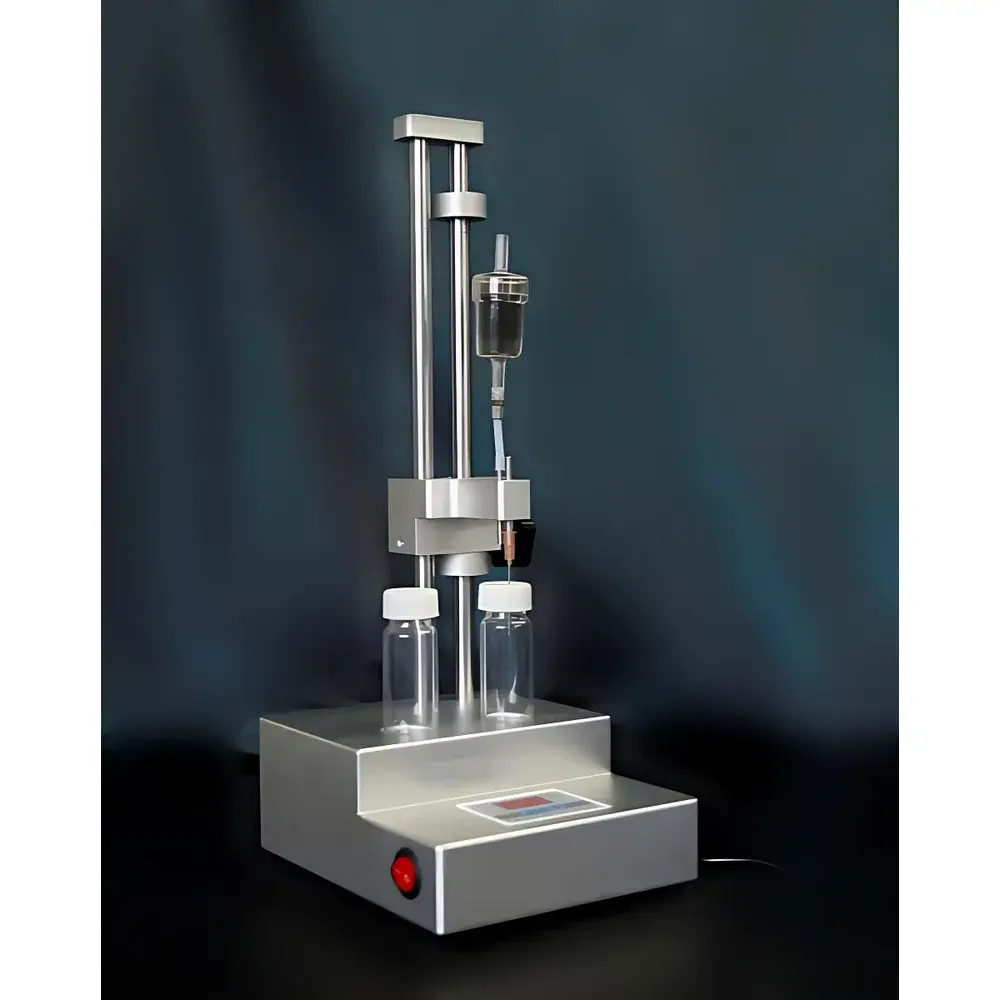
Headspace Sampler YHL-01B
| Origin | Beijing, China |
|---|---|
| Manufacturer Type | Distributor |
| Origin Category | Domestic |
| Model | YHL-01B |
| Instrument Type | Dynamic Headspace Sampler |
| Automation Level | Semi-Automatic |
| Vial Heating Range | Ambient to 90 °C |
| Valve Temperature Control Range | Ambient to 90 °C |
| Loop Volume | 1 mL |
| Vial Positions | 2 |
| Vial Capacity | 10 mL |
| Temperature Accuracy | ±0.5 °C |
| Weight | <3 kg |
Overview
The YHL-01B Headspace Sampler is a semi-automatic dynamic headspace sampling system engineered for precise, reproducible volatile compound transfer from solid or liquid matrices into gas chromatography (GC) or electronic nose (e-nose) platforms. It operates on the principle of controlled thermal equilibration: samples sealed in standard 10 mL headspace vials are heated to a user-defined temperature (ambient to 90 °C), inducing volatilization of analytes into the headspace above the sample phase. A carrier gas sweeps the equilibrated vapor through a thermostatted six-port injection valve—also maintained up to 90 °C—to minimize condensation—and delivers a fixed 1 mL aliquot directly to the analytical instrument. This method eliminates solvent use, reduces matrix interference, and enhances sensitivity for trace-level volatile organic compounds (VOCs), semi-volatiles, and odor-active substances. Designed as a cost-optimized alternative to fully automated systems, the YHL-01B retains critical thermal control fidelity while delegating syringe actuation to manual operation—ensuring operator awareness and procedural transparency during method development and routine QC workflows.
Key Features
- Independent dual-zone temperature control: separate heating modules for vial block (ambient–90 °C) and injection valve (ambient–90 °C), both with ±0.5 °C stability to prevent cold trapping and ensure quantitative transfer.
- Compact benchtop architecture: footprint under 250 × 200 mm and total mass <3 kg, enabling integration into space-constrained GC labs or portable e-nose validation setups.
- Semi-automatic workflow: manual vertical positioning of the sampling needle ensures tactile feedback and real-time alignment verification—critical for method optimization and troubleshooting.
- Standardized vial compatibility: accepts industry-standard 10 mL crimp-top or screw-cap headspace vials; two-position carousel supports parallel sample conditioning or sequential analysis without reconfiguration.
- Robust thermal insulation and PID-controlled heating elements deliver rapid ramp rates and minimal overshoot, supporting ISO 17025-compliant temperature validation protocols.
Sample Compatibility & Compliance
The YHL-01B accommodates aqueous solutions, polymers, food matrices, pharmaceutical tablets, soil slurries, and biological tissues—any sample generating measurable headspace VOCs within its operational thermal window. Its design aligns with ASTM D6144 (standard test method for determination of volatile organic compounds in water by dynamic headspace/gas chromatography), USP residual solvents guidelines, and ISO 11337 (odor measurement by dynamic olfactometry). While not certified for GLP/GMP production environments out-of-the-box, its temperature logging capability (via external digital thermometer integration) and stable thermal performance support audit-ready documentation when paired with laboratory information management systems (LIMS). All wetted surfaces are chemically inert stainless steel or fluoropolymer-lined, ensuring compatibility with aggressive solvents and minimizing carryover.
Software & Data Management
The YHL-01B operates via front-panel membrane keypad with LED display—no proprietary software required. Temperature setpoints, hold times, and valve timing are configured manually and retained in non-volatile memory across power cycles. For traceability, users integrate the device into validated workflows using external data loggers or GC acquisition software (e.g., Agilent OpenLab, Thermo Chromeleon) that timestamp injection events and record ambient conditions. Though lacking native 21 CFR Part 11 compliance features (e.g., electronic signatures, audit trails), its deterministic mechanical behavior and repeatable thermal profiles make it suitable for Stage 1–2 method development, training labs, and ISO/IEC 17025 accredited facilities where manual entry and paper-based SOP adherence are established practice.
Applications
- Electronic nose calibration and response profiling: delivers consistent headspace composition for sensor array training and cross-laboratory odor benchmarking.
- Residual solvent analysis in APIs and excipients per ICH Q3C guidelines.
- VOC screening in packaging materials (migration testing), cosmetics, and consumer products.
- Quality control of fermented foods (e.g., ethanol, esters, aldehydes in wine, yogurt, soy sauce).
- Environmental monitoring of soil/water headspace for BTEX, chlorinated hydrocarbons, and fuel markers.
- Forensic toxicology screening for volatile poisons (e.g., cyanide, methanol, isopropanol) in biological fluids.
FAQ
Is the YHL-01B compatible with all gas chromatographs?
Yes—it features standard 1/16″ stainless-steel tubing connections and a universal six-port valve interface, allowing direct coupling to Agilent, Shimadzu, Thermo Fisher, and PerkinElmer GC inlets.
Can it be upgraded to full automation?
No—the mechanical design lacks motorized syringe drive or robotic vial handler provisions; however, its thermal architecture and valve timing are identical to higher-tier models, facilitating seamless method transfer.
What maintenance is required?
Quarterly cleaning of the valve rotor seal with isopropanol and annual replacement of the PTFE septum in the vial heating block are recommended to maintain leak integrity and temperature uniformity.
Does it support pressure-balanced sampling?
Yes—the carrier gas flow path includes adjustable back-pressure regulation at the valve outlet, enabling pressure matching with GC inlet conditions to prevent flow disruption during injection.
How is temperature accuracy verified?
Users may insert calibrated PT100 probes into empty vials placed in both positions and log readings against the displayed setpoint over 30 minutes using an external datalogger per ISO/IEC 17025 clause 6.4.3.






