
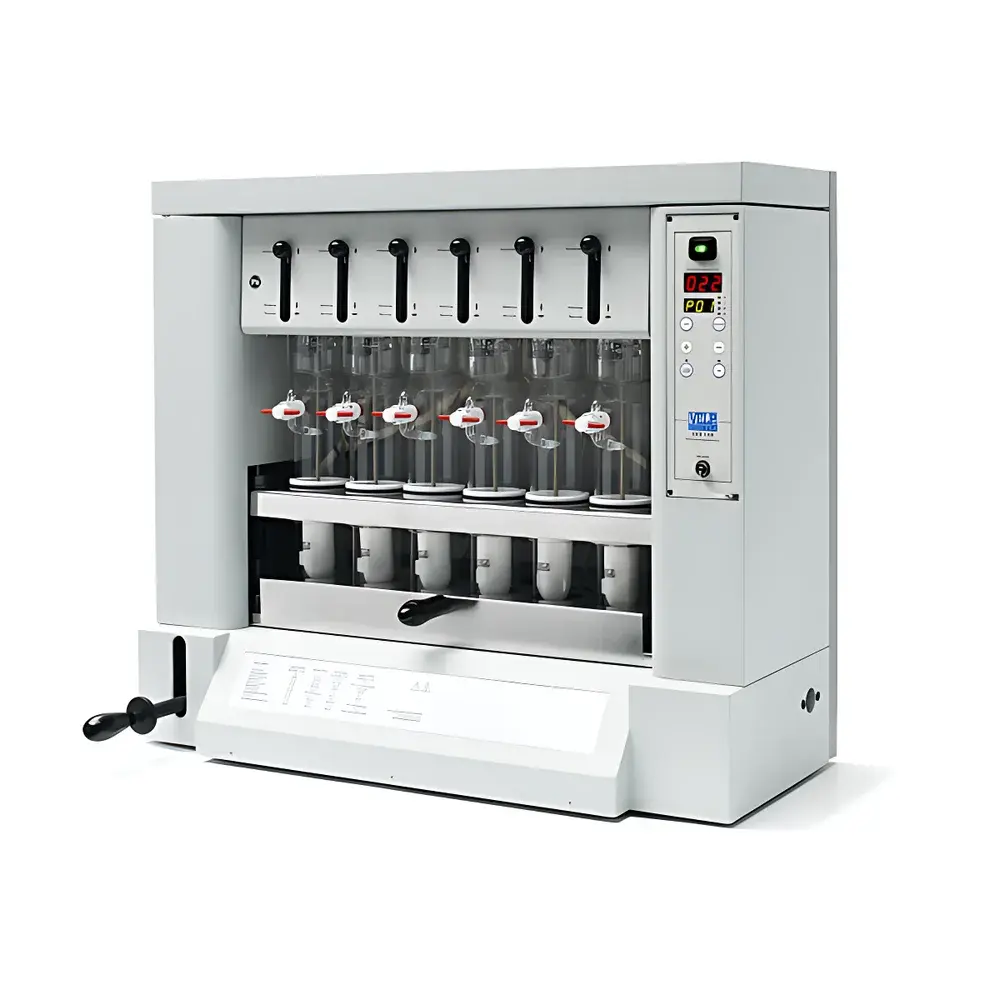
VELP SER148/6 Fat Analyzer (Soxhlet Extractor)
| Brand | VELP |
|---|---|
| Origin | Italy |
| Model | SER148/6 |
| Extraction Channels | 6 |
| Solvent Recovery System | Dual-stage condensation & distillation-based |
| Safety Features | Coolant leak detection alarm |
| Control System | Dual-zone microprocessor with 29 pre-programmed methods |
| Display | Dual-line LCD showing real-time temperature and remaining time |
| Data Output | Print or save extraction logs |
| Sample Format | Solid or semi-solid matrices in filter thimbles |
| Compliance | Designed for ASTM D2231, ISO 1443, AOAC 920.39, USP <467>, and GLP-compliant workflows |
Overview
The VELP SER148/6 Fat Analyzer is a fully automated, six-position Soxhlet extraction system engineered for precision, reproducibility, and regulatory compliance in routine fat and organic solvent-soluble compound determination. Based on the Randall rapid extraction principle—distinct from classical Soxhlet cycling—the SER148/6 employs a three-phase thermal extraction protocol: (1) direct immersion of solid or semi-solid samples in boiling solvent, (2) solvent reflux and dynamic rinsing of the sample matrix, and (3) solvent recovery via controlled distillation. This architecture significantly reduces total cycle time (typically 30–50% faster than conventional systems), improves solvent recovery efficiency (>92% typical recovery rate), and minimizes operator exposure to volatile organic compounds (VOCs). The instrument’s dual-stage condensation system ensures consistent solvent return while limiting atmospheric emissions, aligning with modern laboratory sustainability and occupational health requirements per OSHA 1910.1200 and EU Directive 2004/42/EC.
Key Features
- Six independent extraction positions with individual heating control and thermal isolation, enabling parallel processing without cross-contamination.
- Dual-zone microprocessor controller supporting 29 validated extraction programs—each configurable for ramp rates, hold times, reflux cycles, and distillation endpoints.
- Integrated coolant leak detection sensor that halts operation and triggers audible/visual alerts upon cooling water failure—critical for uninterrupted condenser function and lab safety.
- Real-time dual-line LCD interface displaying current bath temperature and remaining process time, with optional RS232 or USB output for data logging and traceability.
- Passive solvent recovery loop utilizing gravity-fed condensate return and vacuum-assisted distillation, eliminating need for external pumps or cryogenic traps.
- Modular design compliant with IEC 61010-1 safety standards; constructed with corrosion-resistant stainless steel housing and PTFE-sealed joints for long-term chemical compatibility.
Sample Compatibility & Compliance
The SER148/6 accommodates standard cellulose or glass-fiber filter thimbles (e.g., 25 × 80 mm) and is validated for heterogeneous solid and semi-solid matrices including animal feed, cereal grains, pharmaceutical excipients, polymer pellets, textile fibers, soil cores, and municipal sludge. It meets methodological requirements for AOAC Official Method 920.39 (crude fat in foods), ASTM D2231 (fat in rubber), ISO 1443 (milk fat), and EPA Method 3541 (semi-volatile organics in solids). Its closed-loop solvent handling and audit-ready event logging support 21 CFR Part 11–aligned environments when paired with validated LIMS integration.
Software & Data Management
While the SER148/6 operates as a standalone benchtop unit, its embedded firmware supports timestamped extraction reports—including start/stop timestamps, peak temperature, total runtime, and active program ID—that can be exported via thermal printer or saved to USB memory. For laboratories operating under GLP or GMP frameworks, the device’s deterministic control logic and non-volatile parameter storage ensure full method traceability. Optional VELP LabSoft™ software (v3.2+) enables remote monitoring, batch report generation, electronic signature capture, and deviation flagging—fully compatible with FDA-submitted validation protocols.
Applications
- Quantitative fat analysis in animal feed, dairy products, baked goods, and infant formula per Codex Alimentarius and EU Regulation (EC) No 152/2009.
- Extraction of hydrophobic contaminants—including PCBs, PAHs, organochlorine pesticides, and phthalate esters—from environmental solid matrices (soil, sediment, biosolids) prior to GC-MS or HPLC analysis.
- Isolation of extractable lipids and surfactants from industrial detergents, cosmetic emulsions, and pharmaceutical ointments for quality control release testing.
- Preparative clean-up of polymeric materials (e.g., PVC, PET) to quantify plasticizers (DEHP, DINP) or stabilizers in compliance with REACH Annex XVII.
- Supporting sample preparation for pharmacopeial residual solvents testing (USP , Ph. Eur. 2.4.24) where quantitative recovery of volatile organics is essential.
FAQ
What solvent types are compatible with the SER148/6?
Diethyl ether, petroleum ether (40–60 °C fraction), hexane, chloroform, and dichloromethane are routinely used. Ethanol and acetone require method validation due to higher boiling points and polarity effects on reflux dynamics.
Can the SER148/6 be integrated into an automated lab workflow?
Yes—via optional relay I/O modules and Modbus RTU protocol support, it interfaces with robotic sample handlers and central LIMS platforms for unattended batch processing.
Is method validation documentation available?
VELP provides IQ/OQ documentation templates, installation checklists, and performance qualification test scripts aligned with ISO/IEC 17025 and ASTM E2500 guidelines.
What maintenance intervals are recommended?
Coolant lines and condenser seals should be inspected quarterly; heating bath oil (if used) replaced annually; and temperature calibration verified biannually using NIST-traceable PT100 probes.
Does the system comply with green chemistry principles?
Yes—the dual-stage solvent recovery reduces consumption by ≥40% versus single-pass systems, and VOC emissions are typically <5 mg/m³ during operation, meeting ISO 14040 life-cycle assessment benchmarks for analytical instrumentation.



