
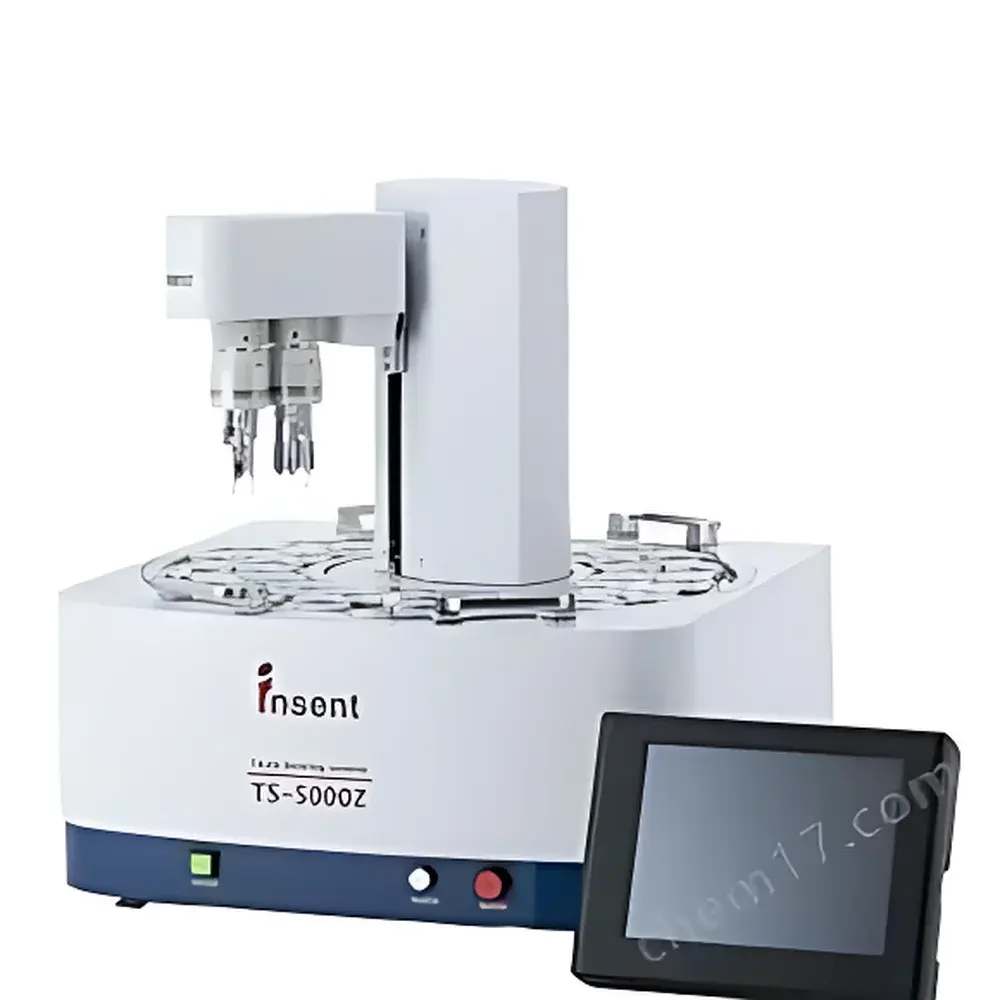
Insent TS-5000Z Automated Electronic Tongue System
| Brand | Insent (Japan) |
|---|---|
| Origin | Japan |
| Type | Taste Sensing System (Electronic Tongue) |
| Sensor Principle | Artificial Lipid Membrane-Based Potentiometric Array |
| Compliance | Designed for GLP/GMP-aligned sensory evaluation workflows |
| Software | TS-5000Z Analysis Suite with FDA 21 CFR Part 11–ready audit trail option |
| Data Output | Multidimensional taste profiles (basic tastes + aftertaste richness), PCA/DA visualization, cluster heatmaps, temporal response curves |
| Sample Throughput | Up to 96 samples per automated sequence (with optional autosampler) |
| Interface | Touchscreen-guided operation with macro scripting support |
| Environmental Stability | EMI-shielded sensor chamber with temperature-controlled sample compartment (±0.1 °C) |
Overview
The Insent TS-5000Z Automated Electronic Tongue System is a high-precision, potentiometric taste sensing platform engineered for objective, quantitative analysis of gustatory properties in liquid and semi-liquid samples. Unlike conventional sensory panels or single-parameter chemical assays, the TS-5000Z employs an array of artificial lipid membrane sensors—each chemically tuned to respond selectively to specific taste modalities (sour, sweet, bitter, salty, umami, and astringent) through ion-selective potential shifts. This biomimetic architecture replicates the transduction mechanism of human taste receptor cells, enabling reproducible measurement of both primary taste intensities and temporal aftertaste dynamics (e.g., lingering bitterness, umami richness, astringency persistence). The system operates on the principle of multivariate pattern recognition: raw sensor response vectors are processed via chemometric algorithms to generate standardized taste fingerprints, making it suitable for applications demanding traceable, operator-independent sensory data.
Key Features
- Eight-channel artificial lipid membrane sensor array with individually calibrated selectivity profiles for sour, sweet, bitter, salty, umami, and astringent stimuli, plus two reference channels for baseline stabilization.
- Fully automated sample handling—including sequential rinsing, calibration, and measurement cycles—reducing inter-run variability and enabling unattended overnight operation.
- Integrated temperature-controlled sample compartment (maintained at 30 °C ± 0.1 °C) to ensure physiological relevance and thermal stability across extended assay sequences.
- EMI-shielded sensor housing and grounded analog signal conditioning circuitry, minimizing electromagnetic interference and supporting high signal-to-noise ratio in industrial laboratory environments.
- Intuitive touchscreen interface with guided workflow navigation, context-sensitive help, and customizable macro functions for routine test protocols (e.g., QC release testing, shelf-life monitoring).
- Embedded data management server supporting local storage, network backup, user access control, and optional FDA 21 CFR Part 11 compliance modules including electronic signatures and full audit trails.
Sample Compatibility & Compliance
The TS-5000Z accommodates aqueous solutions, beverages, dairy products, sauces, pharmaceutical suspensions, oral liquids, and buffer-diluted extracts—with minimal sample preparation required. Viscosity range: 1–50 mPa·s; pH tolerance: 2.0–8.5; particulate content must be <5 µm to prevent sensor fouling. The system supports method validation per ISO 29527:2019 (Electronic Tongue Performance Criteria) and aligns with ASTM E3164-20 guidelines for instrumental sensory profiling. When configured with validated SOPs and metadata logging, it meets GLP and GMP documentation requirements for regulated environments—including QC laboratories in food, nutraceutical, and oral pharmaceutical development.
Software & Data Management
The proprietary TS-5000Z Analysis Suite provides comprehensive data processing capabilities: principal component analysis (PCA), discriminant analysis (DA), hierarchical clustering, and multidimensional scaling (MDS) for comparative taste mapping. Users can generate radar charts for multi-taste profiling, temporal response plots for aftertaste kinetics, and heatmaps for batch-wise similarity assessment. All visualizations are exportable in publication-ready SVG/PNG formats with embedded metadata. The software architecture supports LIMS integration via CSV/Excel import-export and optional OPC UA connectivity. Data integrity is reinforced by version-controlled method templates, automatic timestamping, and role-based permissions (administrator, analyst, reviewer).
Applications
- Objective shelf-life determination via time-series tracking of taste degradation (e.g., increasing bitterness in stored protein hydrolysates or decreasing umami in fermented soy products).
- Pharmaceutical formulation optimization—quantifying bitterness suppression efficacy of taste-masking excipients or evaluating off-taste emergence during accelerated stability studies.
- Consumer preference modeling: correlating electronic tongue profiles with hedonic sensory panel data to predict market acceptance without human panel recruitment delays.
- Raw material authentication and supplier qualification—detecting adulteration or origin variance in coffee, tea, olive oil, or fish sauce based on characteristic taste fingerprints.
- Regulatory dossier support: generating reproducible, instrument-based evidence for taste-related claims (e.g., “reduced bitterness”, “enhanced umami balance”) under EFSA or FDA guidance frameworks.
FAQ
How does the TS-5000Z differ from conventional e-tongue systems using metal oxide or polymer sensors?
The TS-5000Z relies on biomimetic lipid membranes that mimic biological taste transduction—delivering higher specificity for taste ions (H⁺, Na⁺, K⁺, Ca²⁺, amino acid zwitterions) and lower cross-sensitivity compared to non-biological solid-state sensors.
Can the system analyze opaque or turbid samples?
Yes—provided particles are filtered to <5 µm and the sample remains chemically stable during measurement (typically <2 min exposure per sensor). Centrifugation or membrane filtration is recommended prior to loading.
Is sensor recalibration required between sample batches?
A full 3-point calibration (blank, standard, reference) is performed automatically before each run. Sensor drift correction is applied in real time using internal reference channels.
Does the software support multilingual interfaces?
The TS-5000Z Analysis Suite offers English, Japanese, Chinese, and German language packs—configured at installation with no runtime switching limitation.
What maintenance is required for long-term sensor stability?
Sensors are field-replaceable and rated for ≥500 measurements under standard operating conditions. Routine cleaning with ethanol/water (70:30 v/v) and storage in humidified chamber prevents lipid desiccation. Annual sensor performance verification is advised.




