
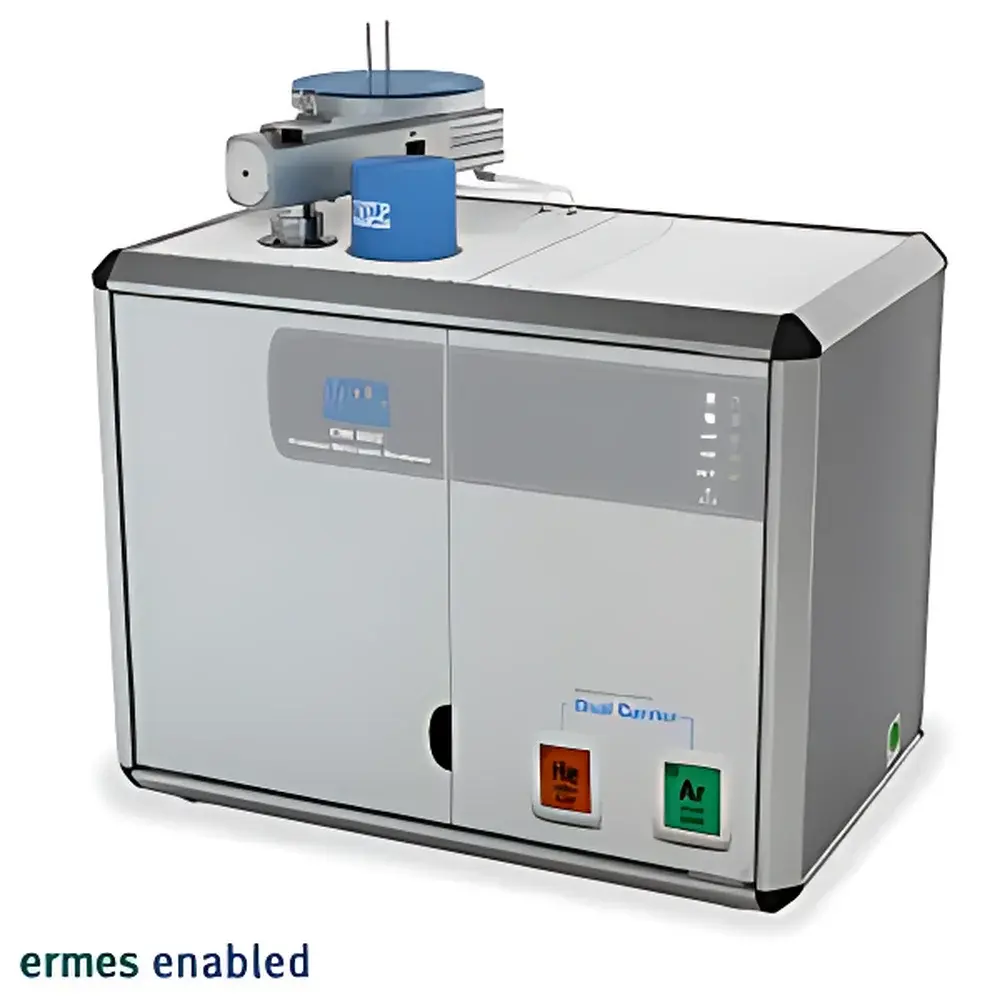
VELP CN 802 Carbon-Nitrogen Elemental Analyzer
| Brand | VELP |
|---|---|
| Country of Origin | Italy |
| Model | CN 802 |
| Detection Principle | High-Temperature Combustion + NDIR & TCD Detection |
| Sample Throughput | 3–4 min per sample |
| Detection Limits | 0.01 mg C, 0.001 mg N |
| Precision | RSD < 0.5% (EDTA) |
| Sample Mass Range | 200 mg – 1 g |
| Carrier Gas Options | He or Ar |
| Connectivity | Ethernet/Wi-Fi to VELP Ermes Cloud Platform |
| Compliance | ASTM D5373, ISO 13878, USP <28>, EN 15936, AOAC 992.23 |
| Software | VELP Ermes Suite with GLP-compliant audit trail, automatic C:N ratio calculation, and report generation |
Overview
The VELP CN 802 Carbon-Nitrogen Elemental Analyzer is a high-precision, dual-detection combustion-based instrument engineered for rapid, reliable quantification of total carbon (TC), total nitrogen (TN), total organic carbon (TOC after acidification), total inorganic carbon (TIC), and the critical C:N ratio in heterogeneous organic matrices. Operating on the principle of high-temperature catalytic combustion (950–1100 °C) in an oxygen-rich environment, the CN 802 fully oxidizes sample carbon to CO₂ and nitrogen to N₂ and NOₓ, followed by selective reduction of nitrogen oxides to molecular nitrogen in a copper-based reduction furnace (RF). The evolved gases undergo sequential conditioning: first-stage physical dehydration via VELP’s proprietary DriStep™ water trap (WT1), second-stage chemical dehydration (WT2), and CO₂ removal using a regenerable adsorption cartridge. The remaining pure N₂ stream is quantified by a LoGas™-enhanced thermal conductivity detector (TCD), while CO₂ is measured independently by a high-stability non-dispersive infrared (NDIR) detector. This dual-path, interference-free gas separation architecture ensures metrological traceability and eliminates cross-sensitivity between C and N signals—critical for regulatory-grade environmental and agricultural testing.
Key Features
- True dual-carrier gas flexibility: Switch between helium (optimized for NDIR sensitivity and baseline stability) and argon (lower operational cost) without hardware modification—enabling method-specific optimization per application or budget constraint.
- Dual-detector architecture: NDIR sensor for CO₂ (carbon quantification) and LoGas™ TCD for N₂ (nitrogen quantification), both calibrated against certified reference materials traceable to NIST SRMs.
- Automated moisture management: Integrated two-stage dehydration system (DriStep™ WT1 + chemical WT2) ensures complete water vapor removal prior to detection—eliminating drift and enhancing long-term reproducibility.
- Robust combustion module: Ceramic-lined quartz combustion tube with Pt/Pd catalyst and integrated reduction furnace (RF) enables complete oxidation of recalcitrant matrices including soils, sediments, activated sludge, and protein-rich feeds.
- 24/7 unattended operation: Designed for continuous duty with auto-start/stop scheduling, consumables monitoring (O₂, CO₂ trap, desiccant), and fault logging compliant with ISO/IEC 17025 laboratory quality requirements.
- Cloud-integrated control: Native Ethernet and Wi-Fi connectivity to the VELP Ermes Cloud Platform enables remote instrument status monitoring, real-time data streaming, method deployment, and firmware updates from any web-enabled device.
Sample Compatibility & Compliance
The CN 802 accommodates solid and liquid samples within a mass range of 200 mg to 1 g—supporting routine analysis of soil, compost, agricultural feedstuffs, food products, wastewater filter residues, sediment cores, and plant tissue. Its combustion protocol conforms to internationally recognized standard methods, including ASTM D5373 (coal and coke), ISO 13878 (soil organic matter), EN 15936 (fertilizers), AOAC 992.23 (feed nitrogen), and USP (pharmaceutical residual solvents). All analytical workflows support full GLP/GMP compliance: electronic signatures, user-access levels, time-stamped audit trails, and raw-data immutability are enforced through the Ermes software suite, satisfying FDA 21 CFR Part 11 requirements for regulated laboratories.
Software & Data Management
The VELP Ermes Suite provides a browser-based interface with no local installation required. It features intuitive method setup wizards, preloaded standard protocols (e.g., ISO 13878 for soil C:N), real-time chromatogram visualization, automated stoichiometric correction for sample heterogeneity, and one-click C:N ratio calculation. All measurement data—including peak areas, retention times, calibration curves, and instrument logs—are stored in a relational database with version-controlled backups. Reports export in PDF/CSV formats and include metadata such as analyst ID, calibration date, gas lot numbers, and uncertainty estimates per ISO/IEC 17025 Annex A.5. Audit trails record every parameter change, result override, or maintenance event with IP address and timestamp.
Applications
- Agricultural science: Quantifying soil organic carbon sequestration potential and optimizing fertilizer N-use efficiency via precise C:N ratio profiling.
- Environmental monitoring: Assessing carbon burial rates in wetlands and estuarine sediments; evaluating wastewater treatment plant sludge stabilization.
- Food & feed QA/QC: Verifying crude protein content (via TN × 6.25), detecting adulteration in dairy and cereal products, and certifying organic certification parameters.
- Research laboratories: Supporting biogeochemical cycling studies, biochar characterization, and microbial substrate utilization assays requiring sub-milligram-level precision.
- Regulatory compliance: Generating data packages for EPA Method 440.1 (TOC), ISO 10694 (soil carbon), and EU Fertilising Products Regulation (EU) 2019/1009 Annex I.
FAQ
What carrier gases are compatible with the CN 802, and how does switching affect performance?
The CN 802 supports both helium and argon as carrier gases. Helium delivers superior NDIR signal-to-noise and baseline stability for ultra-trace carbon work; argon reduces consumable costs by ~60% while maintaining full compliance with ISO 13878 and ASTM D5373 for routine soil and feed analysis.
Can the CN 802 measure TOC and TIC separately?
Yes—by integrating optional acidification pretreatment (e.g., HCl spiking and purge), the instrument quantifies TOC (after inorganic carbon removal) and TIC (via direct acid liberation), enabling full carbon speciation in environmental and geological samples.
Is method validation documentation available for regulatory submissions?
VELP provides a comprehensive Instrument Qualification Package (IQ/OQ/PQ) aligned with ISO/IEC 17025, including linearity, LOD/LOQ, repeatability, intermediate precision, and robustness test reports—all generated using CRM-certified reference materials.
How does the Ermes Cloud Platform ensure data integrity during remote access?
All cloud interactions use TLS 1.2+ encryption; session timeouts enforce re-authentication; and all data writes are logged with immutable SHA-256 hashes—meeting ALCOA+ (Attributable, Legible, Contemporaneous, Original, Accurate, Complete, Consistent, Enduring, Available) principles for GxP environments.
What maintenance intervals are recommended for uninterrupted operation?
Daily: Desiccant and CO₂ trap inspection; Weekly: O₂ cylinder pressure check and combustion tube visual inspection; Quarterly: Catalyst activity verification and TCD zero calibration; Annually: Full system performance qualification (SPQ) with certified CRMs.





