
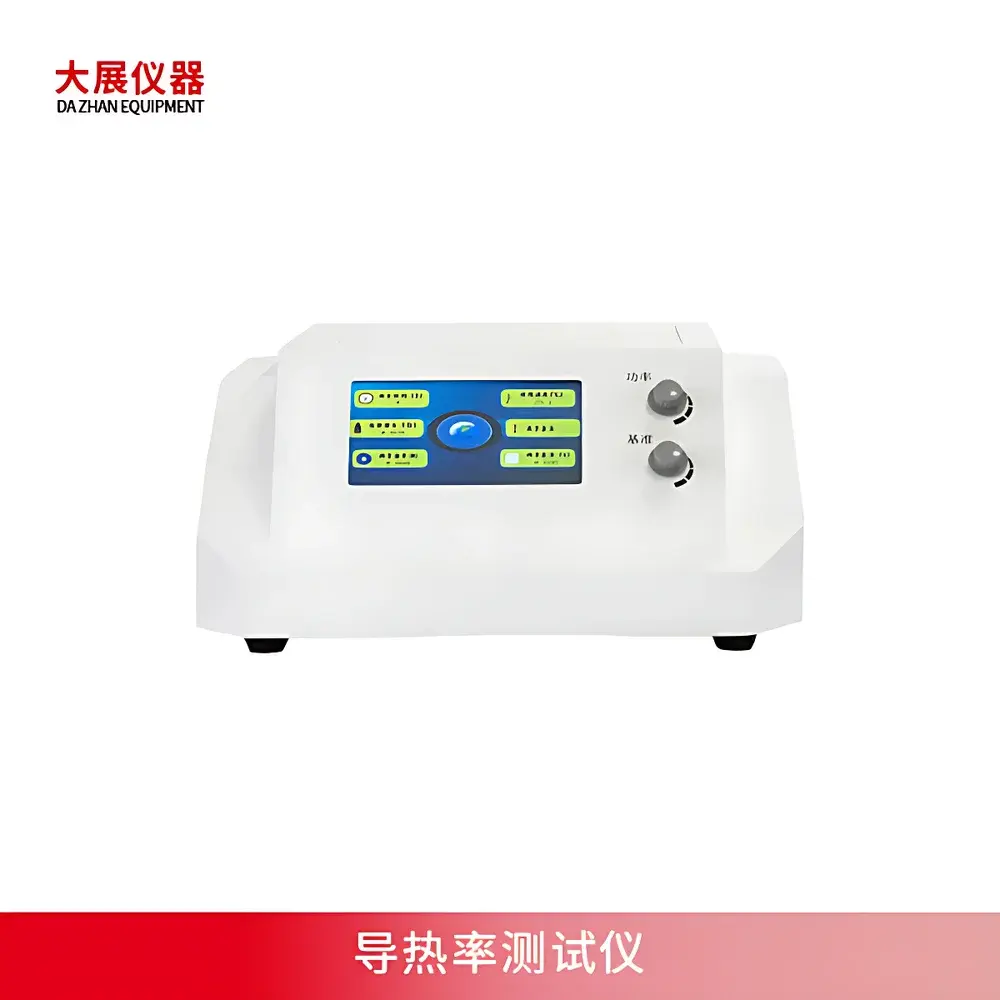
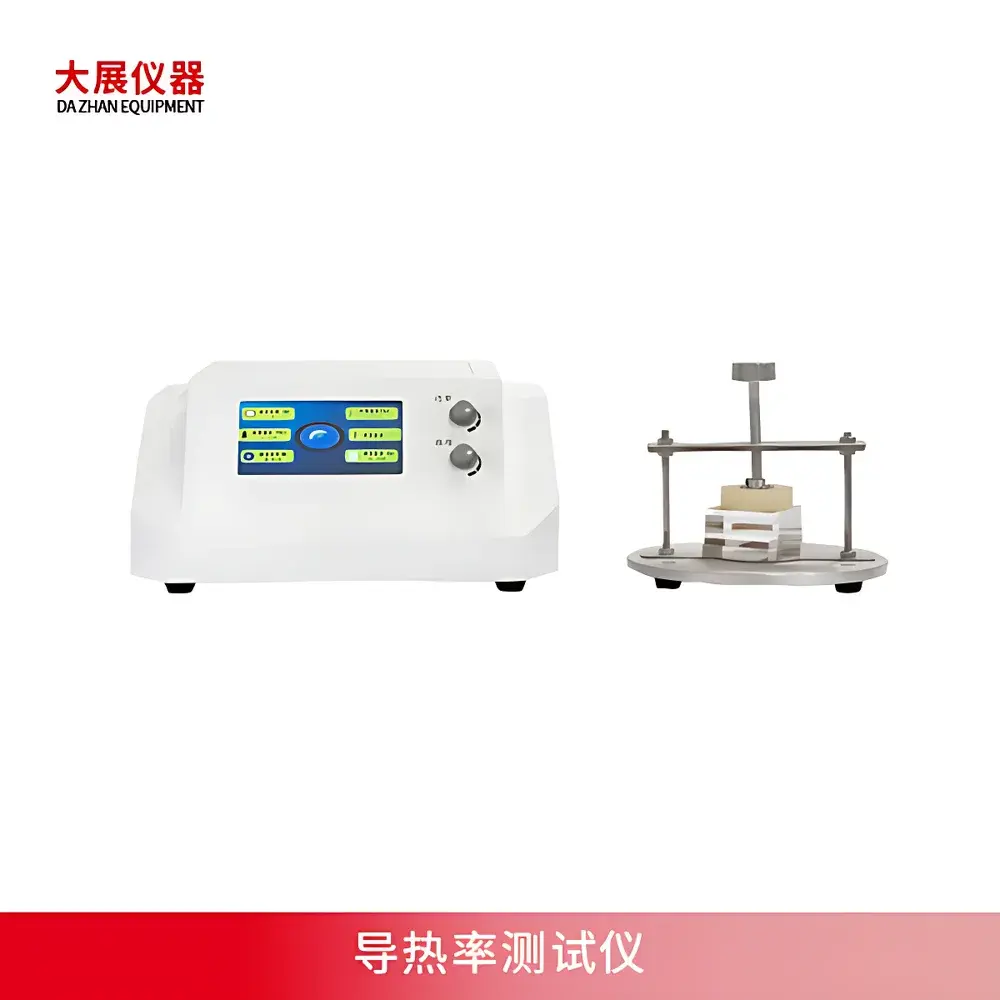
Nanjing Dazhan DZDR-S Transient Plane Source (TPS) Thermal Conductivity Analyzer
| Brand | Nanjing Dazhan |
|---|---|
| Origin | Jiangsu, China |
| Manufacturer Type | Direct Manufacturer |
| Instrument Type | Transient Plane Source (TPS) Method |
| Sample Throughput | Single-sample mode |
| Operating Environment | Ambient temperature (20–30 °C) |
| Thermal Conductivity Range | 0.0001–300 W/(m·K) |
| Accuracy | ±3% |
| Repeatability | ≤3% |
| Sample Forms | Liquids, powders, solids (including metals), gels, pastes, thin films, coatings, and insulating materials |
| Probe Options | 7.5 mm, 15 mm, and 50 mm diameter (standard) |
| Measurement Duration | 5–160 s (user-configurable) |
| Temperature Range | Room temperature to 130 °C |
| Power Supply | AC 220 V, <500 W |
| Minimum Sample Dimensions | ≥15×15×3.75 mm (for 7.5 mm probe), ≥30×30×7.5 mm (for 15 mm probe), ≥50×50×7.5 mm (for 50 mm probe) |
| Powder Test Kit | Included (customizable container set) |
Overview
The Nanjing Dazhan DZDR-S Transient Plane Source (TPS) Thermal Conductivity Analyzer is a precision instrument engineered for rapid, non-destructive measurement of thermal conductivity across a broad spectrum of homogeneous and heterogeneous materials. It operates on the internationally standardized transient plane source method—defined in ISO 22007-2 and ASTM D7984—where a thin, double-helix resistive sensor serves simultaneously as both heating element and temperature detector. When embedded at the interface between two identical sample halves (or placed on the surface of a single thick sample), the probe delivers a controlled step-input of electrical energy. The resulting transient temperature rise is recorded with microsecond resolution, enabling direct calculation of thermal conductivity via analytical solutions to the heat diffusion equation in an infinite medium approximation. This principle eliminates reliance on steady-state equilibrium, thereby reducing test duration to seconds while preserving metrological traceability. The system is calibrated against NIST-traceable reference materials and validated for use in R&D labs, quality control environments, and academic thermal transport studies.
Key Features
- True TPS methodology compliant with ISO 22007-2 and ASTM D7984 for primary thermal conductivity determination
- Three interchangeable probe diameters (7.5 mm, 15 mm, 50 mm) optimized for diverse sample geometries and thermal diffusivity ranges
- Non-invasive, non-destructive testing: samples remain intact and reusable post-measurement
- No specialized sample preparation required—flatness tolerance relaxed to ±0.1 mm over probe-contact area; minimal dimensional constraints per probe size
- Integrated high-resolution data acquisition IC ensures signal fidelity with 24-bit ADC sampling and noise-immune analog front-end design
- Intuitive 7-inch capacitive touchscreen interface with multilingual GUI (English default), real-time curve visualization, and on-device result export
- Thermal stability maintained via passive thermal shielding and ambient-temperature operation; optional heated sample stage supports measurements up to 130 °C
Sample Compatibility & Compliance
The DZDR-S accommodates a wide range of physical states without phase-specific hardware modification: bulk solids (metals, ceramics, polymers), low-density insulators (aerogels, foams), viscous liquids, suspensions, slurries, pastes, gels, powdered compacts, and thin-film laminates. Its dual-role probe design eliminates contact resistance artifacts common in guarded-hot-plate or laser-flash systems. All measurement protocols adhere to GLP-aligned documentation practices, supporting audit-ready data logs with timestamps, operator ID, environmental metadata, and raw voltage-vs.-time traces. While not FDA 21 CFR Part 11-certified out-of-the-box, the software architecture supports integration with validated LIMS environments through CSV/Excel export and configurable audit trail parameters.
Software & Data Management
Bundled DZDR-Control Suite v3.2 provides full instrument orchestration, automated calibration verification, and ISO-compliant uncertainty propagation per GUM (Guide to the Expression of Uncertainty in Measurement). Each measurement session generates a structured report containing thermal conductivity (W/(m·K)), thermal diffusivity (mm²/s), volumetric heat capacity (MJ/(m³·K)), confidence intervals, and residual fit diagnostics. Raw binary data files (.dtd) are stored with embedded metadata (probe ID, ambient RH/T, firmware version) and can be reprocessed using updated algorithms. Export formats include CSV (for Excel/Python analysis), PDF (print-ready reports), and XML (LIMS ingestion). Software updates are delivered via secure HTTPS portal with SHA-256 integrity verification.
Applications
- Thermal interface material (TIM) qualification for electronics cooling (e.g., greases, pads, phase-change materials)
- Quality assurance of insulation products including mineral wool, phenolic foams, and vacuum-insulated panels
- Characterization of battery electrode composites and solid-state electrolytes in energy storage R&D
- Validation of additive manufacturing build parameters via layer-wise thermal property mapping
- Geotechnical assessment of soil thermal resistivity for underground cable rating standards (IEC 60287)
- Pharmaceutical excipient screening where thermal stability impacts lyophilization cycle design
- Academic research in nanocomposites, metamaterials, and phonon-engineered structures
FAQ
What standards does the DZDR-S comply with?
The instrument implements the transient plane source method as specified in ISO 22007-2 and ASTM D7984. Calibration procedures follow ISO/IEC 17025 principles, and reference materials are certified by national metrology institutes.
Can the DZDR-S measure anisotropic materials?
Yes—by orienting the probe normal to principal axes and performing orthogonal measurements, directional thermal conductivity tensors can be estimated for layered or fiber-reinforced composites.
Is vacuum or inert gas enclosure supported?
The base configuration operates in ambient air; optional sealed sample chamber accessories enable controlled-atmosphere testing (N₂, Ar, vacuum down to 10⁻² mbar) to suppress convection artifacts in low-conductivity materials.
How is probe calibration maintained over time?
Each probe includes embedded NTC thermistors and factory-characterized resistance-temperature coefficients. Users perform quarterly verification using supplied glycerol and sapphire reference standards; drift correction is applied automatically during software startup.
Does the system support automated batch testing?
The DZDR-Control Suite includes scriptable measurement sequences and API access (RESTful JSON interface) for integration into automated lab workflows and robotic sample handlers.



