
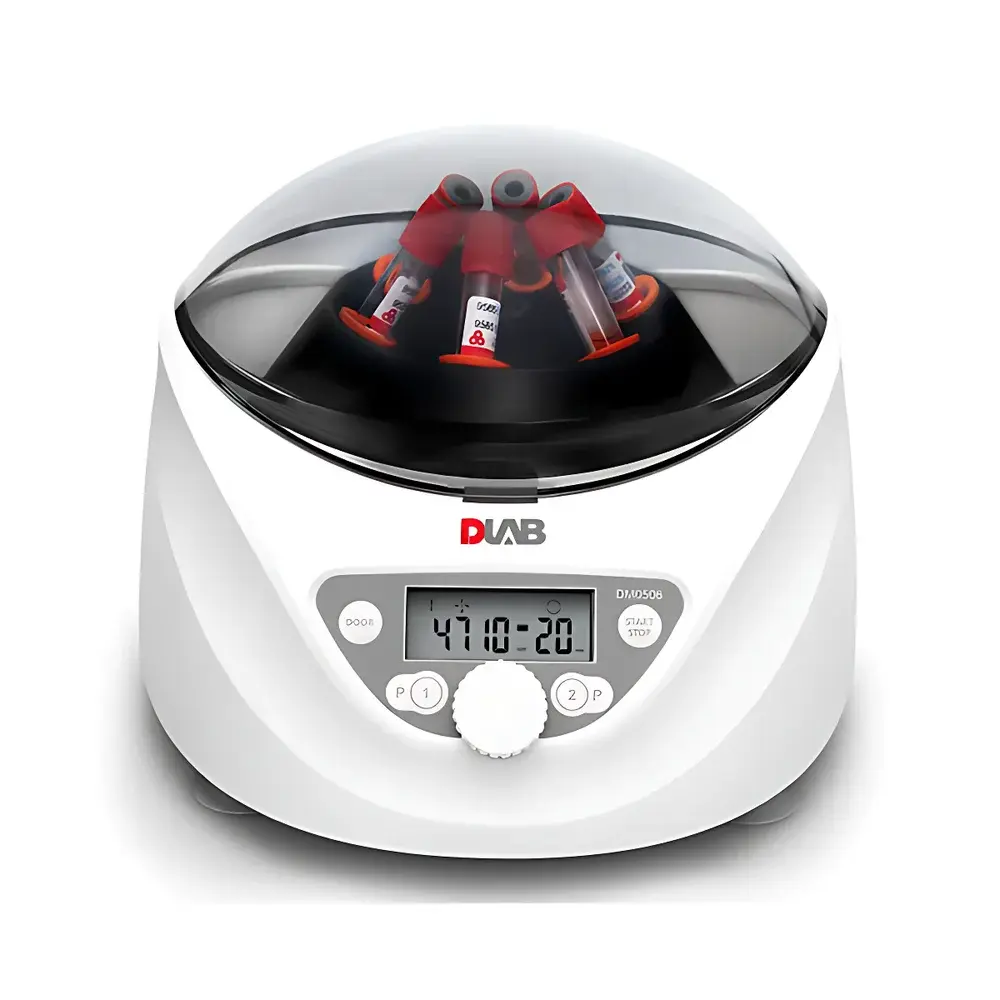
DLAB DM0506 Benchtop Low-Speed Centrifuge
| Brand | DLAB |
|---|---|
| Origin | Beijing, China |
| Manufacturer Type | Direct Manufacturer |
| Instrument Type | Benchtop Centrifuge |
| Speed Range | 300–5000 rpm (10 rpm increments) |
| Max RCF | 2600 × g (10 × g increments) |
| Rotor Capacity | 6 × 15 mL (also compatible with 10 mL, 7 mL, and 1.5–5 mL tubes) |
| Timer Range | 30 s – 99 min + Continuous Mode |
| Acceleration/Deceleration | 1-stage acceleration / 2-stage deceleration (adjustable) |
| Speed Accuracy | ±20 rpm |
| Noise Level | ≤52 dB(A) |
| Power Supply | 100–240 V AC, 50/60 Hz, 70 W |
| Dimensions (L×W×H) | 300 × 240 × 180 mm |
| Weight | 5.2 kg |
| Safety Features | Lid interlock, overspeed protection, real-time status diagnostics |
| Display | LCD with dual-unit (rpm/RCF) toggle, progress bar, audible end-of-run alert |
| Motor | Brushless DC motor |
| Compliance | Designed for GLP-compliant laboratories |
| rotor geometry conforms to ISO 15195 | 2019 (clinical centrifuge performance requirements) |
Overview
The DLAB DM0506 is a compact, high-reliability benchtop low-speed centrifuge engineered for routine clinical, environmental, and academic laboratory workflows requiring gentle yet precise sedimentation of biological suspensions. Operating on the principle of radial acceleration-induced phase separation, the DM0506 generates controlled relative centrifugal force (RCF) to pellet cells, bacteria, erythrocytes, or precipitated analytes without compromising structural integrity—critical for downstream assays such as ELISA, PCR template preparation, or urinalysis sediment analysis. Its fixed-angle rotor A6-15P is statically balanced per ISO 15195:2019 Annex B and calibrated to deliver reproducible RCF distribution across all six positions. With a maximum speed of 5000 rpm and corresponding RCF of 2600 × g, the unit occupies a defined niche between microcentrifuges and high-speed preparative models—optimized for applications where thermal stability, low mechanical stress, and operator ergonomics are prioritized over ultra-high g-forces.
Key Features
- Brushless DC motor architecture ensures maintenance-free operation, extended service life, and consistent torque delivery across the full speed range (300–5000 rpm).
- Dual-mode acceleration/deceleration control: single-step ramp-up for rapid spin initiation; two-stage programmable braking (soft/hard) minimizes resuspension of delicate pellets during deceleration.
- LCD interface with real-time rpm/RCF dual-unit display, visual progress bar, and audible end-cycle notification—including automatic lid release post-run to facilitate sample cooling and reduce condensation buildup.
- Two user-programmable protocols (P1/P2) support rapid recall of frequently used parameters—ideal for standardized clinical workflows in hospital labs or teaching laboratories.
- Integrated safety system includes electromechanical lid interlock, hardware-based overspeed cutoff, and continuous diagnostic monitoring of motor current, temperature, and rotor imbalance.
- Acoustically optimized housing and precision-balanced A6-15P rotor (constructed from reinforced polymer alloy) achieve ≤52 dB(A) operational noise—meeting WHO-recommended ambient noise thresholds for shared lab environments.
Sample Compatibility & Compliance
The DM0506 accommodates standard conical-bottom polypropylene tubes (1.5–15 mL) in fixed-angle configuration, supporting common clinical formats including Vacutainer®-size 10 mL and 15 mL tubes, as well as microcentrifuge tubes down to 1.5 mL. Rotor geometry ensures uniform wall-to-wall pellet formation without vortexing artifacts. All mechanical and electrical design elements comply with IEC 61010-1:2010 (Safety Requirements for Electrical Equipment for Measurement, Control, and Laboratory Use). The instrument supports audit-ready documentation practices: time-stamped run logs (including speed, RCF, duration, and error codes) are retained in non-volatile memory and exportable via manual recordkeeping—fully compatible with GLP and ISO/IEC 17025 quality management frameworks.
Software & Data Management
While the DM0506 operates as a standalone instrument without PC connectivity, its embedded firmware implements robust data integrity safeguards. Each run stores timestamped metadata (start time, selected program, final speed, elapsed time, fault flags) in persistent memory with overwrite protection. The LCD interface provides immediate visual verification of parameter entry and real-time deviation alerts (e.g., excessive vibration detected during spin-up). For regulated environments, the device meets foundational requirements for FDA 21 CFR Part 11 compliance when paired with documented SOPs—specifically, operator identity is enforced via procedural controls (e.g., sign-off sheets), and electronic records are generated only through human-readable screen displays traceable to individual runs.
Applications
- Clinical diagnostics: Separation of serum/plasma from whole blood (EDTA, heparin, or citrate anticoagulated samples); urinary sediment concentration prior to microscopic examination.
- Environmental testing: Clarification of water filtrates for heavy metal analysis or microbial enumeration (e.g., membrane filtration followed by centrifugal concentration).
- Academic research: Harvesting bacterial cultures (E. coli, Bacillus spp.) at mid-log phase; pelleting mammalian cell lines for RNA extraction or immunoblotting prep.
- Quality control labs: Routine particulate removal from reagent stocks or buffer solutions prior to filtration sterilization.
- Veterinary practice: Processing capillary blood samples from small-animal patients using microhematocrit tubes.
FAQ
What tube sizes are supported by the A6-15P rotor?
The fixed-angle rotor accepts six tubes simultaneously in the following configurations: 15 mL, 10 mL, 7 mL, or 1.5–5 mL conical-bottom centrifuge tubes.
Is the DM0506 suitable for use with infectious samples?
Yes—when operated inside a certified biosafety cabinet and fitted with sealed tube caps, the unit complies with BSL-2 containment requirements for centrifugation of clinical specimens.
Does the centrifuge meet international electromagnetic compatibility (EMC) standards?
Yes—it conforms to IEC 61326-1:2012 for electromagnetic emissions and immunity in laboratory environments.
Can the rotor be autoclaved?
No—the A6-15P rotor is constructed from chemically resistant polymer alloy and is cleaned via surface wipe with 70% ethanol or isopropanol; autoclaving would compromise dimensional stability and balance certification.
How is calibration verified during routine maintenance?
Speed accuracy (±20 rpm) and timer fidelity are validated using NIST-traceable tachometers and stopwatches per manufacturer-recommended quarterly checks; no field-adjustable calibration constants are exposed to end users.



