
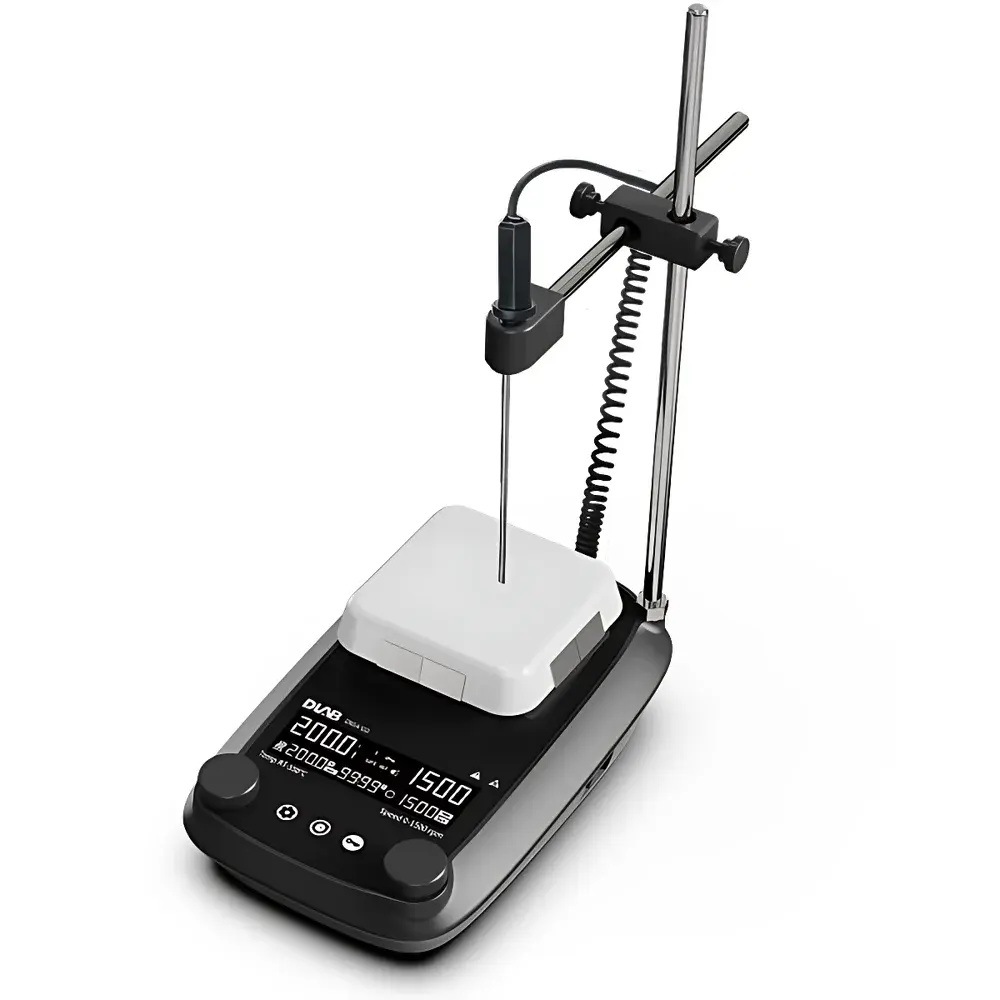
DLAB DMS4-550 LCD Digital Magnetic Stirrer with 4-inch Ceramic Glass Heating Plate
| Brand | DLAB |
|---|---|
| Origin | Beijing, China |
| Manufacturer Type | Direct Manufacturer |
| Instrument Type | Magnetic Stirrer |
| Max Stirring Volume | 10 L (water) |
| Speed Range | 50–1500 rpm (1-rpm increment) |
| Heating Temperature Range | Ambient to 550 °C (1 °C increment) |
| Control Accuracy | ±1 °C (<100 °C) / ±1% (>100 °C) |
| External Sensor | PT1000 (±0.2 °C) |
| Display | Dual LCD for speed & temperature |
| Timer | 1 min – 99 h 59 min |
| Interface | RS232 |
| IP Rating | IP21 |
| Motor | Brushless DC (10 W output, 460 W total power) |
| Plate Dimensions | 100 × 100 mm (4-inch square) |
| Plate Material | Ceramic-coated glass |
| Max Stir Bar Length | 40 mm |
| Overheat Protection | 580 °C cutoff |
| Residual Heat Warning | Active at >50 °C |
| Weight | 2.2 kg |
| Dimensions (L×W×H) | 270 × 175 × 108 mm |
Overview
The DLAB DMS4-550 is a high-performance, digitally controlled magnetic stirrer integrating precise heating and robust stirring capabilities in a compact benchtop format. Engineered for reproducible thermal and mechanical control in synthetic chemistry, materials science, and quality control laboratories, it operates on the principle of rotating magnetic field coupling—where a microprocessor-synchronized brushless DC motor drives a permanent magnet array beneath a thermally stable ceramic-glass plate. This design generates a uniform, high-intensity magnetic field across the entire 100 × 100 mm working surface (IP21-rated enclosure), enabling reliable agitation of viscous media—including polymer solutions, molten salts, and concentrated suspensions—up to 10 L volume (water-equivalent). The unit supports both open-loop heating and closed-loop temperature regulation via optional external PT1000 probe feedback, delivering ±1 °C stability below 100 °C and ±1% accuracy above—meeting routine requirements for ASTM E29–23-compliant thermal protocol execution.
Key Features
- Ceramic-glass top plate (100 × 100 mm): Chemically inert, scratch-resistant, and thermally shock-resistant up to 550 °C; enables rapid heat transfer and effortless decontamination after corrosive reagent use.
- Brushless DC motor: Eliminates carbon brush wear and electrical arcing—ensuring >20,000 hours MTBF, silent operation (<45 dB(A)), and zero maintenance over extended duty cycles.
- Dual-parameter LCD interface: Simultaneously displays real-time speed (50–1500 rpm, 1-rpm resolution) and plate or probe temperature (0.1 °C resolution), with intuitive navigation and parameter lockout via safety key.
- Precision thermal management: Internal heater (410 W thermal output) coupled with adaptive PID algorithm; external PT1000 sensor input (±0.2 °C certified) enables sample-centric temperature control compliant with ISO/IEC 17025 method validation guidelines.
- Comprehensive safety architecture: Hardware-enforced 580 °C thermal cutoff, residual heat warning indicator (>50 °C surface), acoustic fault alert (three-tone buzzer), and programmable timer with auto-shutdown (1 min to 99 h 59 min).
- RS232 serial interface: Enables remote parameter configuration, real-time data logging, and integration into LIMS or ELN systems—supporting audit-ready traceability per FDA 21 CFR Part 11 when paired with validated software.
Sample Compatibility & Compliance
The DMS4-550 accommodates standard laboratory glassware (round-bottom flasks, beakers, reaction vials) up to 500 mL nominal capacity under direct contact; larger vessels (e.g., 2–10 L jacketed reactors) may be used with appropriate stir bar geometry (max. 40 mm length, ≥8 mm diameter). Its ceramic-glass surface resists attack from strong acids (HNO₃, HCl), alkalis (NaOH/KOH), and organic solvents—making it suitable for Grignard reactions, Fischer esterification, and catalyst screening workflows. The device conforms to IEC 61010-1:2010 safety standards for laboratory electrical equipment and meets EMC requirements per EN 61326-1. While not intrinsically rated for hazardous locations, its sealed motor housing and non-sparking drive satisfy general-purpose Class I, Division 2 environments under NFPA 70.
Software & Data Management
Via the included RS232 cable and optional DLAB LabControl™ PC software (Windows-compatible), users can configure multi-step protocols—such as ramp-hold sequences, speed/temperature interlocks, and event-triggered data capture. All parameter changes, runtime logs, and alarm events are timestamped and exportable as CSV or PDF reports. When deployed in GLP/GMP-regulated settings, the system supports electronic signature authentication, user access levels (admin/operator), and immutable audit trails—fully aligning with ALCOA+ data integrity principles. Firmware updates are delivered through secure USB-to-serial bridges, with version history retained in non-volatile memory.
Applications
- Synthetic organic chemistry: Controlled reflux conditions for Suzuki couplings, amidation, and nitration where precise thermal ramping and homogeneous mixing prevent side-product formation.
- Materials synthesis: Sol-gel processing of metal oxides (TiO₂, SiO₂), nanoparticle dispersion in viscous precursors, and thermal curing of epoxy resins under inert atmosphere.
- Pharmaceutical QC: Dissolution testing support (USP ), buffer preparation, and standard solution homogenization prior to HPLC or titration analysis.
- Environmental testing: Digestion of soil/sediment samples in EPA Method 3050B acid matrices, requiring sustained 150–200 °C operation with mechanical stability.
- Academic teaching labs: Modular platform for kinetics experiments (e.g., iodine clock), Arrhenius parameter determination, and calorimetric calibration exercises.
FAQ
What is the maximum recommended vessel size for optimal stirring performance?
For consistent vortex formation and thermal uniformity, use round-bottom flasks ≤500 mL or beakers ≤1 L directly on the plate. Larger volumes (up to 10 L) require oversized stir bars and careful positioning to maintain magnetic coupling efficiency.
Can the DMS4-550 be used under inert gas or vacuum conditions?
Yes—provided the vessel is appropriately sealed and the stir bar is chemically compatible. Avoid prolonged operation above 400 °C under vacuum due to potential outgassing from internal insulation materials.
Is the PT1000 probe included by default?
No—the external PT1000 temperature probe is an optional accessory (order code: DMS-PT1000). The base unit relies on internal plate sensing; probe integration enables sample-temperature-critical applications.
Does the RS232 interface support Modbus RTU or only proprietary protocol?
It implements DLAB’s ASCII-based command set only. Modbus compatibility requires third-party protocol translation hardware or middleware integration.
How often should calibration verification be performed?
Per ISO/IEC 17025, verify speed accuracy annually using a calibrated tachometer and temperature accuracy quarterly using NIST-traceable dry-block calibrators—especially before critical validation studies.



