
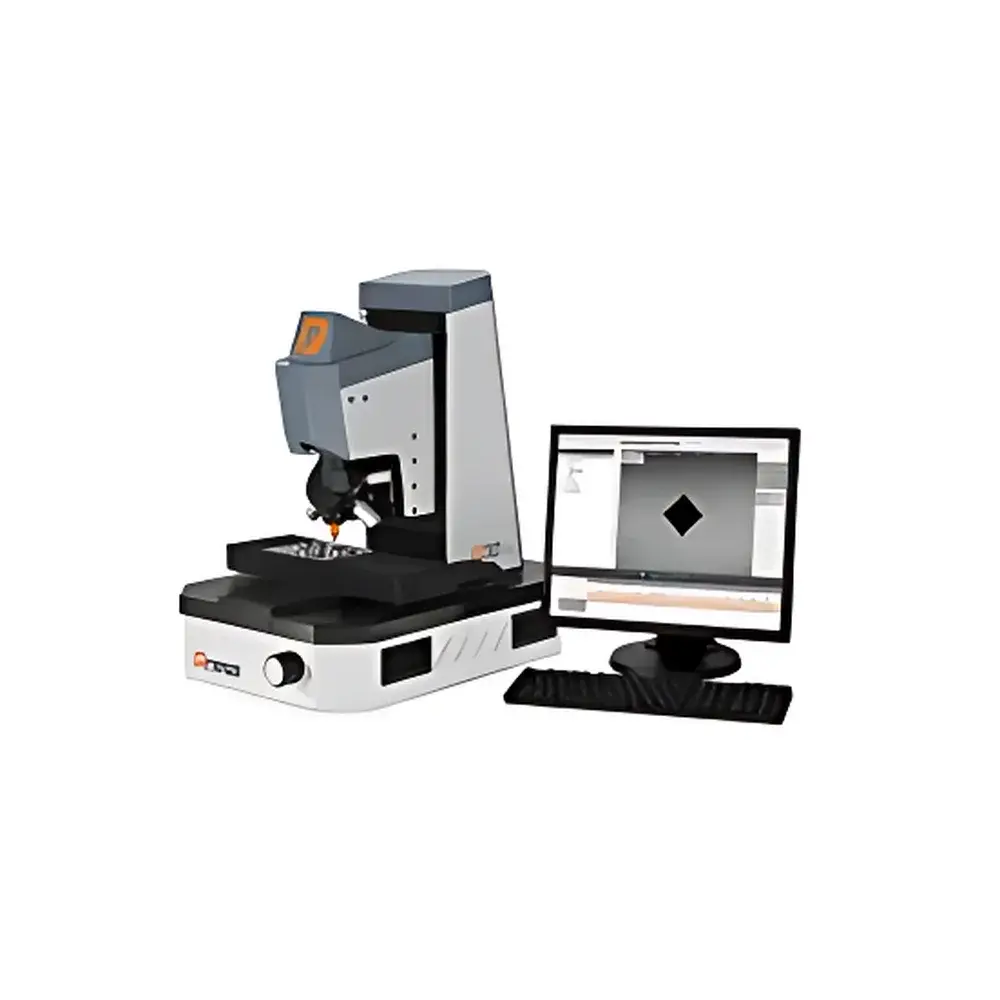
Qness Q10/Q30/60M Semi-Automatic Vickers Hardness Tester by QATM (Austria)
| Brand | QATM |
|---|---|
| Origin | Austria |
| Model | Q10 / Q30 / Q60M Semi-Automatic Vickers Hardness Tester |
| Automation Level | Semi-Automatic with Motorized Turret and Auto-Focus |
| Turret Positions | 6-position motorized turret |
| Display | 12″ industrial touchscreen IPC |
| Software | Qpix Control v5.x with GLP-compliant audit trail |
| Data Export | CSV, PDF, Excel-compatible reports |
| Compliance | ASTM E384, ISO 6507-1, EN ISO 1463, USP <1054> (for hardness validation workflows) |
| Safety | User-level access control (3-tier permission system) |
| Sample Stage | Motorized X-Y-Z stage with dynamic Z-height compensation |
| Imaging | Integrated high-resolution monochrome CMOS camera, 2× optical zoom per objective, real-time edge detection and indentation recognition |
Overview
The Qness Q10/Q30/Q60M series represents QATM’s flagship line of semi-automatic Vickers microhardness testers, engineered in Graz, Austria for precision metrology in R&D laboratories, quality control departments, and accredited testing facilities. Based on the standardized Vickers indentation principle—where a diamond pyramid indenter (136° apex angle) is applied under controlled static load to produce a geometrically defined impression—the system delivers traceable hardness values (HV) in accordance with ASTM E384 and ISO 6507-1. Unlike fully manual or basic semi-automatic systems, the Qness platform integrates closed-loop force control via electromagnetic loading, eliminating mechanical wear and ensuring long-term repeatability (±0.5% load accuracy over full range). Its modular architecture supports test loads from 0.01 kgf to 60 kgf (Q60M), enabling both microhardness (e.g., thin coatings, case-hardened layers) and macrohardness applications (e.g., forged alloys, weld zones) within a single instrument.
Key Features
- 6-position motorized turret with automatic tool change—enabling seamless switching between indenters (Vickers, Knoop, optional Rockwell) and objectives without manual intervention
- Dynamic Z-axis height compensation—adjusts focus position in real time during stage movement to maintain optimal image plane across uneven or tilted samples
- Intelligent indentation recognition engine—uses adaptive thresholding and morphological filtering to detect indents on non-ideal surfaces (e.g., etched, oxidized, or lightly abraded specimens), reducing dependence on perfect metallographic preparation
- Template-based testing workflow—users define spatial patterns (grids, arcs, custom contours) once; subsequent samples are auto-registered and measured with sub-micron positional fidelity using reference point matching
- 12″ ruggedized industrial PC touchscreen interface—hosting Qpix Control v5.x software with intuitive drag-and-drop sample mapping, multi-process queue management, and real-time progress visualization
- Full GLP/GMP readiness—audit trail logs all user actions, parameter changes, calibration events, and result modifications with timestamps and operator IDs; compliant with FDA 21 CFR Part 11 requirements when configured with electronic signature modules
Sample Compatibility & Compliance
The Qness accommodates specimens up to 200 mm × 200 mm × 120 mm (W × L × H) with optional custom stage inserts. Standard clamping fixtures support flat, cylindrical, and irregular geometries—including gear teeth, turbine blades, and sintered components—via configurable vacuum or mechanical chucks. All measurement protocols adhere to international standards: indentation dwell time, load application rate, and diagonal measurement methodology conform to ISO 6507-1 and ASTM E92/E384. For regulatory submissions, raw image data, metadata (load, dwell time, objective, ambient temperature), and processed results are stored in a tamper-evident database with SHA-256 hash verification. Calibration certificates traceable to PTB (Physikalisch-Technische Bundesanstalt) and NIST are available upon request.
Software & Data Management
Qpix Control v5.x provides a unified environment for method development, execution, and post-processing. Test methods—including load sequence, dwell duration, grid spacing, and stop conditions (e.g., “halt when CHD depth reaches 0.8 mm”)—are saved as reusable XML templates. Image analysis employs sub-pixel edge detection algorithms to measure indentation diagonals with ±0.1 µm resolution. Statistical outputs include histograms, trend charts, box plots, and Cpk capability indices—all exportable to CSV or native Excel (.xlsx) format. Reports generate automatically in A4 PDF with embedded images, metadata, and digital signatures. Data archiving supports network drive mapping, SQL database integration (Microsoft SQL Server or PostgreSQL), and scheduled backups with version history retention.
Applications
The Qness platform serves critical roles across metallurgy, aerospace, medical device manufacturing, and additive manufacturing. Typical use cases include: depth profiling of carburized or nitrided case depths (CHD); hardness mapping across weld heat-affected zones (HAZ); evaluation of thermal barrier coating (TBC) adhesion integrity; qualification of powder metallurgy compacts; and microstructural hardness correlation in dual-phase steels. In pharmaceutical manufacturing, it supports hardness validation of tablet cores per USP . Its robust mechanical design and environmental stability (operating range: 15–30 °C, <60% RH non-condensing) ensure consistent performance in ISO Class 7 cleanrooms and production-floor QC labs alike.
FAQ
Does the Qness system support Knoop hardness testing?
Yes—when equipped with a Knoop indenter and appropriate objective lens, the Qness platform calculates HK values per ASTM E384 using the same imaging and analysis pipeline.
Can test methods be locked to prevent unauthorized modification?
Yes—administrator-defined method templates can be set to “read-only” mode with role-based permissions enforced at login.
Is third-party LIMS integration supported?
Yes—Qpix Control provides RESTful API endpoints and HL7-compliant data export for bidirectional communication with laboratory information management systems.
What maintenance is required for the electromagnetic loading mechanism?
None—the contactless load application system has no consumable parts, requires no periodic recalibration, and maintains factory-certified accuracy for ≥5 years under normal operating conditions.
How is measurement uncertainty quantified and reported?
Uncertainty budgets follow EURACHEM/CITAC Guide CG4, incorporating contributions from load cell accuracy, image pixel resolution, stage positioning error, and operator repeatability—automatically calculated and appended to each report.



