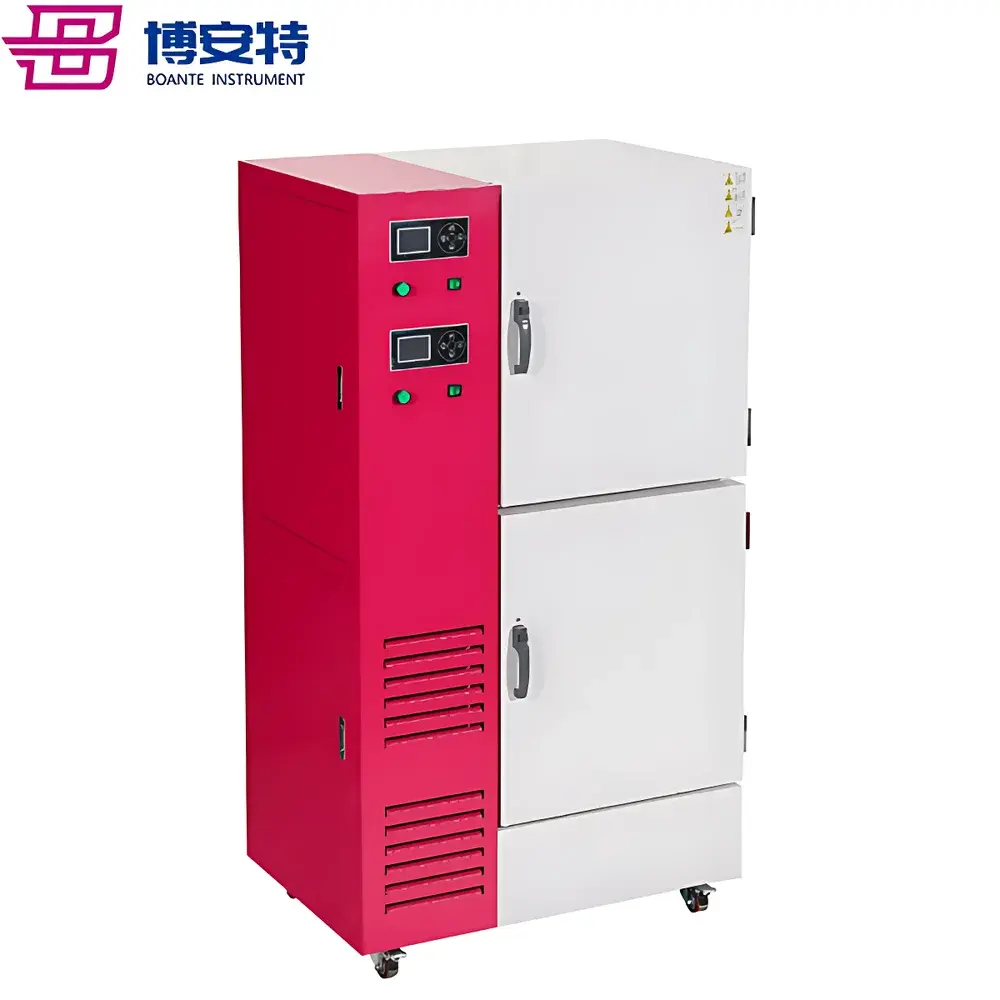
Boante BAT-GZ-M / BAT-QH-M Series Single-Sided Illuminated Programmable Growth Incubator
| Brand | Boante |
|---|---|
| Model | BAT70/150/250/360/460/600GZ-M or BAT70/150/250/360/460/600QH-M |
| Temperature Range | 5–50 °C |
| Temperature Uniformity | ±1 °C (at same level) |
| Humidity Range (QH-M only) | 40–80 %RH (with light on), 50–90 %RH (with light off), within 15–45 °C operating range |
| Humidity Control Accuracy | ±1 %RH |
| Illuminance | Up to 12,000 lx (adjustable in 6 levels, measured at 100 mm from LED source) |
| Light Source | 4000 K white LED array mounted on door |
| Control Interface | 4.3″ color LCD (GZ-M) or optional 7″ touch screen (QH-M) |
| Programming | 30-segment ramp-soak profile with real-time countdown |
| Cooling System | Balanced refrigeration with auto-defrost heat-pump cycle |
| Interior Power Outlet | 220 V AC, 10 A |
| Chamber Volume | 70 / 150 / 250 / 360 / 460 / 600 L |
| Safety Protections | Compressor overheat, fan overheat, overtemperature, high-pressure cutout, overload protection |
Overview
The Boante BAT-GZ-M and BAT-QH-M Series Single-Sided Illuminated Programmable Growth Incubators are engineered for precise environmental simulation in plant physiology, photobiology, seed germination, algal culture, and circadian rhythm studies. Unlike conventional incubators, these units integrate directional, spectrally stable illumination directly into the front door—enabling controlled unilateral light exposure while maintaining thermal and hygric stability across the chamber volume. The system operates on a dual-control architecture: a self-tuning dual-loop PID algorithm governs temperature regulation to suppress overshoot and ensure spatial uniformity (±1 °C at any single horizontal plane), while the QH-M variant adds independent humidity control via integrated ultrasonic humidification and condensation-based dehumidification. All models comply with fundamental laboratory safety standards (IEC 61010-1) and support GLP-aligned operational traceability through timestamped event logging and power-failure recovery.
Key Features
- Single-sided 4000 K white LED illumination (10,000–12,000 lx at 100 mm), mounted on insulated inner door to minimize thermal load and eliminate shadowing artifacts
- 30-step programmable controller supporting independent ramp/soak sequences for temperature, light intensity (6-level discrete or continuous via optional touch interface), and—on QH-M models—relative humidity
- Self-adaptive dual-PID temperature regulation with anti-overshoot logic and real-time thermal mapping feedback
- Balanced refrigeration system with heat-pump-assisted auto-defrost, enabling uninterrupted operation during extended cultivation cycles
- Double-glazed tempered glass observation door with low-emissivity coating preserves internal climate integrity during visual inspection
- Stainless steel interior with removable, height-adjustable shelves (3–4 tiers depending on model); all shelves rated for ≥15 kg loading per level
- Integrated 220 V/10 A power outlet inside chamber for auxiliary devices (e.g., CO₂ sensors, small pumps, or data loggers)
- Comprehensive safety suite: compressor overheat cutoff, fan stall detection, independent overtemperature limiter, refrigerant high-pressure switch, and motor overload protection
Sample Compatibility & Compliance
These incubators accommodate standard tissue culture vessels (e.g., Petri dishes, Magenta boxes, growth jars), multi-well plates, hydroponic trays, and small potted specimens up to 30 cm tall (depending on shelf spacing). The GZ-M series is optimized for light–temperature interaction studies where humidity is externally managed or non-critical; the QH-M series meets ISO 17025-relevant environmental control requirements for humidity-sensitive protocols—including fungal sporulation assays and desiccation tolerance screening. Both variants support audit-ready documentation when paired with optional RS485 interface and thermal printer: logged parameters include setpoints, actual readings, alarm events, and power interruption timestamps—all compliant with basic FDA 21 CFR Part 11 data integrity expectations (electronic signature capability requires external authentication layer).
Software & Data Management
The standard 4.3″ color LCD provides real-time display of current temperature, light level, and (QH-M only) RH%, alongside elapsed time and remaining program duration. Optional 7″ capacitive touchscreen enables graphical profile editing, USB data export (CSV format), and firmware updates. An RS485 port supports Modbus RTU protocol for integration into centralized lab monitoring systems (e.g., LabVIEW, Ignition SCADA). When connected to a compatible thermal printer, the unit generates hard-copy records of temperature excursions, door-open events, and program completion—critical for QA/QC documentation in academic core facilities and contract research organizations. All stored logs retain battery-backed memory for ≥72 hours during mains failure.
Applications
- Photoperiod-controlled plant growth assays (Arabidopsis, rice, lettuce) under defined spectral irradiance
- Light-dependent enzyme activity profiling and photomorphogenesis studies
- Algal biomass production with diurnal light cycling and temperature modulation
- Seed dormancy release experiments requiring synchronized light pulses and thermal priming
- Microbial phototaxis evaluation using directional illumination gradients
- Pre-acclimation protocols for stress physiology (e.g., high-light + elevated temperature co-stress)
- Long-term viability testing of biologics and cell lines under variable illumination conditions
FAQ
What is the difference between GZ-M and QH-M models?
The GZ-M series provides temperature and light control only; humidity is not regulated. The QH-M series adds full-range humidity control (40–90 %RH) with independent sensor feedback and active humidification/dehumidification.
Can I mount external sensors inside the chamber?
Yes—the built-in 220 V/10 A outlet and unobstructed interior volume allow integration of third-party probes (e.g., PAR meters, CO₂ analyzers) without compromising airflow or thermal homogeneity.
Is the light spectrum tunable?
Standard configuration uses fixed 4000 K white LEDs. Optional multi-channel LED modules (red/blue/far-red) are available under custom order (BAT-QH-M-LED-MS) for spectral quality studies.
How is temperature uniformity validated?
Uniformity is verified per ISO 15378 Annex C methodology: nine-point mapping (3×3 grid) at mid-height, with maximum deviation ≤±1 °C under steady-state conditions at 25 °C and 50 %RH (QH-M).
Does the incubator support remote monitoring?
Via optional Wi-Fi module and Boante Cloud Connect, users can receive SMS/email alerts and view live parameters through a secure web dashboard or dedicated WeChat Mini Program—no local server required.