
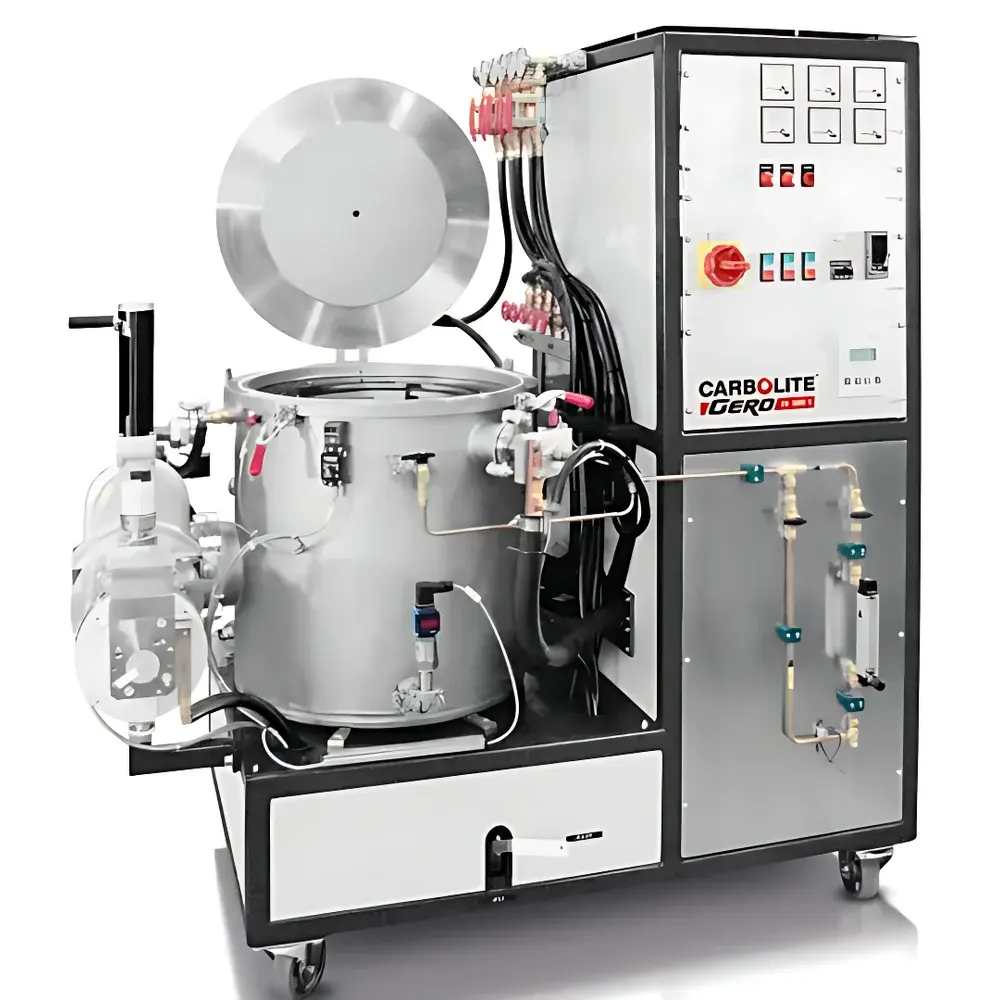
Carbolite Gero LHT Series High-Temperature Laboratory Furnace
| Brand | Carbolite Gero |
|---|---|
| Origin | Germany |
| Instrument Type | Tube Furnace |
| Max Temperature | 3000 °C (Graphite), 2200 °C (Tungsten), 1600 °C (Molybdenum) |
| Atmosphere Options | High Vacuum (down to 1×10⁻⁶ mbar) or Controlled Protective Gases (e.g., H₂, Ar, N₂) |
| Pressure Control Range | 10–1000 mbar |
| Safety Certification | TÜV-certified for operation with toxic and flammable gases |
| Control System Options | Manual operation or fully automated Siemens PLC + WinCC SCADA interface |
| Data Logging | Integrated process data recording compliant with GLP/GMP traceability requirements |
| Heating Element Materials | Graphite, Molybdenum, or Tungsten |
| Chamber Construction | Customizable internal dimensions |
| Compliance | Designed to meet ISO 9001 manufacturing standards |
Overview
The Carbolite Gero LHT Series is a modular high-temperature tube furnace engineered for precision thermal processing under vacuum, inert, reducing, or reactive atmospheres. Based on Couette-type radiant heating architecture and optimized multi-layer insulation design, the LHT platform delivers exceptional thermal uniformity and long-term stability across extreme temperature ranges—from ambient up to 3000 °C in graphite configurations. Its core engineering addresses critical challenges in advanced materials research and industrial R&D: maintaining ultra-low outgassing rates in high-vacuum environments (<1×10⁻⁶ mbar), enabling precise partial-pressure control of hydrogen or other reactive gases, and sustaining mechanical integrity of heating elements and insulation during rapid thermal cycling. The furnace is not a generic heating chamber but a process-integrated system—designed for reproducible sintering, carburization, silicidation, and pyrolysis protocols where atmosphere purity, pressure stability, and thermal ramp fidelity directly determine microstructural outcomes.
Key Features
- Triple-material heating element compatibility: Graphite (up to 3000 °C), tungsten (up to 2200 °C), and molybdenum (up to 1600 °C)—each selected for optimal emissivity, creep resistance, and chemical compatibility with target atmospheres.
- TÜV-certified safety architecture, including redundant overtemperature protection, gas-leak interlocks, and explosion-proof purge sequencing—validated for continuous operation with H₂, CO, or NH₃ at pressures from 10 to 1000 mbar.
- Modular vacuum integration: Direct coupling to turbomolecular pumping stations with integrated cold traps; pre-evacuation ramp control prevents powder fluidization during initial pump-down.
- High-purity process chamber variants: LHTM (molybdenum-lined) and LHTW (tungsten-lined) models minimize metallic contamination for semiconductor-grade sintering or battery cathode synthesis.
- Siemens S7-1200/1500 PLC backbone with WinCC Unified visualization enables deterministic sequence execution, recipe-based parameter loading, and real-time deviation monitoring against setpoints.
- Comprehensive data acquisition: Time-stamped temperature, pressure, flow, and power logs stored locally and exportable in CSV/Excel format; optional 21 CFR Part 11-compliant electronic signature and audit trail module available.
Sample Compatibility & Compliance
The LHT accommodates diverse sample geometries—including crucibles (graphite, ceramic, or refractory metal), boat assemblies, and custom fixtures—within customizable internal diameters (ID) ranging from 50 mm to 300 mm and lengths up to 1200 mm. Its low-outgassing chamber lining and high-efficiency gettering support sensitive applications such as lithium-ion cathode precursor calcination, SiC epitaxial layer annealing, and TiAl alloy brazing under ultra-high-purity argon. The system complies with ISO 15148:2017 for thermal processing equipment validation and supports IQ/OQ/PQ documentation packages aligned with pharmaceutical and aerospace quality systems. All electrical and gas interfaces conform to IEC 61000-6-4 (EMC) and EN 60204-1 (machine safety).
Software & Data Management
Control firmware is built on a deterministic real-time OS supporting synchronized multi-channel PID loops (temperature, pressure, gas flow). The WinCC Unified HMI provides dual-mode operation: technician-level manual tuning via intuitive sliders and engineer-level batch programming using structured text (ST) or sequential function chart (SFC) logic. Process data—including thermocouple readings (Type C, B, or S), Pirani and capacitance manometer outputs, and mass flow controller setpoints—are archived with millisecond resolution. Exported datasets include metadata tags (operator ID, recipe version, calibration certificate expiry), satisfying GLP audit requirements. Optional cloud gateway enables remote diagnostics and predictive maintenance alerts based on heater resistance drift trends.
Applications
- Advanced ceramics: Solid-state reaction synthesis of MAX phases, spark plasma sintering (SPS) pre-heating, and controlled-carbon-loss densification of SiC composites.
- Energy materials: Cathode material (NMC, LFP) calcination under oxygen-controlled atmospheres; anode pre-lithiation under Ar/H₂ mixtures.
- Aerospace alloys: Vacuum brazing of nickel superalloys using BNi-2 filler metals; stress-relief annealing of additive-manufactured Ti-6Al-4V components.
- Nanomaterials: Catalytic graphitization of carbon nanotubes; metal-organic framework (MOF) pyrolysis to porous carbons.
- Electronics: Rapid thermal processing (RTP) of GaN-on-Si wafers; diffusion barrier formation in Cu interconnect stacks.
FAQ
What vacuum level can the LHT achieve, and how is it maintained during heating?
The LHT achieves base pressures down to 1×10⁻⁶ mbar using integrated turbomolecular pumping; active cooling of hot-zone shields and graphite insulation minimizes thermal desorption, ensuring stable vacuum during ramp-hold-cool cycles.
Is the furnace suitable for hydrogen atmosphere sintering of tungsten heavy alloys?
Yes—LHTW configurations with tungsten heating elements and tungsten-rhenium thermocouples are specifically validated for H₂-atmosphere sintering up to 2200 °C, with pressure regulation accuracy ±0.5% FS across 10–1000 mbar range.
How is temperature uniformity verified across the hot zone?
Uniformity is characterized per ASTM E220 using a 5-point thermocouple mapping procedure at three representative temperatures (1200 °C, 1800 °C, 2400 °C); standard LHT models guarantee ±5 °C over 100 mm axial length at maximum operating temperature.
Can the system be integrated into an existing factory MES or LIMS?
Yes—the OPC UA server embedded in the Siemens PLC enables secure, bidirectional data exchange with enterprise systems; pre-built connectors for LabVantage, Thermo Fisher SampleManager, and Siemens Opcenter are available upon request.
What maintenance intervals are recommended for graphite heating elements under cyclic 2500 °C operation?
Graphite elements require visual inspection every 200 operational hours above 2200 °C; typical service life exceeds 1,200 hours when operated within specified vacuum and atmosphere purity limits (H₂O < 1 ppm, O₂ < 0.1 ppm).



