
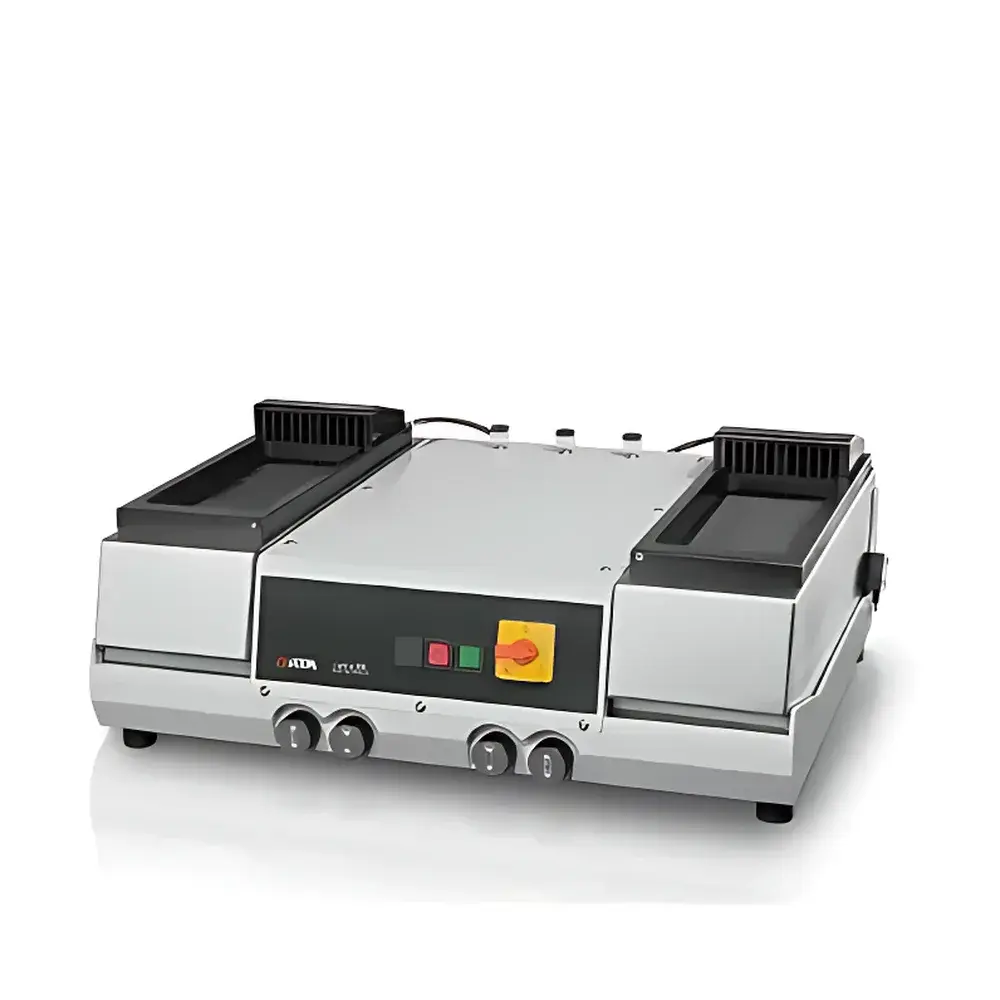
QATM QGRIND 100 Wet Dual-Belt Pre-Grinding Machine
| Brand | QATM |
|---|---|
| Origin | Germany |
| Model | QGRIND 100 |
| Belt Speed | 7 m/s |
| Belt Dimensions | 100 × 920 mm / 100 × 915 mm |
| Number of Grinding Belts | 2 |
| Overall Dimensions (L×W×D) | 630 × 250 × 520 mm |
| Weight | ~55 kg |
| Power Supply | 1.4 kVA (0.75 kW, S6/60% duty cycle) |
| Water Inlet | R½", max. 6 bar |
| Water Outlets | dual Ø40 mm (left & right) |
| Cooling | integrated water-cooled wet grinding system |
Overview
The QATM QGRIND 100 is a precision-engineered, wet dual-belt pre-grinding machine designed for controlled, reproducible material removal in metallurgical, ceramic, and composite sample preparation workflows. Operating on the principle of continuous abrasive belt grinding under regulated water cooling, it delivers consistent surface conditioning prior to fine polishing or microstructural analysis. Unlike single-belt systems, its dual-belt architecture enables sequential coarse-to-fine pre-grinding in a single pass—reducing manual handling, minimizing edge rounding, and improving planarity across heterogeneous samples. The machine is built to meet the mechanical stability and ergonomic requirements of ISO 14971–compliant laboratory environments and supports GLP-aligned documentation when integrated into validated sample prep SOPs.
Key Features
- Dual independent abrasive belts (100 × 920 mm and 100 × 915 mm) mounted on rigid, vibration-damped aluminum frames for uniform contact pressure and long-term alignment stability.
- Adjustable belt centering mechanism with calibrated micrometer dials—enabling precise lateral positioning without tools to maintain optimal belt tracking and minimize premature wear.
- Integrated water management system: pressurized inlet (R½”, up to 6 bar), dual Ø40 mm gravity-fed outlets (left/right), and internal flow channels that direct coolant directly to the grinding interface—ensuring effective debris suspension and thermal control during extended operation.
- Robust drive train delivering constant linear belt velocity of 7 m/s, independent of load fluctuations, via frequency-controlled AC motor (0.75 kW, S6/60% intermittent duty rating).
- Compact footprint (630 × 250 × 520 mm) and modular base design facilitate integration into standard fume hoods or dedicated sample prep benches without requiring floor anchoring.
- Electrical compliance with IEC 61000-6-2 (immunity) and IEC 61000-6-4 (emission); CE-marked per Machinery Directive 2006/42/EC and Low Voltage Directive 2014/35/EU.
Sample Compatibility & Compliance
The QGRIND 100 accommodates flat or slightly contoured specimens up to 100 mm in width and 50 mm in height—including metallographic mounts (phenolic, epoxy, acrylic), sintered ceramics, geological thin sections, and polymer composites. Its wet grinding mode eliminates dry heat buildup, preventing phase transformation in sensitive alloys (e.g., Ti-6Al-4V, austenitic stainless steels) and avoiding resin degradation in embedded samples. The system complies with ASTM E3–22 (Standard Guide for Preparation of Metallographic Specimens) and ISO 15510 (Metallic materials — Metallographic specimen preparation). When operated within documented maintenance intervals and calibrated using traceable reference standards, it supports audit readiness for ISO/IEC 17025-accredited laboratories.
Software & Data Management
The QGRIND 100 is a standalone electromechanical instrument with no embedded firmware or digital interface. All operational parameters—including belt speed, water pressure, and runtime—are manually set and monitored via analog gauges and mechanical controls. This architecture ensures deterministic behavior, eliminates cybersecurity vulnerabilities, and simplifies validation under FDA 21 CFR Part 11 Annex 11 requirements where electronic records are not mandated. For labs implementing digital SOPs, optional external logging (e.g., via PLC-connected flow meters or time-stamped video capture) may be deployed to satisfy ALCOA+ data integrity principles without modifying the base unit.
Applications
- Rapid removal of saw marks and machining artifacts from cross-sectioned welds, castings, and additively manufactured components prior to etching or SEM imaging.
- Uniform thickness reduction of brittle materials (e.g., silicon wafers, optical glasses, ferrites) where wheel-based grinding risks chipping or subsurface damage.
- Preparation of large-area samples for automated EBSD mapping—where planarity and minimal deformation are critical for pattern indexing accuracy.
- Batch pre-grinding of embedded samples in high-throughput QA/QC labs serving aerospace, power generation, and automotive sectors.
- Conditioning of reference blocks used in hardness calibration (e.g., per ASTM E10, E18, E384) to ensure geometric conformity and surface integrity.
FAQ
Is the QGRIND 100 compatible with automated sample loading systems?
No—it is manually loaded and unloaded; its design prioritizes operator control and tactile feedback over automation integration.
Can non-aqueous coolants be used?
No—only deionized or tap water is approved; use of oil-based or glycol solutions voids warranty and risks seal degradation.
What belt grit ranges are recommended for initial setup?
Typical sequencing: P80–P120 on the first belt, followed by P180–P220 on the second; exact selection depends on material hardness and downstream polishing protocol.
Does QATM provide IQ/OQ documentation packages?
Yes—factory-verified Installation Qualification (IQ) and Operational Qualification (OQ) protocols are available upon request, aligned with ISO 9001:2015 and GMP Annex 15 expectations.
How often must the water filtration system be serviced?
The inline filter cartridge requires replacement every 200 operating hours or quarterly—whichever occurs first—to maintain flow consistency and prevent nozzle clogging.



