
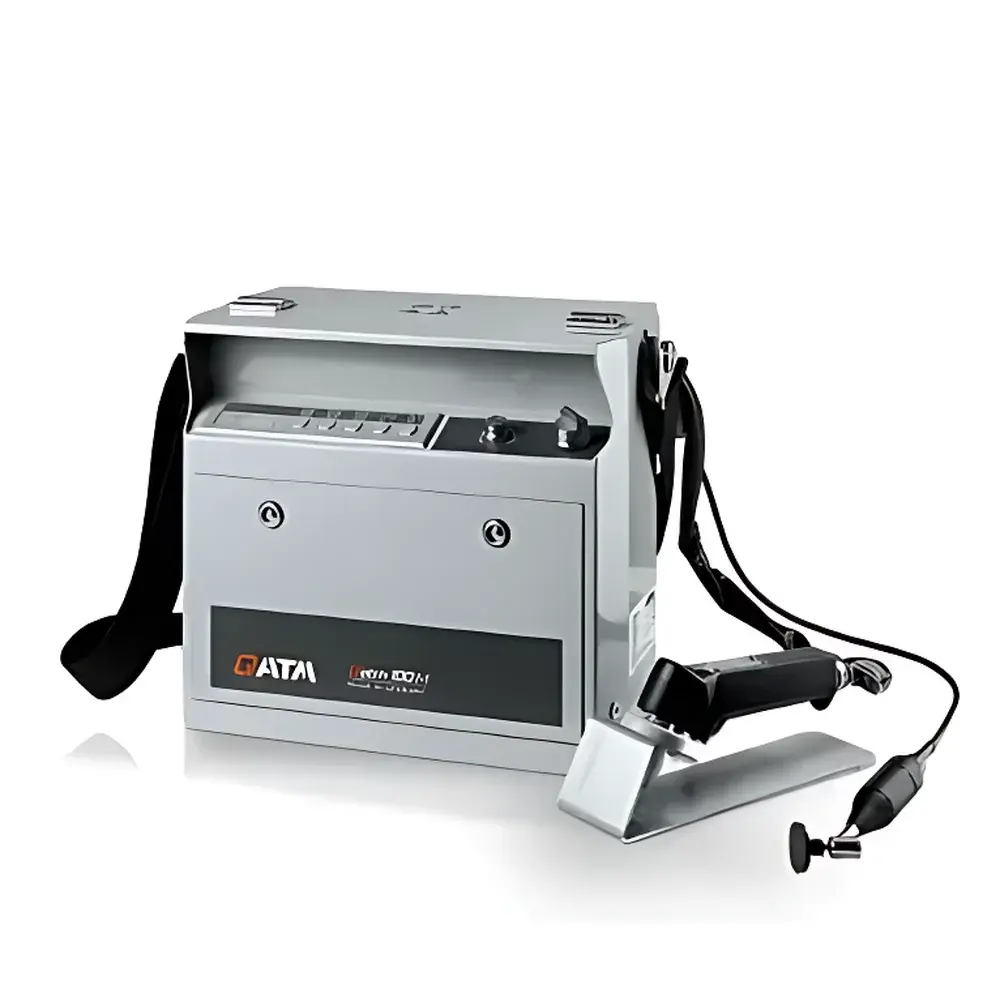
QATM QETCH 100M Portable Battery-Powered Electrolytic Polishing and Etching Unit
| Brand | QATM |
|---|---|
| Origin | Germany |
| Model | QETCH 100M |
| Dimensions (L×W×D) | 380 × 355 × 180 mm |
| Max. Power | 160 W |
| Max. Voltage | 90 V DC |
| Max. Current | 2 A |
| Electrolyte Capacity | 1 L |
| Weight | ~8.5 kg (without electrolyte) |
| Operating Mode | Microprocessor-Controlled Automatic Cycle |
| Display | Color LED + LCD (showing real-time voltage, current, elapsed time) |
| Polishing Area | Ø ~9 mm |
| Power Source | Rechargeable Lithium-Ion Battery |
Overview
The QATM QETCH 100M is a compact, battery-operated electrolytic polishing and etching unit engineered for high-precision metallographic sample preparation in both laboratory and field environments. Unlike conventional AC-powered units requiring fixed infrastructure, the QETCH 100M employs controlled direct-current (DC) electrolysis to selectively remove surface material from conductive metallic specimens—enabling artifact-free surface finishing for optical microscopy, SEM imaging, and microstructural analysis. Its core operating principle relies on Faraday’s laws of electrolysis: under precisely regulated voltage and current, anodic dissolution occurs at the specimen surface immersed in a compatible electrolyte (e.g., oxalic acid for aluminum, perchloric-ethanol for stainless steel), yielding uniform, non-deformed surfaces without mechanical smearing or heat-affected zones. Designed for metallurgical labs, failure analysis centers, and on-site quality assurance teams, the unit delivers reproducible results across diverse alloys—including ferrous and non-ferrous metals, superalloys, and sintered materials—while eliminating dependency on mains power or compressed air.
Key Features
- Integrated lithium-ion battery system enabling up to 4–6 hours of continuous operation per charge—ideal for remote inspections, plant floor audits, or mobile lab deployments.
- Microprocessor-controlled automatic cycle with programmable voltage (0–90 V DC), current limit (0–2 A), and time duration (0–300 s), ensuring repeatability across operators and shifts.
- Dual-display interface: color LED status indicator for rapid visual feedback (e.g., “Ready”, “Running”, “Error”) and high-contrast LCD showing real-time operational parameters—voltage, current, elapsed time, and selected program ID.
- Robust anodized aluminum housing with protective resin coating, rated IP54 for dust and splash resistance; all critical electronics and fluid pathways are shock-mounted and sealed against vibration-induced failure.
- Ergonomic design featuring integrated carrying handle and detachable shoulder strap—optimized for single-hand transport and stable handheld operation during vertical or overhead sample positioning.
- Modular electrolyte reservoir (1 L capacity) with quick-release lid, level sensor, and corrosion-resistant PTFE-coated internal components; compatible with standard ASTM E407 and ISO 3887 electrolytes.
Sample Compatibility & Compliance
The QETCH 100M supports standardized electrolytic preparation of flat, conductive metallographic specimens up to Ø 9 mm diameter, including but not limited to carbon steels, austenitic and ferritic stainless steels, aluminum alloys, copper, titanium, nickel-based superalloys, and tungsten carbide composites. Specimen mounting (cold-mount or hot-mount) must ensure electrical continuity via conductive adhesive or clamping. The unit complies with IEC 61000-6-3 (EMC emission standards) and IEC 61000-6-2 (immunity requirements). Its control firmware adheres to GLP-aligned logging practices: all executed cycles are timestamped and stored internally (up to 500 records), supporting audit-ready traceability per ISO/IEC 17025 and ASTM E3-22 requirements for metallographic method validation.
Software & Data Management
While the QETCH 100M operates autonomously via its onboard controller, optional QATM LabLink software (Windows-compatible, USB connection) enables advanced configuration, firmware updates, and export of cycle logs in CSV format. Each log includes operator ID (assignable via keypad), program number, start/end timestamps, mean voltage/current values, and deviation alerts. Data export meets FDA 21 CFR Part 11 readiness when used with validated user access controls and electronic signature workflows. No cloud connectivity or remote telemetry is implemented—ensuring full data sovereignty and alignment with industrial cybersecurity policies.
Applications
- Routine quality control of weld zones, heat-affected zones (HAZ), and additive manufacturing builds in aerospace and energy sectors.
- Failure analysis of fracture surfaces where mechanical polishing would obscure fatigue striations or intergranular cracking.
- Preparation of TEM foil precursors via electropolishing thinning—when paired with QATM’s precision jig systems.
- On-site verification of surface integrity following thermal spray, cladding, or electroplating processes.
- Educational metallography labs requiring safe, low-voltage, plug-and-play electrolytic training tools compliant with EN 61000-1-1 safety directives.
FAQ
What electrolytes are compatible with the QETCH 100M?
Standard aqueous and organic electrolytes specified in ASTM E407, ISO 3887, and ASTM E1558 are supported—including 10% oxalic acid (Al), 20% sulfuric acid (Cu), and 10% perchloric acid in ethanol (stainless steels). Always consult QATM’s Material Compatibility Matrix before use.
Can the unit be used for electropolishing non-metallic conductive materials?
No. The QETCH 100M is designed exclusively for electrically conductive metallic specimens. Graphite, CMCs, or conductive ceramics require specialized voltage/current profiles outside this unit’s validated range.
Is calibration required prior to use?
The unit undergoes factory calibration for voltage and current sensors (traceable to PTB standards). Annual verification using NIST-traceable multimeters is recommended per ISO/IEC 17025 Clause 6.5.
How is maintenance performed on the electrolyte reservoir?
After each use, rinse the reservoir with deionized water and dry with nitrogen. Inspect O-rings quarterly; replace if cracked or swollen. QATM supplies certified replacement kits (P/N QETCH-RES-KIT-1L).
Does the battery support hot-swapping?
No. Battery replacement requires powering down the unit and accessing the rear service panel. Two swappable Li-ion packs (QATM P/N BAT-Q100M) are available for extended field deployment.



