
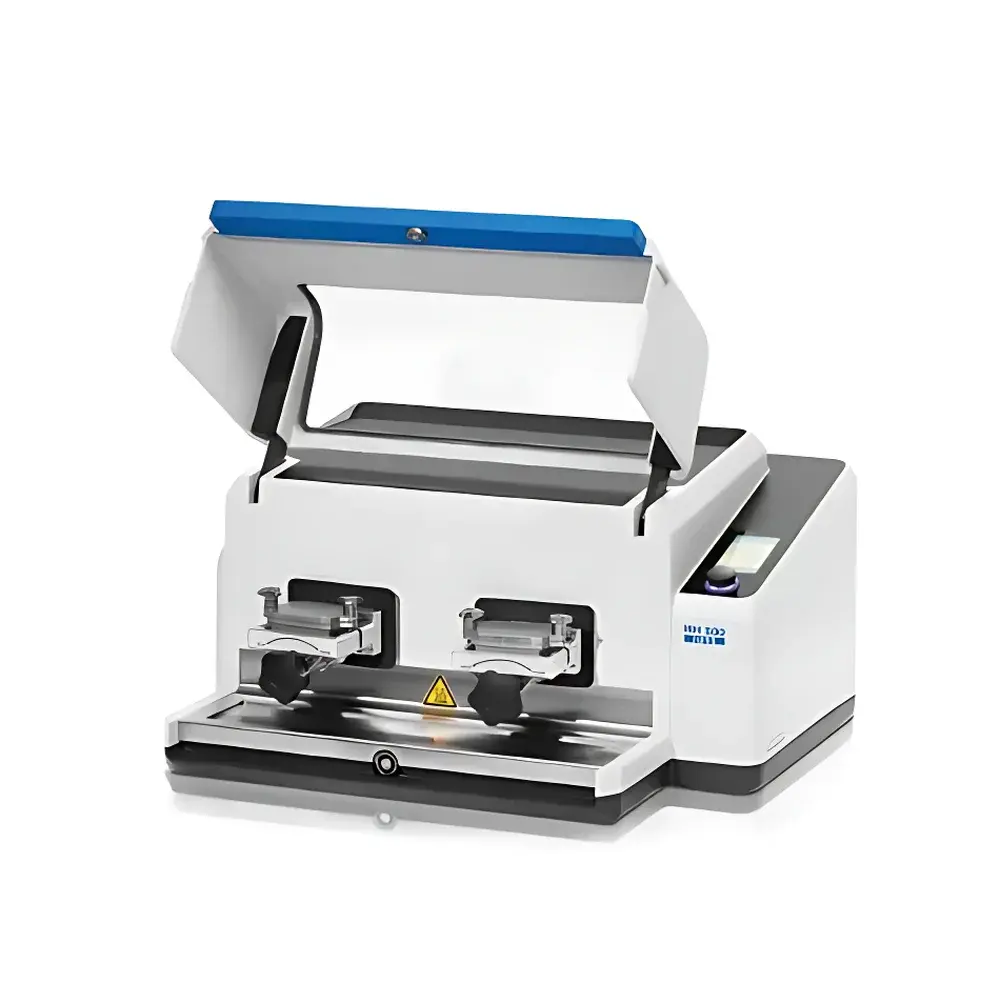
Retsch MM500 NANO High-Energy Mixer Mill
| Brand | Retsch |
|---|---|
| Origin | Germany |
| Model | MM500 NANO |
| Sample Type | Hard materials |
| Final Particle Size | ~0.1 µm |
| Max Feed Size | ≤ 10 mm |
| Batch Capacity | 2 × 45 mL |
| Frequency Range | 3–35 Hz (180–2100 min⁻¹) |
| Power Input | 750 W |
| Dimensions (W×H×D) | 690 × 375 × 585 mm |
| Weight | ~60 kg |
| Protection Class | IP 30 |
| Compliance | CE |
Overview
The Retsch MM500 NANO is a high-energy, dual-vial mixer mill engineered for reproducible nanoscale comminution of hard and brittle materials via mechanical impact and shear forces. Operating on the principle of horizontal oscillation with controlled frequency modulation (3–35 Hz), the instrument delivers intense kinetic energy transfer through stainless steel or tungsten carbide grinding balls—enabling consistent particle size reduction to approximately 0.1 µm without thermal degradation. Unlike planetary ball mills, the MM500 NANO employs a single-axis oscillatory motion that minimizes sample heating, eliminates centrifugal artifacts, and ensures uniform energy distribution across both vials simultaneously. Its robust cast-aluminum frame, precision-balanced drive system, and integrated vibration damping ensure long-term stability during extended operation—up to 99 hours continuous runtime—making it suitable for demanding applications in mechanochemistry, mechanical alloying, and nanostructured material synthesis.
Key Features
- Dual-vial configuration supports parallel processing of two independent samples (max. 2 × 45 mL per run), enhancing throughput and experimental reproducibility.
- Digital frequency control (3–35 Hz, resolution 0.1 Hz) enables precise tuning of impact energy—critical for balancing fragmentation efficiency against amorphization or phase transformation risks.
- Integrated touchscreen interface with ergonomic layout allows intuitive parameter entry, real-time status monitoring, and secure access control.
- Pre-programmed library of 12 SOPs and 4 customizable sequence protocols (repeatable up to 99 cycles) supports standardized workflows compliant with GLP and ISO/IEC 17025 documentation requirements.
- Compatible with cryogenic grinding using liquid nitrogen-cooled adapters, preserving thermolabile compounds and inhibiting recrystallization during milling.
- Tool-free clamping mechanism secures grinding jars (50 mL, 80 mL, or 125 mL variants) with screw-top lids—ensuring leak-proof containment for wet, dry, or solvent-based milling.
- Wide material compatibility for grinding media: hardened steel, stainless steel, tungsten carbide, and yttria-stabilized zirconia—selected based on sample reactivity, contamination limits, and desired wear resistance.
Sample Compatibility & Compliance
The MM500 NANO accommodates diverse sample classes including oxides, metals, alloys, pharmaceutical actives, geological matrices, polymers, ceramics, and biological tissues (when pre-frozen). It meets CE marking requirements and adheres to IEC 61000-6-2 (immunity) and IEC 61000-6-4 (emissions) standards. For regulated environments, its programmable audit trail functionality—including timestamped start/stop events, parameter logs, and user ID tracking—supports compliance with FDA 21 CFR Part 11 when integrated with validated LIMS or ELN platforms. Grinding jar materials are certified non-reactive per USP Class VI biological safety testing where applicable.
Software & Data Management
No proprietary software installation is required; all operational parameters are configured directly via the built-in capacitive touchscreen. The device stores full execution records—including frequency, duration, pause intervals, and cycle counts—for each run. Export options include USB-stored CSV files containing time-stamped metadata for traceability in quality-controlled laboratories. Optional integration with Retsch’s optional LabManager software enables remote monitoring, centralized protocol deployment, and automated report generation aligned with ISO 17025 clause 7.7 (result reporting).
Applications
- Mechanochemical synthesis of metal–organic frameworks (MOFs), co-crystals, and solid-state catalysts.
- Top-down nanomaterial fabrication from bulk precursors (e.g., TiO₂, SiC, Fe₂O₃).
- Homogenization of heterogeneous composites prior to XRD, SEM-EDS, or BET surface area analysis.
- Preparation of ultrafine reference materials for interlaboratory calibration studies.
- Cryomilling of heat-sensitive APIs to enhance dissolution kinetics without solvent exposure.
- Grinding of slag, fly ash, or mineral ores for geochemical assay preparation (ASTM D5630, ISO 12904).
- Rapid cell lysis of microbial pellets under cryogenic conditions for proteomic extraction.
FAQ
What is the maximum recommended operating frequency for routine nanogrinding?
The optimal frequency depends on sample hardness and desired fineness; however, 30–35 Hz is typically applied for sub-100 nm endpoint achievement with hard ceramics or metals.
Can the MM500 NANO be used for wet grinding with organic solvents?
Yes—provided compatible grinding jars (e.g., PTFE-lined or zirconia) and sealed caps are employed; solvent volume must not exceed 1/3 of jar capacity to prevent splashing and pressure buildup.
Is there an option for automated jar loading/unloading?
No—the MM500 NANO is manually loaded; however, its ergonomic clamping design and low center-of-gravity minimize operator fatigue during repeated batch handling.
How does the MM500 NANO compare to planetary ball mills regarding temperature rise?
Due to its linear oscillation geometry and absence of rotational friction losses, the MM500 NANO generates significantly less heat—typically maintaining sample temperatures below 40 °C even after 60 minutes at 35 Hz, whereas planetary mills often exceed 80 °C under equivalent conditions.
Are grinding jars supplied with the instrument?
Jars are sold separately to allow selection based on application-specific needs; common configurations include stainless steel (50 mL), tungsten carbide (50 mL), and zirconia (80 mL) variants.
Related Products



