
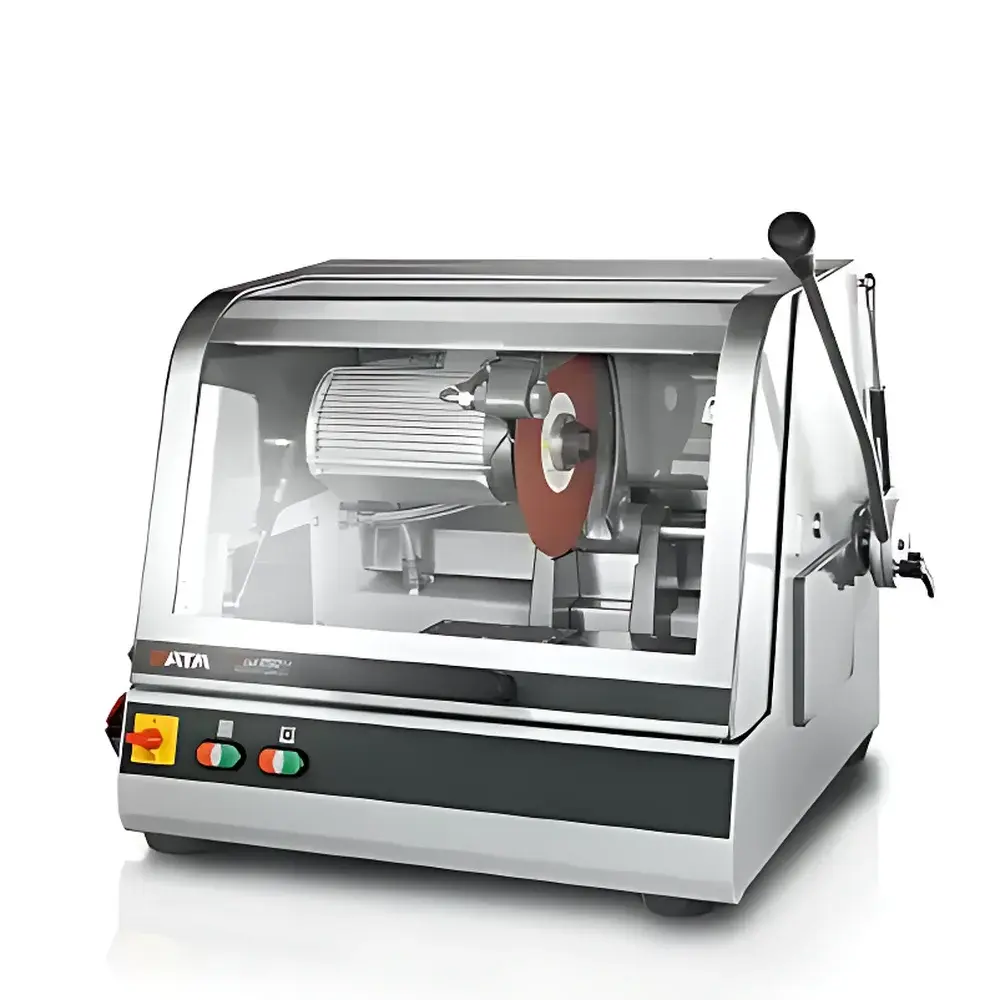
QATM Qcut 250 M Brilliant 200 Benchtop Wet Abrasive Cutting Machine
| Brand | QATM |
|---|---|
| Origin | Germany |
| Model | Qcut 250 M |
| Cutting Wheel Diameter | Up to Ø250 mm (10") |
| Max. Cutting Capacity | Ø55 mm (solid) / Ø90 mm (continuous cut, up to 25 mm length) |
| Spindle Flange Size | Ø32 mm |
| Y-axis (Vertical Stroke) | 145 mm |
| Worktable Dimensions | 350 × 288 mm (stainless steel, T-slot 12 mm) |
| Power Supply | 4.5 kVA |
| Rated Output (S6, 40% duty cycle) | 3 kW |
| Overall Dimensions (W×H×D) | 810 × 735 × 650 mm |
| Weight | ~75 kg |
| Safety | Interlocked transparent enclosure, integrated wheel coolant delivery, arc-shaped viewing window, powder-coated aluminum housing |
Overview
The QATM Qcut 250 M Brilliant 200 is a precision-engineered benchtop wet abrasive cutting machine designed for reliable, repeatable sample sectioning in metallurgical, materials science, and quality control laboratories. It operates on the principle of controlled mechanical abrasion using a rotating diamond- or silicon-carbide-impregnated wheel under continuous aqueous coolant flow—ensuring thermal stability, minimal artifact generation, and dimensional fidelity in cross-sectional preparation. Unlike automated or semi-automated systems, the Qcut 250 M emphasizes operator control and ergonomic accessibility without compromising structural rigidity or safety compliance. Its open-front architecture—enabled by a retractable front window that slides into the machine body—provides unobstructed access to the cutting chamber while maintaining full CE and ISO 12100-compliant safeguarding. The unit integrates coolant delivery directly into the wheel guard assembly, eliminating external hose routing and minimizing splash risk during operation.
Key Features
- Ergonomic front-access design with motorized or manual retraction of the transparent polycarbonate front window—reducing operator fatigue during repeated setup and post-cut inspection.
- Large-diameter viewing window with optimized arc geometry, delivering expanded field-of-view across the entire cutting zone for real-time monitoring of kerf width, wheel wear, and sample alignment.
- Stainless steel worktable (350 × 288 mm) featuring standardized 12 mm T-slots and interchangeable wear-resistant top plates—compatible with QATM’s modular clamping systems including the 80-series vise and custom fixture adapters.
- Integrated coolant manifold within the wheel guard ensures consistent, targeted fluid application at the wheel–sample interface—critical for suppressing heat-induced phase transformations in sensitive alloys and composites.
- Robust aluminum chassis with industrial-grade powder coating provides long-term corrosion resistance and mechanical damping, supporting stable cutting performance even under prolonged high-load cycles.
- Interlocked transparent enclosure meets EN ISO 13857 and EN 60204-1 requirements; door position sensors disable spindle rotation immediately upon opening, ensuring full compliance with laboratory safety protocols.
Sample Compatibility & Compliance
The Qcut 250 M accommodates a broad range of conductive and non-conductive specimens—including ferrous and non-ferrous metals, sintered carbides, ceramics, geological cores, and polymer composites—provided dimensional constraints are observed (max. Ø55 mm solid section; Ø90 mm for segmented or interrupted cuts ≤25 mm in depth). Its wet-cutting configuration satisfies ASTM E3-22 and ISO 14577 requirements for metallographic specimen preparation, and its closed-loop coolant containment system aligns with OSHA 1910.1200 (HCS) and EU REACH guidelines for workplace fluid management. All electrical components conform to IEC 61000-6-3 (EMC) and IEC 61000-6-4 (immunity), and the machine carries CE marking under the Machinery Directive 2006/42/EC.
Software & Data Management
As a manually operated instrument, the Qcut 250 M does not incorporate embedded firmware or digital control interfaces. However, it supports full traceability within GLP/GMP environments through optional integration with QATM’s Q-Mess documentation suite (sold separately), which enables timestamped operator ID logging, cutting parameter templates (wheel type, feed rate, coolant flow), and audit-ready PDF reports compliant with FDA 21 CFR Part 11 when paired with validated networked PCs. Physical calibration records—including spindle runout verification (<5 µm TIR) and table flatness certification (<0.02 mm/m)—are supplied with each unit and referenced in the factory certificate of conformance.
Applications
This system is routinely deployed in accredited metallurgical labs for preparing specimens prior to optical microscopy (OM), scanning electron microscopy (SEM), electron backscatter diffraction (EBSD), and microhardness testing (e.g., Vickers or Knoop). Its precise vertical stroke (145 mm Y-travel) and lateral accessibility enable sectioning of elongated samples—such as weld coupons, turbine blades, or extruded profiles—without requiring intermediate re-fixturing. In R&D settings, it serves as a primary tool for failure analysis workflows where preservation of interfacial integrity (e.g., coating–substrate boundaries or brazed joints) is essential. Universities utilize the Qcut 250 M in undergraduate materials labs due to its intuitive mechanical interface and low learning curve—facilitating hands-on instruction in safe, standards-aligned sample preparation methodology.
FAQ
Is the Qcut 250 M suitable for cutting hardened steels or tungsten carbide?
Yes—when equipped with an appropriate resin-bonded diamond wheel and maintained coolant flow, it achieves clean, low-distortion sections in materials up to 65 HRC.
Can third-party cutting wheels be used?
Only wheels meeting EN 12413 certification and bearing the manufacturer’s specified maximum RPM rating for Ø250 mm diameter may be installed; QATM recommends using OEM-branded wheels for warranty validity and performance consistency.
Does the machine require compressed air or external vacuum?
No—coolant circulation is gravity-fed or pump-assisted via optional external reservoir; no pneumatic or vacuum connections are necessary.
What maintenance intervals are recommended?
Daily: Coolant level and filter inspection; Weekly: T-slot debris removal and guide rail lubrication; Annually: Spindle bearing preload verification and electrical safety testing per IEC 62353.
Is remote service support available for international users?
Yes—QATM’s technical support team provides multilingual video-assisted diagnostics and supplies certified spare parts with documented traceability for regulatory submissions.



