
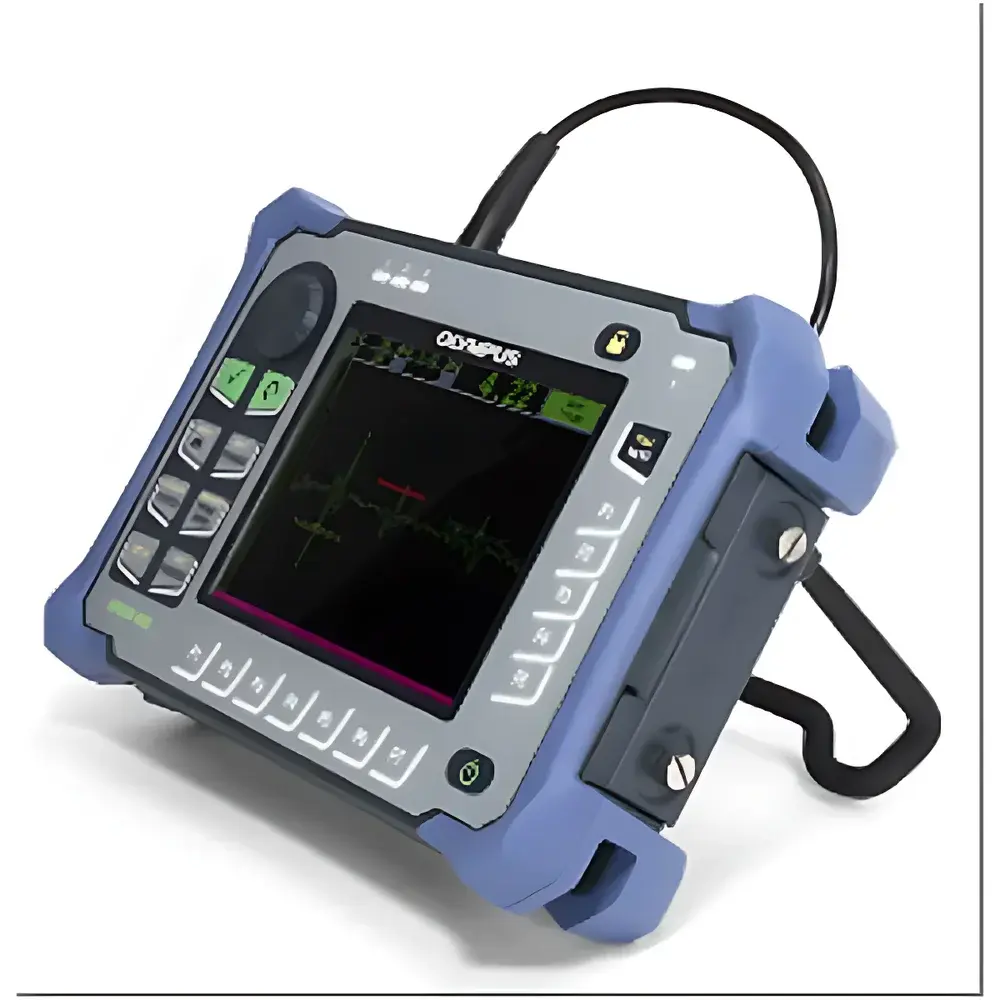
Olympus EPOCH 650 Digital Ultrasonic Flaw Detector
| Brand | Olympus |
|---|---|
| Origin | Japan |
| Model | EPOCH 650 |
| Instrument Type | Digital |
| Inspection Method | Pulse-Echo |
| Waveform Type | Pulsed Ultrasound |
| Compliance | EN 12668-1:2010 |
| IP Rating | IP66 (rotary knob), IP67 (keypad) |
| Operating Temperature | –10 °C to 50 °C |
| Weight | 1.6 kg (with Li-ion battery) |
| Display | Full VGA (640 × 480) transflective color LCD |
| Battery Life | >15 hours |
| PRF | 10–2000 Hz |
| Pulse Energy | 100–400 V |
| Pulse Width | 25 ns–5000 ns (PerfectSquare™) |
| Receiver Bandwidth | 0.2–26.5 MHz |
| Digital Filters | 30 standard, including 7 EN-compliant |
| Gain Range | 0–110 dB |
| Dynamic Range | 110 dB (DAC) |
| A-Scan Memory | 100,000 encoded records |
| Storage | Standard 2 GB microSD card |
| Interfaces | USB OTG, VGA, RS-232, analog output (optional), digital I/O, encoder input |
| Probe Connectors | Two BNC or LEMO No.1 |
| Certifications | MIL-STD-810F (shock/vibration/explosion-proof), NFPA 70 Class I, Div. 2, Group D |
Overview
The Olympus EPOCH 650 Digital Ultrasonic Flaw Detector is an industrial-grade, portable pulse-echo ultrasonic testing (UT) instrument engineered for high-fidelity flaw detection and thickness measurement in demanding field and laboratory environments. Based on time-of-flight diffraction (TOFD)-compatible pulse-echo architecture, the EPOCH 650 employs a digitally synthesized square-wave pulser (PerfectSquare™ technology) coupled with a high-dynamic-range (110 dB) wideband receiver (0.2–26.5 MHz) to deliver exceptional signal fidelity across diverse material types—including aluminum alloys, titanium, composites, and high-attenuation steels—commonly encountered in aerospace structural integrity verification. Its full VGA (640 × 480) transflective display ensures legibility under extreme ambient lighting—from dim hangar interiors to direct sunlight—while its ergonomic, ruggedized chassis meets IP66/IP67 ingress protection standards per IEC 60529 and passes MIL-STD-810F environmental qualification for shock (15 g, 11 ms half-sine), vibration (1 hr/axis), and operation in hazardous atmospheres (NFPA 70 Class I, Div. 2, Group D). Designed in accordance with EN 12668-1:2010 for performance verification of ultrasonic equipment, the EPOCH 650 serves as a reference-grade platform for certified NDT Level 2 and Level 3 personnel conducting ASTM E317-compliant inspections.
Key Features
- PerfectSquare™ adjustable square-wave pulser with energy levels from 100 V to 400 V and pulse width tunable from 25 ns to 5000 ns—enabling optimal excitation of broadband and narrowband transducers.
- Digital high-dynamic-range receiver with 30 programmable digital filters, including seven EN 12668-1–compliant bandwidths (e.g., 0.2–10 MHz, 2.0–21.5 MHz, 8.0–26.5 MHz) for precise noise suppression and resolution enhancement.
- Two fully independent measurement gates supporting simultaneous amplitude (%FSH) and time-of-flight (TOF) analysis—with gate start, width, and threshold independently adjustable across the entire display range.
- Full-screen A-scan mode optimized for maximum waveform clarity and real-time interpretation; supports dual-gate tracking, echo-to-echo thickness calculation, and dynamic DAC/TCG with up to 50 reference points.
- Integrated DGS/AVG evaluation with real-time distance-amplitude correction and equivalent reflector sizing (ERS), compliant with ISO 19285 and EN 1330-4 for quantitative defect assessment.
- Hardware-configurable interface options: rotary encoder (IP66-rated) for rapid coarse/fine parameter adjustment, or tactile keypad (IP67-rated) with directional navigation keys and dedicated function buttons for gain, freeze, save, and gate control.
- Battery-powered operation exceeding 15 hours on a single rechargeable Li-ion pack; hot-swappable microSD card (standard 2 GB) supports offline data logging of up to 100,000 encoded inspection records.
Sample Compatibility & Compliance
The EPOCH 650 is validated for use with standard contact, immersion, delay-line, and angle-beam transducers (BNC or LEMO No.1 interfaces), supporting velocity calibration from 635 m/s (e.g., polyethylene) to 15,240 m/s (e.g., beryllium). Its dual-probe ports enable simultaneous operation of transmitter/receiver pairs for pitch-catch configurations or phased array pre-scan setup. The instrument conforms to EN 12668-1:2010 for instrument performance verification and supports traceable calibration via automated zero-offset, sound velocity, and DAC curve generation per ASTM E1316 Annex A1. Optional corrosion module enables encoded B-scan acquisition with cross-zero algorithm and V-path correction—validated against API RP 579-1/ASME FFS-1 for remaining strength assessment. All data handling complies with GLP/GMP principles: audit-trail-enabled file management, timestamped reports, and non-modifiable raw A-scan storage ensure regulatory readiness for FAA AC 150/5370-10C, EASA Part-145, or ISO/IEC 17025 accredited laboratories.
Software & Data Management
Onboard report generation includes customizable templates for ASME BPVC Section V, AWS D1.1/D1.5, and EN ISO 17640 compliance documentation. Data export is supported via USB OTG to Windows-based PCs running Olympus NDT Analysis software (v5.x+), enabling post-processing with advanced filtering, overlay comparison, and statistical trend analysis. All stored waveforms retain full digitized fidelity (12-bit ADC) and metadata—including probe ID, calibration date, operator ID, GPS coordinates (when paired with external GNSS), and environmental conditions. The system enforces read-only archival integrity for exported .udf files and supports encrypted microSD cards meeting FIPS 140-2 Level 1 requirements. Optional analog output (1 V/10 V full-scale, 4 mA max) facilitates integration into automated test stands with PLC-triggered pass/fail logic.
Applications
Primary deployment domains include aerospace airframe inspection (skin lap joints, wing spar welds, turbine disk boreholes), power generation (boiler tube wall loss, nuclear containment weld screening), rail infrastructure (railhead defect mapping, axle ultrasonic testing), and offshore oil & gas (subsea pipeline girth weld verification, FPSO structural integrity audits). The instrument’s low-noise front-end and high PRF (up to 2 kHz) support rapid scanning of large-area components using encoded wheels or robotic scanners. Its corrosion module is routinely deployed for thickness profiling of aging aircraft fuselage skins per FAA Advisory Circular 65-15A, while DGS/AVG functionality satisfies EN 1714 requirements for manual weld inspection in pressure vessel fabrication.
FAQ
Does the EPOCH 650 support TOFD inspection?
No—it is a pulse-echo platform optimized for conventional UT and DGS/AVG evaluation. TOFD requires dedicated hardware synchronization and dual-channel acquisition not present in this model.
Can the instrument be calibrated to ASTM E1316 standards?
Yes—its EN 12668-1 compliance and built-in calibration wizards (zero offset, velocity, DAC) align with ASTM E1316 Annex A1 for equipment performance verification.
Is firmware upgrade capability available in the field?
Yes—USB OTG port enables direct firmware updates using Olympus-provided .bin files without PC dependency.
What transducer impedance ranges are supported?
The pulser offers selectable damping (50 Ω, 100 Ω, 200 Ω, 400 Ω) to match common piezoelectric transducer impedances.
Does the EPOCH 650 meet FDA 21 CFR Part 11 requirements?
While not certified out-of-the-box for regulated pharmaceutical manufacturing, its audit-trail logging, electronic signature support (via optional password-protected user roles), and immutable data export meet foundational Part 11 criteria when implemented within a validated QMS framework.



