
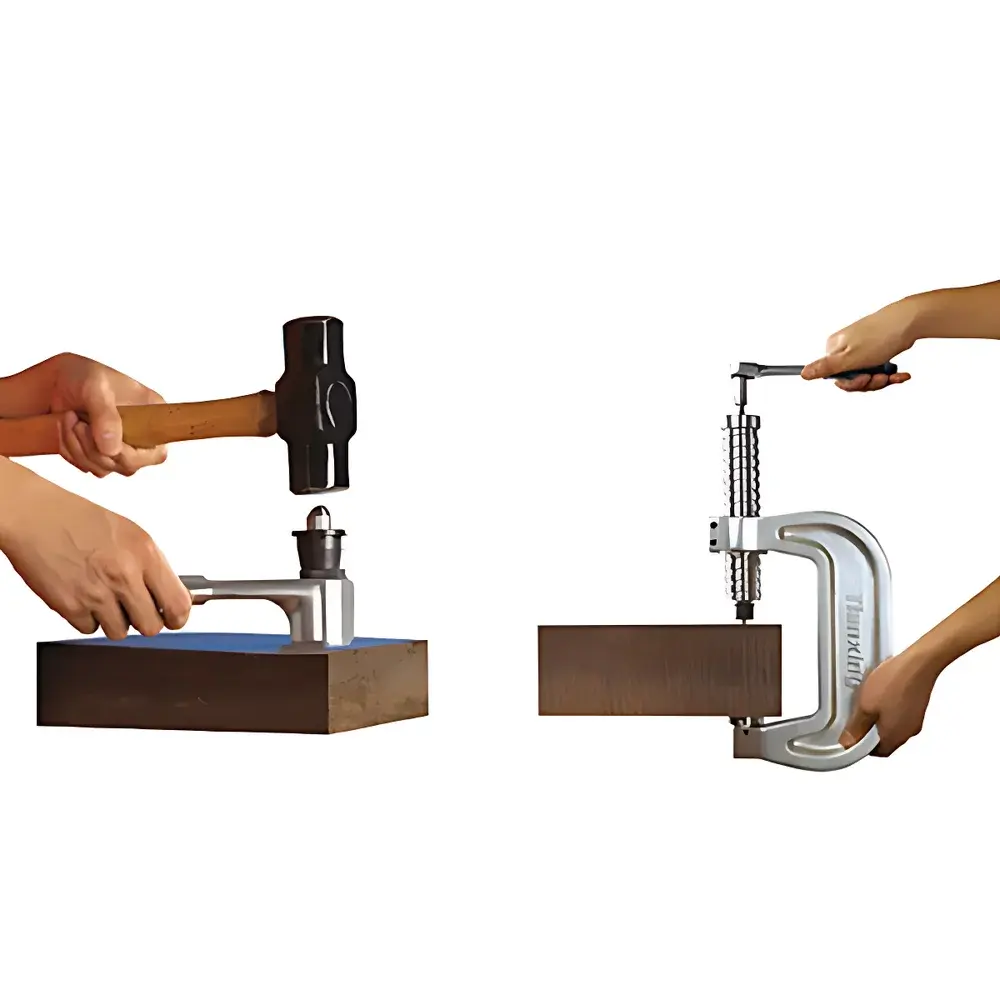
OLYMPUS PHB-150 Shear-Pin Brinell Hardness Tester
| Brand | OLYMPUS |
|---|---|
| Origin | Japan |
| Model | PHB-150 |
| Type | Portable Shear-Pin Operated Brinell Hardness Tester |
| Force Application | Mechanical Screw-Driven & Hammer-Impact Dual Mode |
| Hardness Scale | HBW (Brinell Hardness Number, tungsten carbide ball indenter) |
| Indentation Measurement | Optical Readout via Integrated Eyepiece Microscope |
| Compliance | Designed per ISO 6506-1, ASTM E10, and JIS Z 2243 standards |
Overview
The OLYMPUS PHB-150 Shear-Pin Brinell Hardness Tester is a field-deployable, mechanically actuated hardness testing instrument engineered for reliable Brinell hardness evaluation on components where conventional benchtop hardness testers are impractical. It operates on the fundamental principle of Brinell hardness testing—applying a known test force via a hardened tungsten carbide ball indenter to produce a spherical indentation in the material surface, followed by precise measurement of the resulting impression diameter. The hardness value (HBW) is then determined using standardized empirical relationships defined in ISO 6506-1. Unlike hydraulic or electromechanical systems, the PHB-150 employs a calibrated shear-pin mechanism to guarantee consistent, repeatable test force delivery—eliminating operator-dependent variability inherent in manual load application. Its C-frame architecture enables stable positioning on irregular surfaces, while its dual-force application mode (screw-driven static loading and hammer-impact dynamic loading) extends usability across diverse geometries and site constraints.
Key Features
- Shear-pin force control system ensures traceable, reproducible test loads—each pin rated for a specific nominal force (e.g., 500 kgf, 1500 kgf, 3000 kgf), with visual confirmation of pin shearing upon full load engagement.
- C-frame mechanical design provides structural rigidity during indentation and accommodates workpieces up to 300 mm in height and unlimited width or depth when used with auxiliary supports.
- Dual operation modes: precision screw-driven loading for controlled, vibration-free indentation on machined surfaces; and hammer-impact activation for rapid field assessment on large castings, forgings, or in-situ structures.
- Integrated optical readout system includes a high-magnification eyepiece microscope (20×) with dual-scale reticle for direct measurement of indentation diameter to ±0.02 mm resolution.
- No external power supply required—fully portable and suitable for workshop floors, foundry environments, construction sites, and maintenance depots.
- Compliant with international calibration traceability requirements; shear pins are supplied with individual certification per ISO/IEC 17025-accredited calibration reports.
Sample Compatibility & Compliance
The PHB-150 accommodates a broad range of metallic materials—including carbon steels, alloy steels, aluminum alloys, copper, brass, and cast iron—provided surface finish meets minimum roughness criteria (Ra ≤ 6.3 µm) and thickness exceeds ten times the indentation depth. It supports standard Brinell test forces (F = 500, 1500, or 3000 kgf) with 10 mm tungsten carbide ball indenters, enabling HBW determinations across the typical range of 10–650 HBW. The instrument conforms to the geometric and procedural requirements of ISO 6506-1:2023 (Metallic materials — Brinell hardness test — Part 1: Test method), ASTM E10-23 (Standard Test Method for Brinell Hardness of Metallic Materials), and JIS Z 2243:2022. All measurements satisfy GLP documentation requirements when paired with certified shear pins and calibrated microscope reticles.
Software & Data Management
While the PHB-150 is a purely mechanical-optical instrument without embedded electronics, it integrates seamlessly into digital QA workflows. Indentation diameter measurements can be recorded manually into LIMS or SPC platforms, or digitized using optional USB eyepiece cameras (e.g., OLYMPUS UC50) coupled with image analysis software compliant with ASTM E140 Annex A3 for automated diameter detection. Hardness conversion tables (HBW ↔ HV, HBW ↔ UTS) are provided in accordance with ISO 18265 and ASTM E140. Audit trails—including operator ID, date/time stamp, pin lot number, and measured d-value—are maintainable per FDA 21 CFR Part 11 guidelines when entered into validated electronic records systems.
Applications
- In-service inspection of large-diameter pipeline girth welds and base metal heat-affected zones (HAZ).
- Quality verification of as-cast or as-forged components in heavy machinery manufacturing prior to machining.
- Hardness mapping of rail heads, ship hull plates, and structural steel beams without disassembly.
- Field validation of heat treatment uniformity across turbine casings, pressure vessel shells, and offshore platform nodes.
- Educational use in metallurgy laboratories for hands-on demonstration of classical hardness principles and uncertainty analysis.
FAQ
What test forces are supported by the PHB-150?
The instrument is compatible with standardized shear pins rated for 500 kgf, 1500 kgf, and 3000 kgf, corresponding to common Brinell test conditions (e.g., 10 mm ball, F/D² = 30).
Can the PHB-150 measure hardness on curved surfaces?
Yes—its articulated C-frame and adjustable anvil allow stable positioning on convex or concave surfaces with radii ≥ 50 mm; correction factors per ISO 6506-1 Annex B apply.
Is calibration of the microscope reticle required?
Yes—reticle calibration must be performed annually using NIST-traceable stage micrometers; OLYMPUS provides calibration kits and documented procedures.
Does the PHB-150 meet requirements for third-party inspection agencies?
It is routinely accepted by TÜV, DNV, and ABS for field hardness verification when operated under documented SOPs and supported by certified shear pins and calibrated optics.
How is measurement uncertainty estimated for PHB-150 results?
Uncertainty contributors include indentation diameter measurement error (±0.02 mm), pin force tolerance (±1.5%), surface flatness deviation, and operator repeatability; combined uncertainty typically falls within ±3% k=2 for HBW < 300.



