
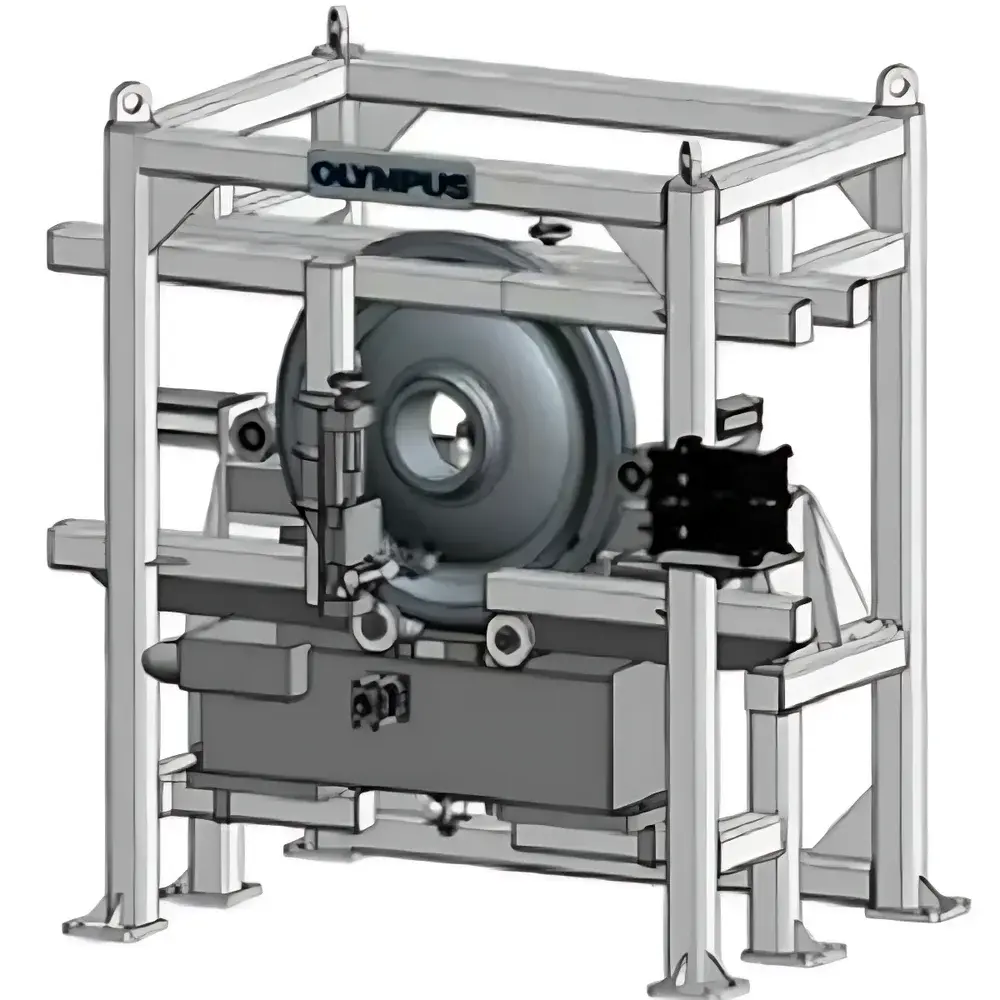
Olympus Phased Array Ultrasonic Testing (PAUT) Retrofit System for Railway Wheel Inspection
| Brand | Olympus |
|---|---|
| Origin | Shanghai, China |
| Manufacturer Type | Authorized Distributor |
| Regional Classification | Domestic (China) |
| Model | Custom PAUT Retrofit Kit |
| Pricing | Available Upon Request |
| Application Domain | Railway Rolling Stock Maintenance & Manufacturing |
Overview
The Olympus Phased Array Ultrasonic Testing (PAUT) Retrofit System for Railway Wheel Inspection is an engineered solution designed to modernize legacy manual ultrasonic inspection stations used in railway wheel manufacturing and overhaul facilities. This retrofit integrates Olympus phased array probe technology—including matrix or linear array transducers—into existing water-coupled immersion tanks, enabling automated, multi-angle volumetric scanning of forged or cast steel railway wheels. Unlike conventional single-element pulse-echo ultrasonics, the system leverages electronic beam steering, focusing, and dynamic depth correction to achieve superior flaw detectability across complex geometries such as wheel rims, spokes, and hubs. The measurement principle is based on time-of-flight diffraction (TOFD) and sectorial scanning (S-scan) modalities, compliant with ISO 10893-5, EN 1369, and ASTM E2700 for ultrasonic examination of wrought steel components.
Key Features
- Modular phased array probe integration compatible with Olympus OmniScan MX2 or MX3 acquisition units
- Water-immersion coupling architecture with precision XYZ motorized positioning for repeatable wheel centering and scan path alignment
- Pre-configured inspection setups for standard UIC 812-2, AAR M-107/M-208, and GB/T 8601 wheel profiles
- Real-time S-scan and C-scan imaging with automatic gain compensation (AGC) and surface-following algorithms
- Ruggedized mechanical interface designed for integration into high-throughput production lines without requiring structural plant modifications
- Support for dual-encoding (linear + angular) motion control to accommodate curved wheel surfaces during raster scanning
Sample Compatibility & Compliance
This retrofit system is validated for use with monobloc and segmented railway wheels ranging from 840 mm to 1250 mm in diameter, fabricated from R7, R8, ER8, or CL60 grade steels. It accommodates both hot-rolled and heat-treated conditions, including wheels post-tempering or stress-relieving. All inspection procedures conform to ISO/IEC 17025 requirements for testing laboratories, and data reporting meets traceability mandates under EN 15085-2 (welding of railway vehicles) and IRIS Rev. 03. The system supports audit-ready documentation generation aligned with GLP principles, including operator ID logging, calibration timestamping, and probe wear tracking.
Software & Data Management
Operation is managed via Olympus NDT SetupBuilder and OmniPC software, enabling rapid setup validation through synthetic aperture focusing technique (SAFT) simulation prior to physical deployment. Acquired A-scan, B-scan, and volumetric C-scan datasets are stored in ASME BPVC Section V-compliant .udx format, supporting long-term archiving and cross-facility review. The software suite provides built-in tools for flaw characterization per ISO 11063—including height, length, and depth quantification—and exports reports in PDF/A-1b and XML formats compatible with enterprise CMMS platforms. Full 21 CFR Part 11 compliance is achievable through optional digital signature modules and role-based access controls.
Applications
- In-line quality assurance during wheel forging and machining stages
- Periodic non-destructive evaluation of service-aged wheels in depot maintenance bays
- Root cause analysis of wheel failures involving subsurface cracking, shrinkage porosity, or inclusion clusters
- Validation of repair welds on spoke-repaired wheels per EN 15085-3
- Support for condition-based maintenance (CBM) programs through trend analysis of recurring indication patterns across fleet-wide datasets
FAQ
Can this retrofit be installed on existing water tanks from other manufacturers?
Yes—the mechanical mounting interface is customizable to accommodate standard immersion tank dimensions and flange specifications (e.g., ISO 20811 or DIN 2512). Structural reinforcement assessment is recommended prior to installation.
Does the system support automated defect classification?
It provides quantitative sizing and location data required for AI-driven classification models; however, automated pass/fail decision logic requires integration with third-party machine learning inference engines trained on domain-specific flaw libraries.
What calibration standards are required for daily verification?
A certified IIW Type 2 reference block and wheel-specific notched calibration standards per UIC 812-2 Annex B must be used for sensitivity and resolution verification before each shift.
Is operator certification required to run the system?
Personnel must hold Level 2 certification per ISO 9712 in Ultrasonic Testing (UT), with additional training on phased array operation and wheel geometry-specific scanning protocols provided by Olympus-certified instructors.
How is probe wear monitored during extended production runs?
The system logs cumulative firing counts per element and triggers alerts when deviation from baseline pulse-echo response exceeds ±12% amplitude variation—indicating potential element degradation or coupling loss.



