
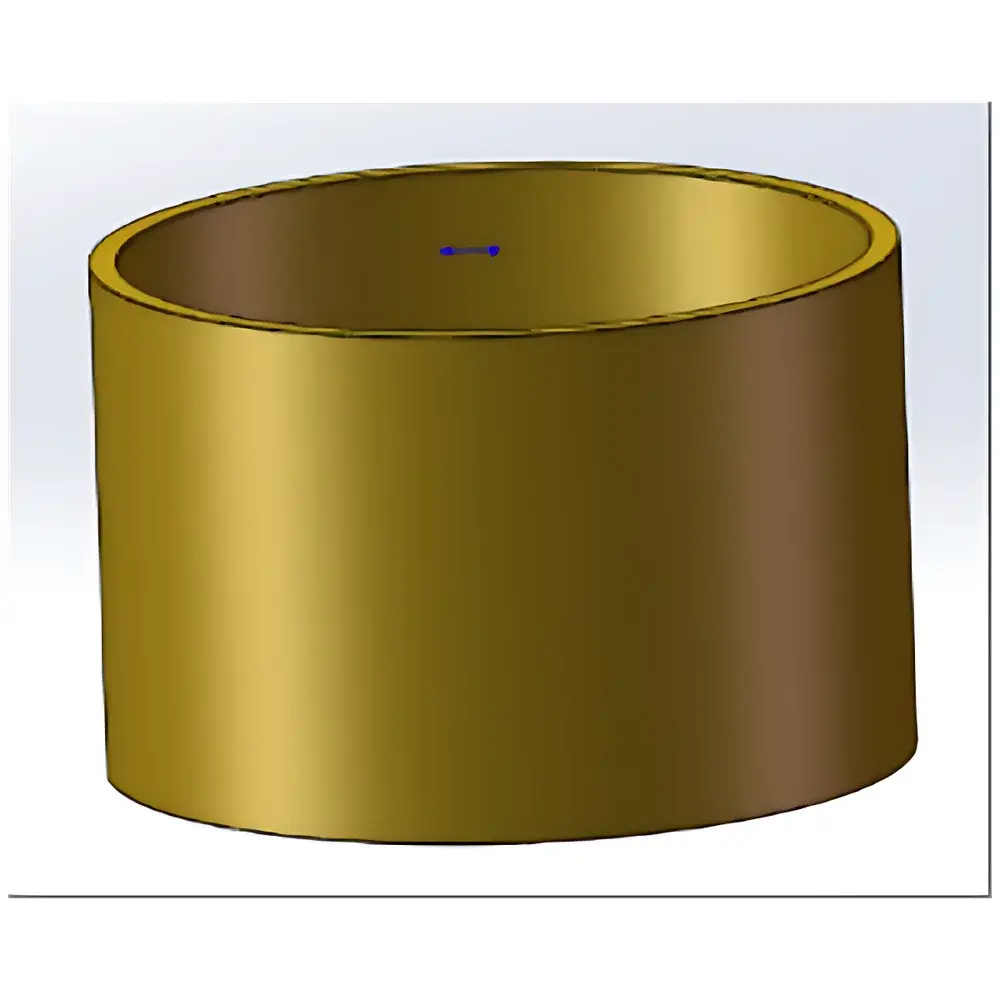
Olympus FocusPX32128PR Automated Phased Array Ultrasonic Testing System for Copper Rings
| Brand | Olympus |
|---|---|
| Origin | Shanghai, China |
| Manufacturer Type | Authorized Distributor |
| Regional Classification | Domestic (China) |
| Model | FocusPX32128PR |
| Pricing | Upon Request |
| Application Domain | Non-Destructive Testing of Non-Ferrous Metal Components |
Overview
The Olympus FocusPX32128PR Automated Phased Array Ultrasonic Testing (PAUT) System for Copper Rings is an engineered solution for high-throughput, precision volumetric inspection of large-diameter copper annular components—specifically designed for rings up to 550 mm outer diameter (OD) and 360 mm maximum OD per operational specification. This system implements pulse-echo and through-transmission ultrasonic principles using phased array beam steering and dynamic depth focusing, enabling full-volume coverage of both lateral (side) surfaces and axial (end) faces without mechanical repositioning. The core measurement methodology adheres to the physics of acoustic wave propagation in isotropic, non-ferrous metals—leveraging water-coupled immersion techniques to ensure consistent acoustic impedance matching and minimize near-surface dead zones inherent in contact-based methods. Designed for integration into production-line quality control environments, the system delivers repeatable, traceable, and audit-ready inspection data compliant with fundamental NDT process validation requirements.
Key Features
- Automated 4-axis probe positioning system supporting simultaneous side-wall and end-face scanning of copper rings via programmable motion sequences
- Olympus FocusPX32128PR PAUT instrument platform with 128-channel parallel acquisition, real-time TCG/DAC compensation, and full matrix capture (FMC) capability
- Custom water-immersion phased array transducers optimized for copper’s acoustic velocity (~3,600 m/s) and attenuation characteristics, including near-surface wall probes for end-face inspection
- Motor-driven rotary support with dual driven/idler wheels and optical encoder feedback for precise angular position synchronization—enabling C-scan reconstruction with ≤0.1° angular resolution
- Overhead gantry hoist with load-rated hooks and programmable lift/positioning logic for hands-free part loading/unloading
- Robust stainless-steel water tank with temperature-stabilized recirculation, filtration, and degassing subsystems to maintain coupling consistency across multi-shift operation
Sample Compatibility & Compliance
The system accommodates copper rings with outer diameters up to 550 mm, inner diameters down to 100 mm, and axial thicknesses ranging from 10 mm to 120 mm. Material compatibility extends to oxygen-free copper (OFHC), electrolytic tough pitch (ETP) copper, and copper alloys with acoustic impedance within ±15% of pure copper. Detection sensitivity is validated per ASTM E273-22 (Standard Practice for Ultrasonic Examination of Pipe and Tubing) and ISO 16810:2014 (Non-destructive testing — General concepts — Ultrasonic testing). Minimum detectable flaw sizes are verified at 0.5 mm flat-bottomed hole (FBH) equivalent in side-wall orientation and 1.0 mm FBH in end-face orientation under standard calibration block conditions (e.g., IIW Type 2 or custom copper reference blocks). System design supports GLP/GMP-aligned documentation workflows, including electronic signature support and audit trail logging per FDA 21 CFR Part 11 when deployed with configured software modules.
Software & Data Management
The integrated inspection software is a proprietary application built on Olympus OpenView SDK architecture, developed by Binrui NDT. It provides a unified interface for hardware control, real-time A/B/C/D/S-scan visualization, automated defect recognition (ADR) based on amplitude-threshold and spatial clustering algorithms, and customizable report generation in PDF/XML formats. All raw RF data, scan parameters, and calibration records are stored in a timestamped, version-controlled database with SHA-256 hashing for integrity verification. Remote operation is supported via secure TLS 1.2–encrypted WebSocket connections, enabling off-site supervision and collaborative review. Software update history, user access logs, and parameter change tracking meet ISO/IEC 17025:2017 clause 7.7.1 requirements for software validation in accredited laboratories.
Applications
This system is routinely deployed for incoming material verification, in-process monitoring, and final acceptance testing of copper rings used in high-vacuum chamber components, electromagnetic shielding housings, superconducting magnet assemblies, and power transmission busbar interconnects. Typical defect types identified include subsurface porosity clusters, intergranular delamination, cold shuts from casting processes, and fatigue-induced radial cracking. Its automation architecture enables seamless integration with MES/SCADA systems via OPC UA or Modbus TCP protocols, facilitating real-time SPC analysis and statistical process feedback loops. The system has been successfully commissioned in facilities operating under AS9100D and IATF 16949 quality management frameworks.
FAQ
What ultrasonic standards does this system comply with?
It conforms to ASTM E273-22, ISO 16810:2014, and EN 1330-4 for terminology and general PAUT methodology; calibration procedures follow ISO 12718:2019 for ultrasonic testing equipment.
Can the system inspect copper alloys beyond pure copper?
Yes—provided the alloy’s longitudinal sound velocity falls between 3,400–3,800 m/s and attenuation remains below 1.2 dB/mm at 5 MHz, which covers common Cu-Zn, Cu-Sn, and Cu-Ni compositions.
Is raw RF data export supported?
Yes—full FMC datasets can be exported in HDF5 format with embedded metadata (transducer ID, gate settings, time-of-flight maps) for third-party analysis in MATLAB, Python, or CIVA.
Does the software support multi-language UI?
The current release includes English and Simplified Chinese interfaces; additional languages (German, Japanese, Korean) are available upon request and require localized validation.
What maintenance intervals are recommended for the water circulation system?
Filter cartridges require replacement every 200 operational hours; water resistivity must be maintained above 1 MΩ·cm, verified weekly via inline conductivity sensor calibration.



