
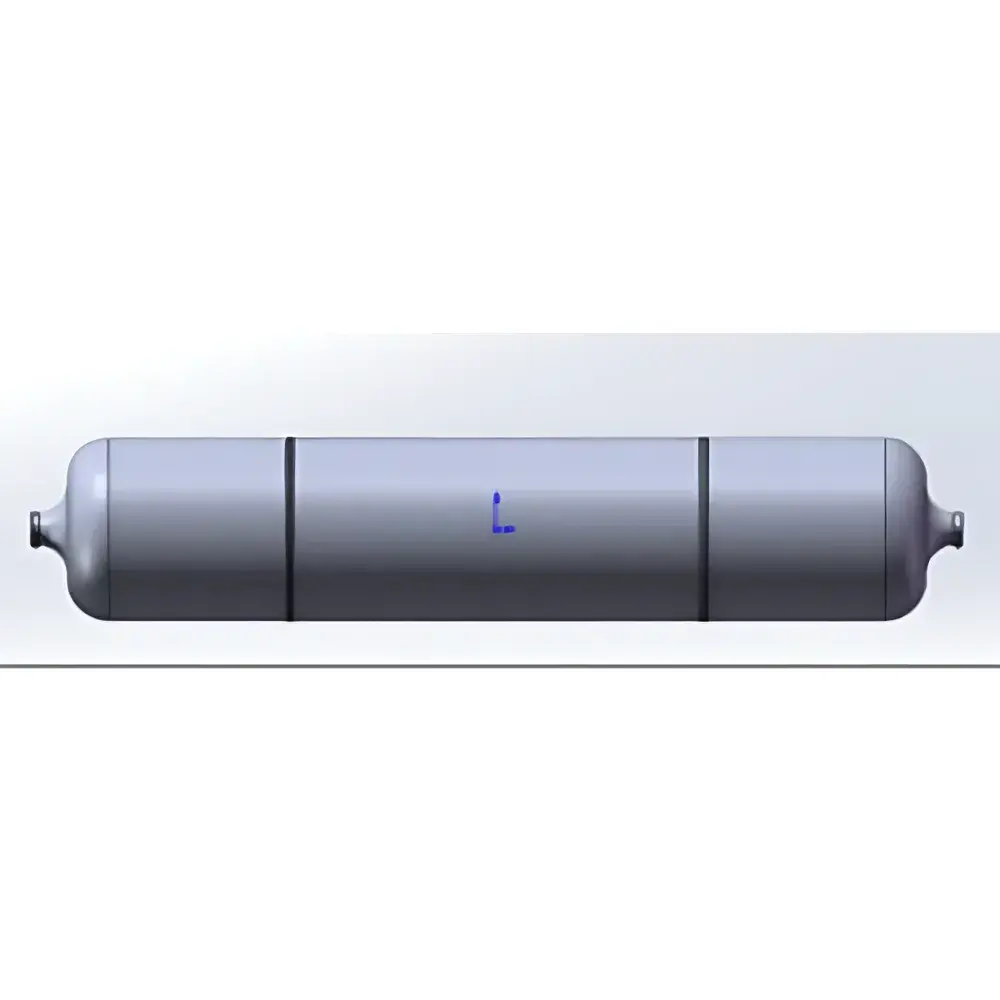
Olympus OmniScan MX2-Based Automated Cylindrical Gas Cylinder Inspection System
| Brand | Olympus |
|---|---|
| Origin | Shanghai, China |
| Manufacturer Type | Authorized Distributor |
| Country of Origin | China |
| Model | Custom-Integrated OmniScan MX2 Platform |
| Pricing | Upon Request |
| Application Domain | Pressure Vessel NDT, Composite & Thermoplastic Weld Integrity Assessment |
Overview
The Olympus OmniScan MX2-Based Automated Cylindrical Gas Cylinder Inspection System is a fully integrated ultrasonic non-destructive testing (NDT) platform engineered for high-reliability volumetric assessment of circumferential butt welds in high-pressure composite and thermoplastic-lined gas cylinders—particularly those fabricated from nylon-based polymer composites. Leveraging phased array ultrasonic testing (PAUT) principles under controlled water-coupled immersion conditions, the system delivers consistent beam steering, dynamic depth focusing, and sectorial scanning across curved cylindrical surfaces. Unlike conventional manual UT or basic pulse-echo methods, this solution implements full matrix capture (FMC) and total focusing method (TFM) reconstruction algorithms to enhance defect detectability, sizing accuracy, and signal-to-noise ratio in geometrically complex weld zones. The system is purpose-built for compliance-driven production environments where traceability, repeatability, and audit-ready documentation are mandatory.
Key Features
- Core acquisition hardware: Olympus OmniScan MX2 PAUT/TOFD instrument with 128-channel capability, supporting real-time TFM processing and advanced wedge delay calibration for curved-surface compensation.
- Custom-engineered water-immersion phased array probe assembly with focused linear or matrix arrays optimized for 2–10 MHz operation on nylon-composite interfaces.
- Motorized multi-axis manipulator system (CNC-controlled rotation + axial translation) ensuring precise positional repeatability ±0.1 mm and angular resolution < 0.05° over full 360° cylinder circumference.
- Embedded real-time scan synchronization: encoder-triggered data acquisition aligned with rotational position and immersion depth to eliminate spatial aliasing.
- Ruggedized industrial enclosure rated IP54, designed for integration into ISO Class 8 cleanrooms or regulated manufacturing cells handling Class III/IV pressure vessels.
- Hardware-level compliance with IEC 61000-6-2 (EMC immunity) and IEC 61000-6-4 (EMC emissions), meeting baseline requirements for factory-floor deployment.
Sample Compatibility & Compliance
The system accommodates standard industrial gas cylinders ranging from DN300 to DN900 (diameter) and lengths up to 2,000 mm, including Type IV composite-overwrapped pressure vessels (COPVs) with nylon inner liners. It supports inspection of both as-welded and post-hydrostatic-test conditions. All inspection procedures adhere to ASTM E2700–22 (Standard Practice for PAUT of Welds) and ISO 13588:2022 (Non-destructive testing — Ultrasonic testing — Use of TOFD and PAUT techniques). Calibration protocols follow ASME BPVC Section V, Article 4 and EN 1330-4 definitions for reference reflectors (e.g., side-drilled holes, flat-bottomed holes) in polymer-matched calibration blocks. Traceable calibration certificates are generated per ISO/IEC 17025 requirements when operated within an accredited laboratory framework.
Software & Data Management
The proprietary inspection software provides unified control of motion, acquisition, visualization, and reporting. It features automated setup wizards for common cylinder geometries, real-time C-scan/S-scan/B-scan fusion, and AI-assisted indication classification (e.g., porosity clusters vs. lack-of-fusion vs. crack-like indications) based on amplitude, depth, lateral extent, and phase coherence metrics. All raw A-scan data, encoded positional metadata, and reconstructed TFM images are stored in ASME-compliant .udx format with embedded DICOM-RT headers. Audit trails—including operator ID, timestamp, parameter changes, and calibration events—are recorded in accordance with FDA 21 CFR Part 11 and EU Annex 11 requirements. Export options include PDF reports with embedded hyperlinked scans, CSV defect logs, and XML datasets compatible with enterprise MES/QMS platforms (e.g., Siemens Opcenter, ETQ Reliance).
Applications
- Automated volumetric screening of nylon liner butt welds in Type IV hydrogen and compressed natural gas (CNG) cylinders.
- Post-manufacturing quality gate verification prior to hydrostatic proof testing.
- In-service inspection of refilled cylinders under periodic requalification programs (e.g., DOT-SP 16350, ECE R110).
- Process validation support for laser welding, hot-gas welding, and extrusion-butt joining of thermoplastic composites.
- Root cause analysis of field failures via comparative analysis between production baseline scans and returned-unit inspections.
FAQ
Does the system support both PAUT and TOFD modalities simultaneously?
Yes—the OmniScan MX2 platform enables concurrent PAUT and TOFD acquisition using time-multiplexed channel allocation, allowing dual-method validation without mechanical reconfiguration.
Can the software generate ASME Section VIII, Division 1 Appendix 12-compliant reports?
Yes—report templates are configurable to meet specific acceptance criteria defined in ASME BPVC Section VIII, Appendix 12 for plastic-lined pressure vessels, including minimum detectable flaw size thresholds and evaluation zones.
Is remote diagnostics and firmware update capability available?
Yes—secure TLS 1.2-enabled remote access allows OEM-level diagnostics, configuration backup/restore, and over-the-air firmware updates compliant with IEC 62443-3-3 cybersecurity standards.
What calibration standards are required for daily verification?
A certified nylon-matched calibration block containing SDHs at 10, 20, and 30 mm depths, along with a curvature-compensated IIW-type reference block, is required for daily system performance verification per ASTM E317.
Is the system validated for use with recycled or reprocessed nylon feedstock?
Yes—system sensitivity and noise floor characterization has been verified across multiple batches of virgin and 15–30% recycled-content nylon 6/6 and nylon 12 liners, with no degradation in POD (probability of detection) at ≥1.2 mm equivalent reflector size.
Related Products



