
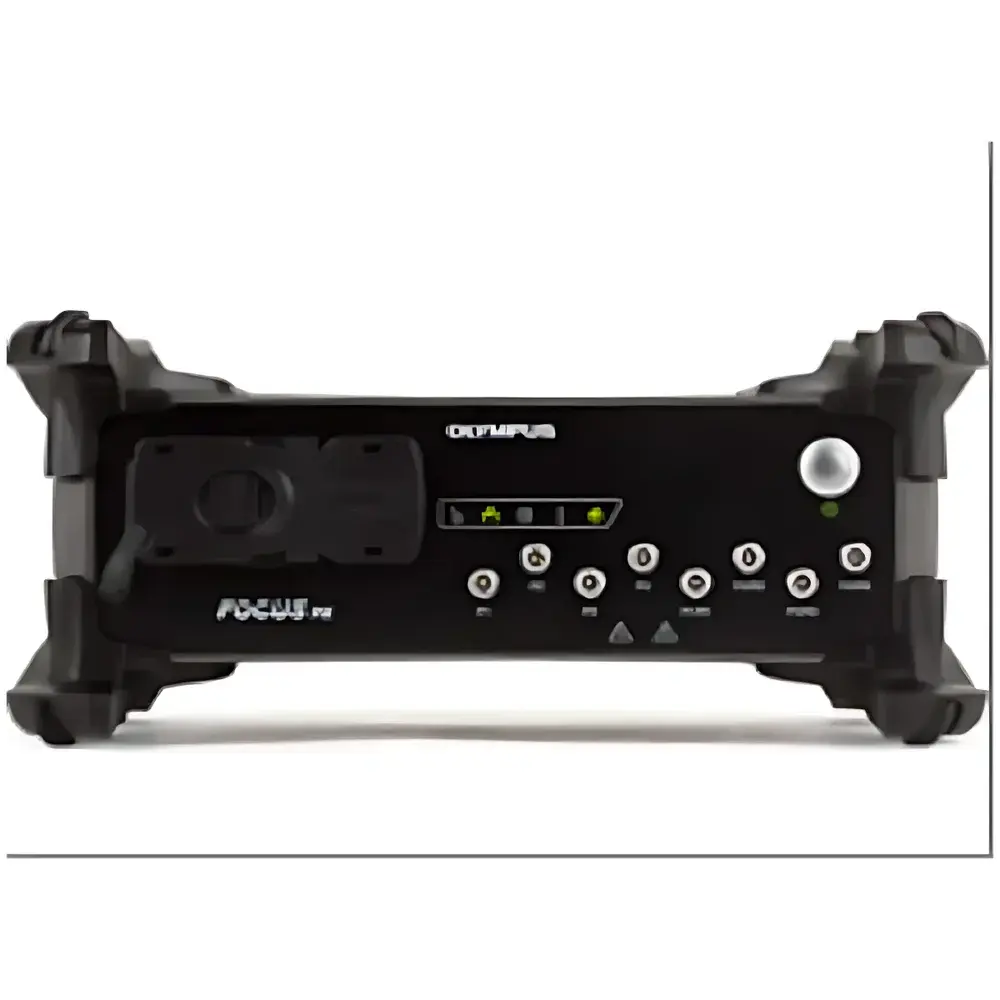
Olympus FOCUS PX/PC/SDK Advanced Phased Array Ultrasonic Flaw Detection System
| Brand | Olympus |
|---|---|
| Origin | Japan |
| Model | FOCUS PX / PC / SDK |
| Phased Array Channels | 16:64PR, 16:128PR, 32:128PR |
| Conventional UT Channels | 4 dedicated |
| Max Simultaneous Units | 4 |
| Data Throughput | up to 60 MB/s (4 units) |
| A-scan Rate | up to 20,000 @ 12-bit resolution (750 points/A-scan) |
| Pulse Voltage Range | PA: 4–115 V |
| UT | 50–190 V |
| Gain | PA: 80 dB (46 dB analog + 34 dB digital) |
| UT | 120 dB digital |
| Pulse Width | PA: 30–500 ns (2.5 ns step) |
| UT | 30–1000 ns (2.5 ns step) |
| Bandwidth (−3 dB) | PA: 0.6–17.8 MHz |
| UT | 0.25–28 MHz |
| Beam Count | up to 1024 |
| PRF | 1 Hz–20 kHz |
| Real-time Averaging | PA: 1–16 |
| UT | 1–64 |
| Gate Count | 4 detection + 1 encoder sync |
| Enclosure Rating | IP65 |
| Operating Temperature | up to 40 °C |
| Dimensions (with housing) | 30.7 × 13.5 × 23.6 cm |
| Weight (with housing) | 4.8 kg |
Overview
The Olympus FOCUS PX/PC/SDK is a high-performance, modular phased array ultrasonic testing (PAUT) system engineered for mission-critical non-destructive evaluation in aerospace, power generation, oil & gas, and heavy manufacturing environments. Built upon the principles of coherent beamforming and time-domain signal synthesis, the system delivers deterministic control over ultrasonic wavefronts—enabling precise focusing, steering, and dynamic depth correction across complex geometries. Unlike conventional pulse-echo systems, the FOCUS PX architecture leverages parallel multi-channel acquisition with synchronized digital signal processing to achieve real-time beam synthesis at up to 1024 unique focal laws per scan line. Its hardware-software co-design ensures compliance with industry-standard inspection methodologies defined in ASTM E2700, ISO 16810, and EN 13588, while supporting traceable data acquisition workflows required under ASME BPVC Section V and API RP 1104.
Key Features
- Modular acquisition architecture: FOCUS PX unit supports scalable configurations—from single 16:64PR setups to synchronized clusters of up to four units for multi-probe, multi-angle inspections.
- Dual-mode operation: Native support for both phased array (PA) and conventional pulse-echo (UT) modes within a unified hardware platform—eliminating cross-platform calibration drift and enabling hybrid inspection strategies.
- High-fidelity signal integrity: 12-bit ADC sampling at up to 30 MB/s per unit (60 MB/s aggregate), with programmable pulse voltage (4–115 V for PA; 50–190 V for UT), sub-nanosecond timing resolution, and digitally synthesized filters (bandpass, high-pass, low-pass).
- Ruggedized industrial design: IP65-rated enclosure with passive thermal management via integrated heat-dissipating fins; operational capability up to 40 °C ambient without forced cooling.
- Low-latency synchronization: Hardware-triggered inter-unit synchronization via dedicated I/O lines—enabling precise phase alignment across distributed transducer arrays without external timing hubs.
- Direct-mount mechanical integration: Four M4 threaded mounting holes on chassis base allow rigid attachment to scanners, robotic arms, or custom fixtures—minimizing cable-induced noise and signal degradation.
Sample Compatibility & Compliance
The FOCUS PX/PC/SDK system accommodates a broad spectrum of industrial test specimens—including weldments in carbon steel, stainless alloys, titanium, and composites—as well as castings, forgings, and additive-manufactured components. Its flexible focal law engine supports sectorial scanning (S-scan), linear scanning (L-scan), and encoded C-scan acquisition modes compliant with ASNT SNT-TC-1A qualification requirements. All raw RF data, parameter sets, and inspection logs are stored in vendor-neutral formats (e.g., .uf, .udx) compatible with third-party analysis tools and long-term archival systems. The platform meets electromagnetic compatibility standards per IEC 61000-6-2/6-4 and carries CE marking for use in EU-regulated facilities. For regulated industries, FocusPC supports audit-trail-enabled operation aligned with FDA 21 CFR Part 11 requirements when deployed with appropriate IT governance controls.
Software & Data Management
FocusPC serves as the central interface for configuration, acquisition, visualization, and post-processing. Its tabbed workspace enables concurrent management of setup templates, calibration records, scan sequences, and report generation—all accessible through role-based user profiles. The software implements real-time data compression (up to 1:2000 ratio) without loss of waveform fidelity, ensuring efficient storage of high-density volumetric datasets. Advanced analysis modules include dynamic depth gain correction (DDGC), time-of-flight diffraction (TOFD) overlay, and automated indication characterization using amplitude-threshold and spatial-clustering algorithms. Custom display layouts—fully reconfigurable via drag-and-drop view panes—support simultaneous rendering of A-scan, B-scan, C-scan, S-scan, and encoded position overlays. All session metadata (including probe ID, wedge delay, material velocity, and calibration date) is embedded in each dataset for full metrological traceability.
Applications
This system is routinely deployed for critical applications including: automated weld inspection of pipeline girth welds per ISO 17640; turbine disk and blade root inspection in aviation maintenance; corrosion mapping of pressure vessel walls under ASME Section XI Appendix VIII; and additive layer verification in directed-energy deposition (DED) processes. Its ability to execute rapid, multi-focal-law scans makes it especially effective for detecting lack-of-fusion, porosity, and planar indications in thick-section austenitic welds where conventional UT exhibits limited sensitivity. In-service inspection of rail axle ultrasonic testing (RUT) and nuclear component surveillance also benefit from its high PRF stability (1–20 kHz) and encoder-synchronized gating for precise positional correlation.
FAQ
Can the FOCUS PX operate independently without FocusPC?
No—the FOCUS PX is a dedicated acquisition engine requiring FocusPC or a custom application built on the FocusControl/FocusData SDKs for configuration, triggering, and data retrieval.
Does the system support TOFD acquisition?
Yes—FocusPC includes native TOFD setup wizards, dual-gate detection logic, and diffraction-based sizing algorithms compliant with ISO 10863.
Is real-time imaging supported during scanning?
Yes—live B-scan and C-scan updates are rendered at full acquisition frame rate, with optional color-mapping and interpolation for enhanced defect localization.
What level of software customization is possible with the SDKs?
FocusControl provides programmatic access to all hardware control functions (focal law loading, gate setup, PRF adjustment); FocusData enables direct binary access to raw RF waveforms and processed A-scan envelopes for integration into proprietary analytics pipelines.
How is calibration traceability maintained?
Each calibration event is timestamped, logged with operator ID and reference standard ID (e.g., IIW Block, DAC block), and embedded in the dataset header—ensuring full compliance with ISO/IEC 17025 documentation requirements.



