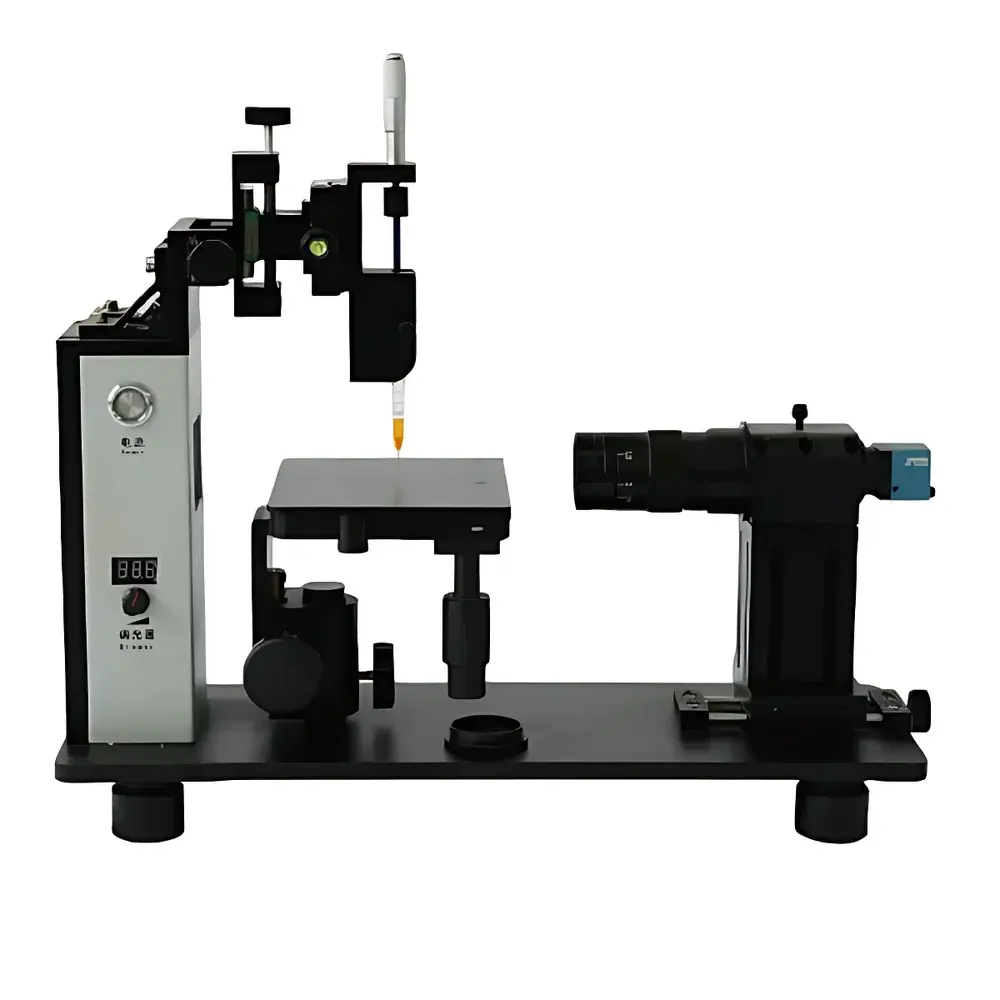
VC Plasma NA Water Contact Angle Tester
| Brand | VC Plasma |
|---|---|
| Origin | Guangdong, China |
| Manufacturer Type | Authorized Distributor |
| Regional Classification | Domestic (China) |
| Model | NA |
| Pricing | Available Upon Request |
Overview
The VC Plasma NA Water Contact Angle Tester is a precision optical instrument engineered for quantitative characterization of solid surface wettability through static and dynamic contact angle measurements. Based on the sessile drop method, it utilizes high-resolution digital imaging coupled with advanced edge-detection algorithms to determine the tangent angle formed between a liquid–vapor interface and a solid substrate at the three-phase contact line. This measurement serves as a fundamental parameter in surface science, directly correlating with surface free energy, interfacial tension, and chemical heterogeneity. Designed for laboratory and pilot-scale industrial environments, the system supports routine quality control of coatings, films, membranes, medical devices, and functionalized substrates where surface hydrophilicity or hydrophobicity must be rigorously validated.
Key Features
- High-contrast, motorized focus optics with adjustable LED backlighting for optimal droplet contour definition
- Automated dispensing module capable of precise micro-liter volume deposition (0.1–10 µL) with syringe pump control
- Real-time image capture at up to 60 fps for dynamic contact angle analysis (advancing/receding angles, roll-off behavior)
- Integrated tilt stage (±90° range) for slide-angle and hysteresis evaluation under controlled inclination
- Calibration traceable to NIST-traceable reference standards for spherical and non-spherical droplets
- Robust aluminum alloy chassis with vibration-damping base, suitable for integration into cleanroom or QC lab environments
Sample Compatibility & Compliance
The NA series accommodates flat, curved, porous, and textured substrates with dimensions up to 150 mm × 150 mm and thickness ≤25 mm. Sample holders are modular and compatible with standard petri dishes, silicon wafers, polymer sheets, metal foils, and textile swatches. All measurement protocols align with ISO 19403-2 (2017) for contact angle determination using the sessile drop method and ASTM D7334-22 for surface energy estimation via contact angle analysis. The instrument’s operational parameters and data output structure support GLP-compliant documentation workflows; audit trails, user access logs, and electronic signatures can be implemented via optional software modules compliant with FDA 21 CFR Part 11 requirements when integrated with validated LIMS platforms.
Software & Data Management
Control and analysis are executed via VC Plasma’s proprietary WinDrop v4.x software suite, running on Windows 10/11 (64-bit). The software provides real-time droplet profile fitting using Young–Laplace equation-based algorithms, supports multiple fitting models (circle, ellipse, Young–Laplace), and enables batch processing of up to 99 samples per session. Export formats include CSV, XLSX, PDF reports with embedded images and metadata (timestamp, operator ID, environmental conditions). Raw image sequences (TIFF/AVI) are stored with EXIF tags containing camera settings, stage position, and dispensing parameters. Data integrity is preserved through SHA-256 checksum verification upon file save and automatic backup to network drives or NAS endpoints configured by the user.
Applications
- Quality assurance of plasma-treated surfaces in automotive and electronics manufacturing
- Development and validation of anti-fog, anti-reflective, and self-cleaning coatings
- Characterization of biomaterials including hydrogels, surgical meshes, and drug-eluting stents
- Surface modification monitoring during corona, flame, or low-pressure plasma processing
- Hydrophobicity screening of filtration membranes in water treatment and pharmaceutical processing
- Research on nanomaterial-coated textiles, paper, and packaging substrates
FAQ
What liquids can be used besides deionized water?
Deionized water is standard for baseline hydrophilicity/hydrophobicity assessment, but the system supports any Newtonian liquid with known surface tension (e.g., glycerol, ethylene glycol, diiodomethane) for surface energy component calculation via Owens–Wendt or van Oss approaches.
Is temperature and humidity control integrated?
The base configuration operates under ambient lab conditions (15–30°C, 30–60% RH). Optional environmental chamber add-ons provide active temperature regulation (±0.5°C) and humidity control (20–80% RH) for ISO 291-compliant testing.
Can the system measure advancing and receding contact angles automatically?
Yes—via programmable liquid addition/removal cycles using the motorized syringe pump, combined with continuous image acquisition and automated contour tracking.
Does the instrument meet ISO/IEC 17025 calibration requirements?
While the instrument itself is not a certified calibration laboratory, its optical path, dispensing accuracy, and stage positioning are verifiable using NIST-traceable reference slides and volumetric standards; full metrological validation must be performed by an accredited third-party provider per client-specific QA protocols.
Is remote operation supported?
Remote desktop access is enabled via standard RDP or VNC protocols; however, live image streaming and real-time control require local network configuration and are subject to IT security policies governing instrument network segmentation.