
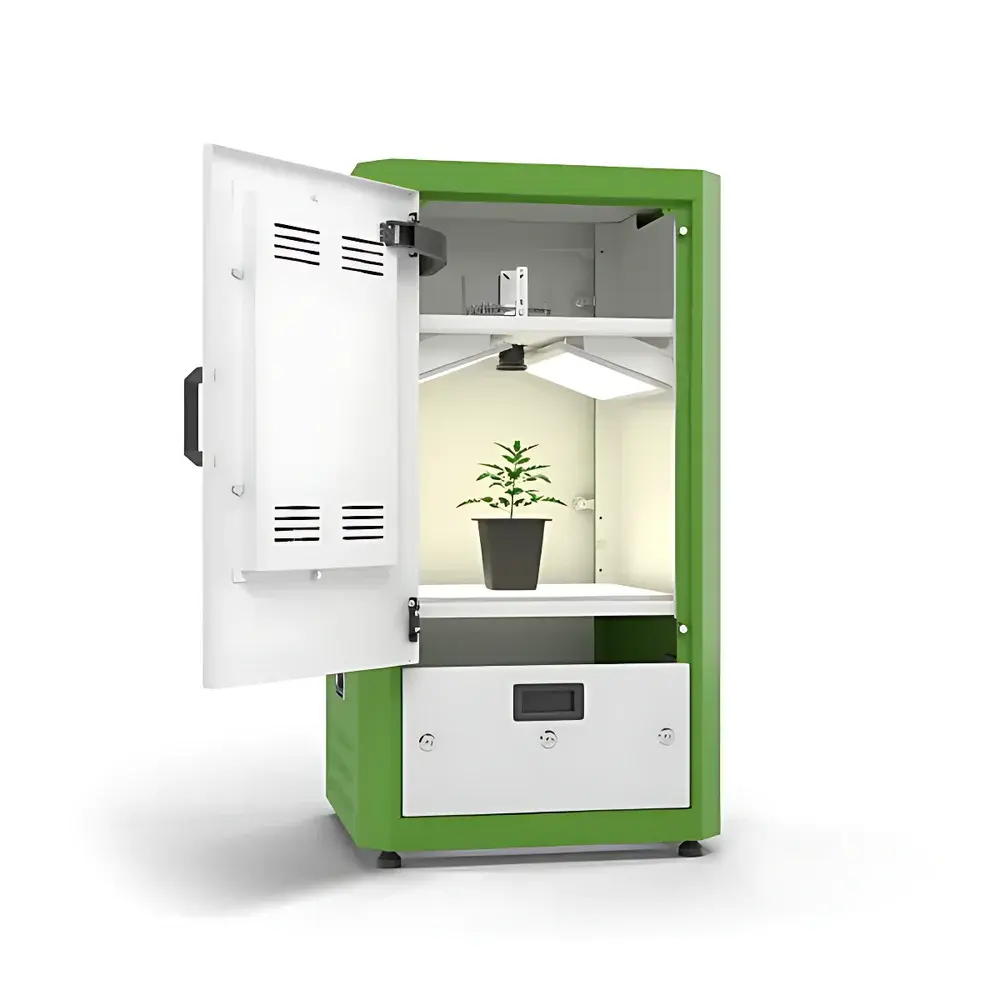
LemnaTec PhenoAIxpert Laboratory Plant Phenotyping Imaging System
| Brand | LemnaTec |
|---|---|
| Origin | Germany |
| Model | PhenoAIxpert |
| Configuration | Integrated cabinet system with top-mounted visible-light imaging unit, uniform diffused LED illumination, embedded industrial PC with touch interface |
| Imaging Modality | Top-view RGB imaging only |
| Sample Format Support | Petri dishes, multi-well plates (6–96-well), small pots (≤15 cm diameter), leaf discs, seeds, insect specimens, and plant-pathogen interaction assays |
| Data Output | Quantitative phenotypic parameters including projected area, width, symmetry index, color histograms (RGB/L*a*b*), lesion count/area, seed count/color distribution, density maps |
| Software Architecture | Workflow-driven image analysis engine with preconfigured and user-customizable pipelines |
| Compliance Context | Designed for GLP-compliant lab environments |
Overview
The LemnaTec PhenoAIxpert is a compact, cabinet-integrated laboratory-scale plant phenotyping imaging system engineered for high-throughput, non-destructive acquisition and quantitative analysis of morphological and chromatic traits in controlled-environment studies. Unlike field-based or greenhouse phenotyping platforms, the PhenoAIxpert employs a fixed top-view visible-light (400–700 nm) imaging architecture grounded in standardized digital photogrammetry principles. Its optical design follows Köhler illumination geometry, with a high-resolution monochrome or color CMOS sensor (pixel resolution configurable per application) coupled to a telecentric lens assembly to minimize perspective distortion across heterogeneous sample arrays. The system operates on the principle that two-dimensional projection metrics—when acquired under reproducible lighting, positioning, and focus conditions—serve as robust surrogates for underlying physiological and genetic states. It is explicitly designed for use in biosafety level 1 (BSL-1) laboratories, supporting experiments requiring strict environmental containment, operator safety, and traceable data lineage.
Key Features
- Top-mounted visible-light imaging unit with motorized focus and auto-exposure calibration, optimized for consistent capture across variable sample heights (0–120 mm working distance)
- Uniform, spectrally stable LED backlighting module delivering >95% spatial homogeneity (measured per ISO 14883) to eliminate specular reflection and shadow artifacts on glossy or waxy leaf surfaces
- Integrated industrial-grade PC housed within the imaging cabinet, running real-time Linux-based firmware with capacitive multi-touch HMI for protocol selection, acquisition triggering, and live preview
- Workflow-oriented software architecture: users select or compose analysis pipelines via drag-and-drop interface—each workflow encapsulates image preprocessing (flat-field correction, background subtraction), segmentation (adaptive Otsu + morphological filtering), feature extraction (shape descriptors, color moment statistics), and statistical summarization
- Hardware-software co-design ensures deterministic latency (<150 ms from trigger to disk write) and full synchronization between illumination pulse, shutter actuation, and sensor readout—critical for time-series stress-response assays
Sample Compatibility & Compliance
The PhenoAIxpert accommodates diverse biological substrates without mechanical reconfiguration: standard tissue-culture plates (6-, 12-, 24-, 48-, and 96-well), Petri dishes (35–150 mm diameter), individual pots (up to 15 cm Ø), detached leaf discs (3–20 mm Ø), dry or imbibed seeds (0.5–10 mm), and arthropod specimens (e.g., aphids, spider mites, lepidopteran eggs) placed directly on agar or filter paper. All sample carriers are compatible with standard lab automation footprints (e.g., ANSI/SLAS microplate dimensions). From a regulatory standpoint, the system supports Good Laboratory Practice (GLP) workflows through immutable acquisition logs (including EXIF metadata, operator ID, timestamp, and applied workflow hash), optional integration with LIMS via RESTful API, and export of analysis results in machine-readable formats compliant with ISA-Tab and MIAPPE specifications. While not FDA-cleared, its architecture aligns with principles outlined in FDA Guidance for Industry: Computerized Systems Used in Clinical Investigations (2023) regarding data integrity and audit trail requirements.
Software & Data Management
PhenoAIxpert’s proprietary software suite—PhenoStudio—runs natively on the embedded platform and provides both guided and scriptable analysis modes. Predefined workflows cover common use cases: seed viability scoring (color + morphology), leaf lesion quantification (binary mask overlay + connected-component labeling), multi-well growth kinetics (area/time derivative), and pathogen colonization mapping (RGB thresholding + spatial clustering). Users may extend functionality via Python 3.9-compatible scripting modules (NumPy, OpenCV, scikit-image), with all custom code subject to version-controlled deployment and execution logging. Raw images are stored in lossless TIFF format with embedded XMP sidecar files containing full provenance metadata. Processed outputs include tabular summaries (CSV), annotated visualizations (PNG), and hierarchical feature vectors (HDF5) suitable for downstream ML training. Data exports comply with FAIR principles—findable via persistent identifiers, accessible via authenticated HTTP, interoperable through schema.org-compatible JSON-LD, and reusable via open license annotations.
Applications
This system serves as a primary phenotyping engine in academic and industrial plant science laboratories engaged in: quantitative genetics (QTL mapping of leaf shape or seed coat pigmentation), abiotic stress phenotyping (drought-induced chlorosis kinetics, salinity-driven necrosis progression), biotic interaction studies (spatial-temporal tracking of fungal hyphae expansion on leaf discs), mutagenesis screening (automated detection of dwarfism or anthocyanin overaccumulation), seed quality assessment (crack detection, mold coverage, germination synchrony), and toxicology (herbicide dose–response curves based on cotyledon expansion rate). Its throughput (up to 200 samples/hour depending on plate format and workflow complexity) enables statistically powered replication in genotype × environment interaction trials, while its metrological consistency ensures cross-laboratory comparability when used in multi-site collaborative projects such as those coordinated by the European Infrastructure for Plant Phenotyping (EMPHASIS).
FAQ
Does the PhenoAIxpert support near-infrared (NIR) or fluorescence imaging?
No. The system is strictly configured for visible-light (RGB) top-view imaging. Multispectral or fluorescence capabilities require LemnaTec’s modular Scanalyzer series platforms.
Can third-party image analysis software be used with PhenoAIxpert output?
Yes. All raw and processed data are exported in open, documented formats (TIFF, CSV, HDF5, JSON) compatible with ImageJ/Fiji, MATLAB, R (phenoptr, plantcv), and Python-based computer vision toolchains.
Is remote operation or monitoring supported?
Remote desktop access (VNC) is enabled for maintenance and troubleshooting. However, routine acquisition and analysis must be initiated locally via the integrated touchscreen to ensure hardware synchronization integrity.
What calibration standards are provided?
Each system ships with NIST-traceable grayscale and color reference charts (X-Rite ColorChecker Passport), along with a geometric calibration target for spatial pixel-to-mm conversion verification at multiple focal planes.
How is data security and user access managed?
The embedded OS implements role-based access control (RBAC) with local authentication. Audit logs record all user actions, and encrypted backups can be scheduled to network-attached storage (NAS) via SMB/CIFS or SFTP protocols.



