
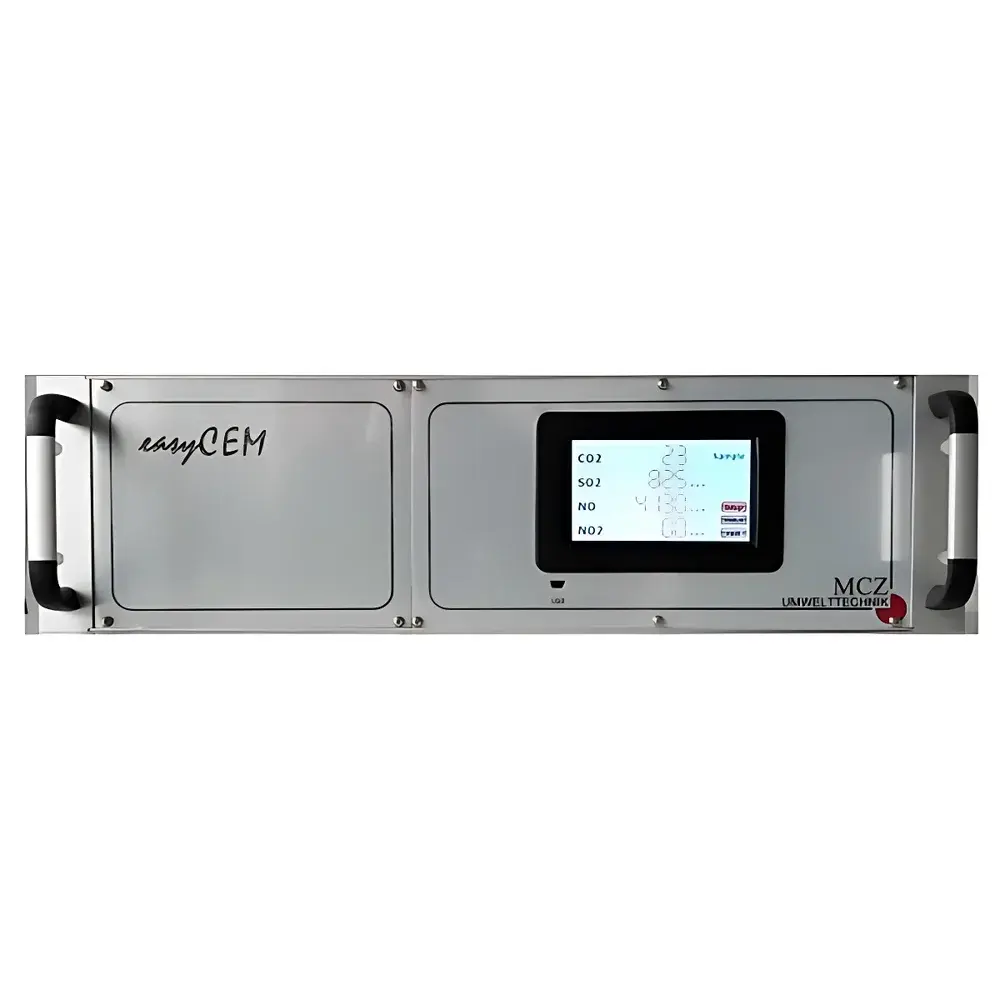
EasyCEM Exhaust Emission Multicomponent Gas Analyzer
| Origin | Germany |
|---|---|
| Manufacturer Type | Authorized Distributor |
| Origin Category | Imported |
| Model | EasyCEM |
| Price Range | USD 70,000–140,000 (FOB) |
| Instrument Principle | NDIR, TDLS, NDUV, PID, EC hybrid optical/electrochemical sensing |
| Product Type | Online Continuous Emission Monitoring System |
| Response Time | t₉₀ < 2 s at 60 L/h |
| Repeatability | ±0.5 % of span and zero |
| Gas Measurement Methods | NDIR for CO, CO₂, NO, SO₂, SF₆, THC |
Overview
The EasyCEM Exhaust Emission Multicomponent Gas Analyzer is an online, rack-mountable continuous emission monitoring system engineered for high-precision, real-time quantification of regulated and process-critical gaseous pollutants in industrial exhaust streams. Designed and assembled in Germany under strict quality control protocols, the EasyCEM employs a modular multi-principle architecture—integrating non-dispersive infrared (NDIR), tunable diode laser spectroscopy (TDLS), non-dispersive ultraviolet (NDUV), photoionization detection (PID), and electrochemical (EC) sensing technologies within a single 19-inch chassis. This hybrid approach enables simultaneous, interference-resistant measurement of up to four gas components with minimal cross-sensitivity, supporting compliance with EN 15267, EN 14181, and ISO 14001-based emission reporting frameworks. The analyzer operates continuously under ambient temperatures from 0 °C to 45 °C, with a warm-up time of less than three minutes and calibrated response times meeting stringent regulatory thresholds for dynamic stack monitoring.
Key Features
- Modular sensor architecture supporting configurable combinations of NDIR, TDLS, NDUV, PID, and EC detection modules
- Simultaneous analysis of up to four gas species—including CO, CO₂, NO, NO₂, SO₂, NH₃, HCl, CH₄, SF₆, THC, O₂, O₃, and VOCs—within a single 19-inch rack unit
- Rapid response performance: t₉₀ < 2 seconds at nominal sample flow (60 L/h); t₉₀ < 1 second at elevated flow (180 L/h)
- High metrological stability: repeatability of ±0.5 % of span and zero; accuracy of ±2 % of full scale
- Digital communication via RS232 interface; optional analog output (1–10 V DC), integrated sampling pump, flow meter, particulate filtration, and programmable alarm relays
- Robust mechanical design: aluminum chassis compliant with IEC 60297-3-100; weight range 8–14 kg depending on configuration
- Low thermal drift: temperature coefficient < 1 % of range per 10 K, enabling stable operation across unconditioned plant environments
Sample Compatibility & Compliance
The EasyCEM is validated for use with hot, humid, and particulate-laden flue gases typical of combustion processes (e.g., cement kilns, waste incinerators, power boilers, and chemical reactors). Sample conditioning is supported via optional heated filter housings and Nafion™ dryers to mitigate condensation and aerosol interference. All core measurement methods conform to internationally recognized standards: NDIR modules comply with EN 14792 for CO/CO₂/SO₂; TDLS channels meet EN 15446 requirements for NH₃ and HCl; electrochemical O₂ sensors are certified to EN 50104; and PID-based THC/VOC measurements align with EPA Method 25A and ISO 16000-6 traceability guidelines. The system supports audit-ready data logging and is compatible with GLP/GMP environments when paired with timestamped digital output and external secure storage.
Software & Data Management
The EasyCEM operates without proprietary PC software—its embedded firmware provides local parameter configuration, calibration management, and diagnostic self-tests via front-panel navigation. All measurement data are transmitted as ASCII-formatted strings over RS232, enabling seamless integration into SCADA, DCS, or environmental data acquisition systems (EDAS). Output includes real-time concentration values (ppm or vol%), status flags (e.g., sensor fault, flow error, calibration due), and timestamped event logs. Optional firmware upgrades support Modbus RTU protocol and extended memory buffering for offline operation during network outages. While not FDA 21 CFR Part 11–certified out-of-the-box, the system’s deterministic digital output and immutable serial log structure facilitate validation in regulated manufacturing settings when deployed with validated third-party data historians.
Applications
- Continuous emission monitoring (CEMS) for regulatory reporting under EU IED Directive, US EPA 40 CFR Part 60, and China’s GB 13223
- Process optimization and combustion control in thermal power plants, glass furnaces, and metallurgical facilities
- Ammonia slip monitoring in SCR denitrification systems
- Hydrochloric acid and sulfur dioxide tracking in municipal solid waste incineration
- THC and VOC emissions verification in paint booths, coating lines, and pharmaceutical solvent recovery units
- Lab-scale method development and reference instrument validation for gas standard generation and inter-laboratory comparison studies
FAQ
What gas species can the EasyCEM measure simultaneously?
Up to four gas components may be measured concurrently—selected from CO, CO₂, NO, NO₂, SO₂, NH₃, HCl, CH₄, SF₆, THC, O₂, O₃, and VOCs—depending on installed sensor modules.
Is the EasyCEM suitable for high-dust or corrosive flue gas applications?
Yes, when equipped with optional heated inlet filters, Teflon-lined sample lines, and corrosion-resistant NDIR/TDLS optical cells; pre-conditioning modules are recommended for gas streams exceeding 5 mg/m³ particulate load.
Does the system require daily calibration?
No—zero and span checks are typically performed weekly or biweekly per EN 14181 QAL2 requirements; automatic zero compensation algorithms reduce drift-related maintenance frequency.
Can the EasyCEM integrate with existing plant automation systems?
Yes—via RS232 ASCII output or optional Modbus RTU; analog 1–10 V DC signals are available for legacy PLC interfacing.
What certifications does the EasyCEM hold?
CE-marked per EMC Directive 2014/30/EU and Low Voltage Directive 2014/35/EU; individual sensor modules carry EN 14792, EN 15446, and EN 50104 type approvals; full CEMS certification requires site-specific QAL1/QAL2 validation.
Related Products







