
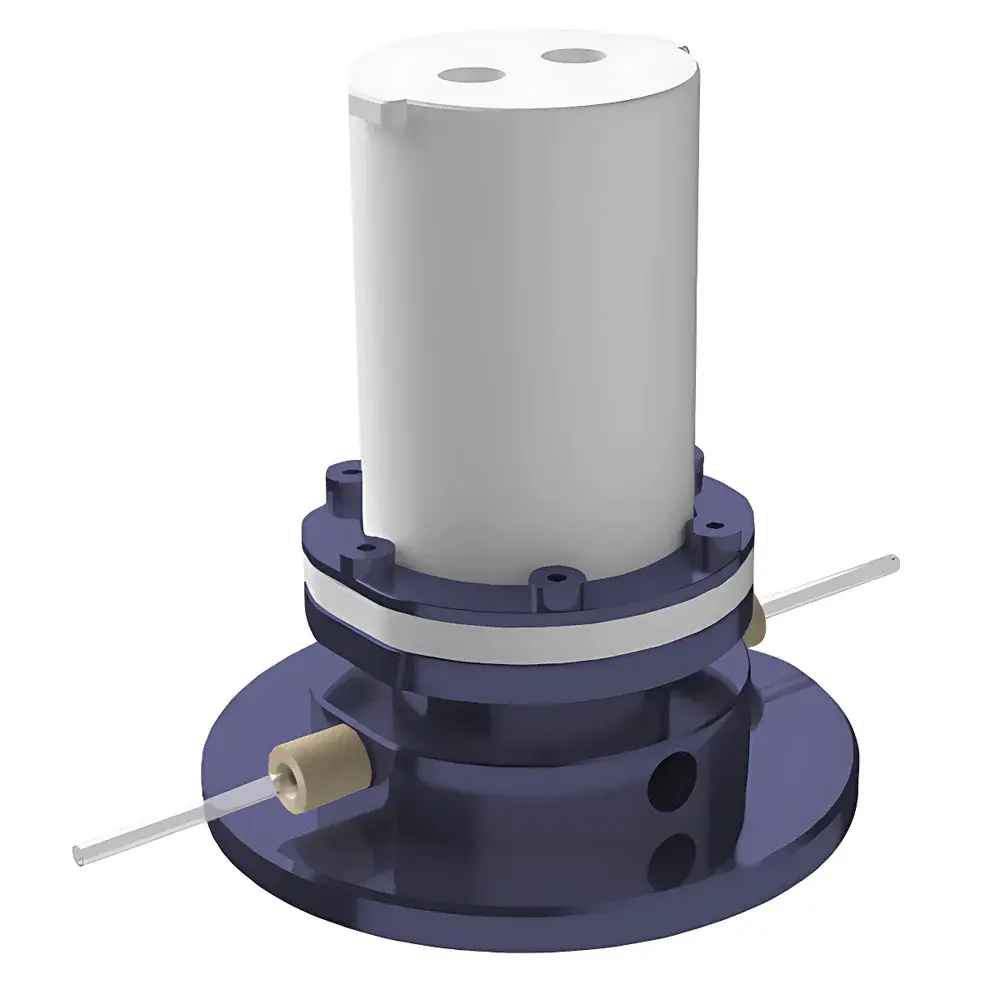
EWIN-TECH HC-100 Redox Catalyst Testing Fixture
| Brand | EWIN-TECH |
|---|---|
| Origin | Shanghai, China |
| Manufacturer Type | OEM/ODM Producer |
| Country of Origin | China |
| Model | HC-100 |
| Material | PEEK + 316L Stainless Steel + PFA |
| Active Area | 0.5 cm² |
| Operating Temperature Range | Ambient to 95 °C |
| Relative Humidity Control | Up to 100 % RH |
| Gas Supply Interface | Standardized mass flow-controlled O₂ inlet |
| Electrolyte Compatibility | Acidic (e.g., 0.1 M HClO₄, 0.5 M H₂SO₄) and alkaline media |
| Three-Phase Interface Design | Gas–Solid–Liquid |
| Compliance | Designed for ASTM D7212, ISO 23841, and fuel cell catalyst R&D workflows per DOE Hydrogen Program Targets |
Overview
The EWIN-TECH HC-100 Redox Catalyst Testing Fixture is an engineered electrochemical test platform designed to bridge the performance gap between conventional rotating disk electrode (RDE) measurements and real-world membrane electrode assembly (MEA) operation in proton exchange membrane fuel cells (PEMFCs) and electrolyzers. Unlike traditional RDE systems—where oxygen transport is limited by aqueous solubility and diffusion kinetics—the HC-100 implements a gas-diffusion-layer-integrated three-phase boundary architecture. This design enables direct gaseous O₂ delivery to the catalyst surface under controlled flow, pressure, and humidity, thereby eliminating dissolved-oxygen mass transport limitations that constrain RDE-derived kinetic analysis (typically yielding ≤6 mA/cm² at 1600 rpm). The fixture operates on the principle of localized electrochemical impedance spectroscopy (LEIS), linear sweep voltammetry (LSV), and chronoamperometry within a physically representative micro-environment, supporting quantitative evaluation of intrinsic catalyst activity, durability, and interfacial charge-transfer resistance under MEA-relevant conditions.
Key Features
- True MEA-mimetic configuration: Integrated gas diffusion layer (GDL) mounting with precise clamping force control ensures reproducible catalyst–electrolyte–gas contact geometry.
- Full environmental controllability: Independent regulation of temperature (ambient to 95 °C) and relative humidity (10–100 % RH) via integrated humidification module and PID-controlled heating jacket.
- Multi-physics operational fidelity: Simultaneous coupling of gas-phase O₂ supply, liquid-phase electrolyte feed, solid-phase catalyst loading, and electrical biasing enables concurrent thermal, hydraulic, and electrochemical stress application.
- Chemically inert construction: Wetted components fabricated from PEEK (polyether ether ketone), ASTM F138-certified 316L stainless steel, and perfluoroalkoxy (PFA) tubing—validated for long-term exposure to <1 M acidic electrolytes (e.g., HClO₄, H₂SO₄) and oxidizing potentials up to +1.2 V vs. RHE.
- Modular scalability: Standard 0.5 cm² active area accommodates standard catalyst ink deposition protocols; optional custom flow-field geometries, larger active zones (up to 5 cm²), or dual-chamber configurations available upon request.
Sample Compatibility & Compliance
The HC-100 supports catalyst layers deposited on carbon paper, sputtered thin films, or spray-coated electrodes, with compatibility verified for Pt/C, PtCo/C, Fe–N–C, and non-PGM catalyst systems. Its mechanical and chemical design conforms to key industry reference standards including ASTM D7212 (standard test method for determining oxygen reduction reaction activity of PEMFC catalysts), ISO 23841 (fuel cell testing—catalyst characterization), and DOE Hydrogen Program technical targets for specific activity and mass activity reporting. All sealing interfaces meet ISO 2852 hygienic clamp specifications, ensuring leak-tight operation at differential pressures up to 3 bar(g). The system architecture supports GLP-compliant data acquisition when paired with validated potentiostats (e.g., BioLogic SP-300, Gamry Interface 5000E) and audit-trail-enabled software.
Software & Data Management
While the HC-100 is a hardware-only fixture, it integrates natively with third-party electrochemical workstations supporting standard USB/Ethernet communication protocols. Raw current–voltage curves, impedance spectra, and time-resolved potential step responses are acquired using instrument-specific drivers compatible with MATLAB, Python (via PyGamry or EC-Lab SDK), and LabVIEW environments. For regulatory traceability, users may configure automated metadata tagging—including ambient lab conditions, gas flow rates, electrolyte batch IDs, and operator credentials—to satisfy 21 CFR Part 11 requirements when deployed in GMP-aligned R&D labs. Export formats include .mpt, .txt, and .csv, enabling direct import into catalyst performance databases such as the U.S. DOE’s Catalyst Database or the European Fuel Cells and Hydrogen Joint Undertaking (FCH JU) repository.
Applications
- Quantitative ORR activity screening: Derivation of kinetic current density (jk), electron transfer number (n), and Tafel slopes under variable O₂ partial pressure and humidity.
- Catalyst degradation profiling: Accelerated stress tests (ASTs) simulating voltage cycling (0.6–1.0 V vs. RHE), hold-time oxidation, and start-stop corrosion protocols.
- Ionomer–catalyst interaction studies: Evaluation of Nafion® equivalent weight effects, sulfonic acid group distribution, and water uptake influence on local proton conductivity.
- Electrode structure–function correlation: Correlation of TEM/XRD-derived particle size distributions with macroscopic polarization behavior under realistic gas-feed conditions.
- Scale-up validation: Benchmarking lab-scale catalyst ink formulations against single-cell MEA performance metrics prior to stack integration.
FAQ
Does the HC-100 require a dedicated potentiostat or gas controller?
No—it is a passive mechanical fixture. Users must provide a compatible bipotentiostat (for RRDE mode) or single-channel potentiostat, along with mass flow controllers (MFCs) for O₂/N₂ and humidified carrier gas lines.
Can the fixture be used for hydrogen evolution reaction (HER) testing?
Yes, with appropriate reconfiguration of gas inlets and electrolyte selection (e.g., 0.1 M KOH for alkaline HER), though primary validation focuses on oxygen reduction reaction (ORR) and oxygen evolution reaction (OER) kinetics.
Is the 0.5 cm² active area fixed, or can it be modified?
The standard configuration uses a 0.5 cm² circular aperture; however, custom apertures (square, elliptical, or segmented) and active areas ranging from 0.1 to 5 cm² are available under OEM engineering support.
How is temperature uniformity across the catalyst layer ensured?
A thermally conductive aluminum heating block with embedded PT100 sensor and closed-loop PID feedback maintains ±0.5 °C stability across the entire electrode plane during steady-state operation.
What maintenance procedures are recommended for long-term use?
Quarterly inspection of PFA O-rings, ultrasonic cleaning of 316L flow channels in 5 % citric acid solution, and verification of PEEK compression set using calibrated torque wrenches per assembly protocol.



