
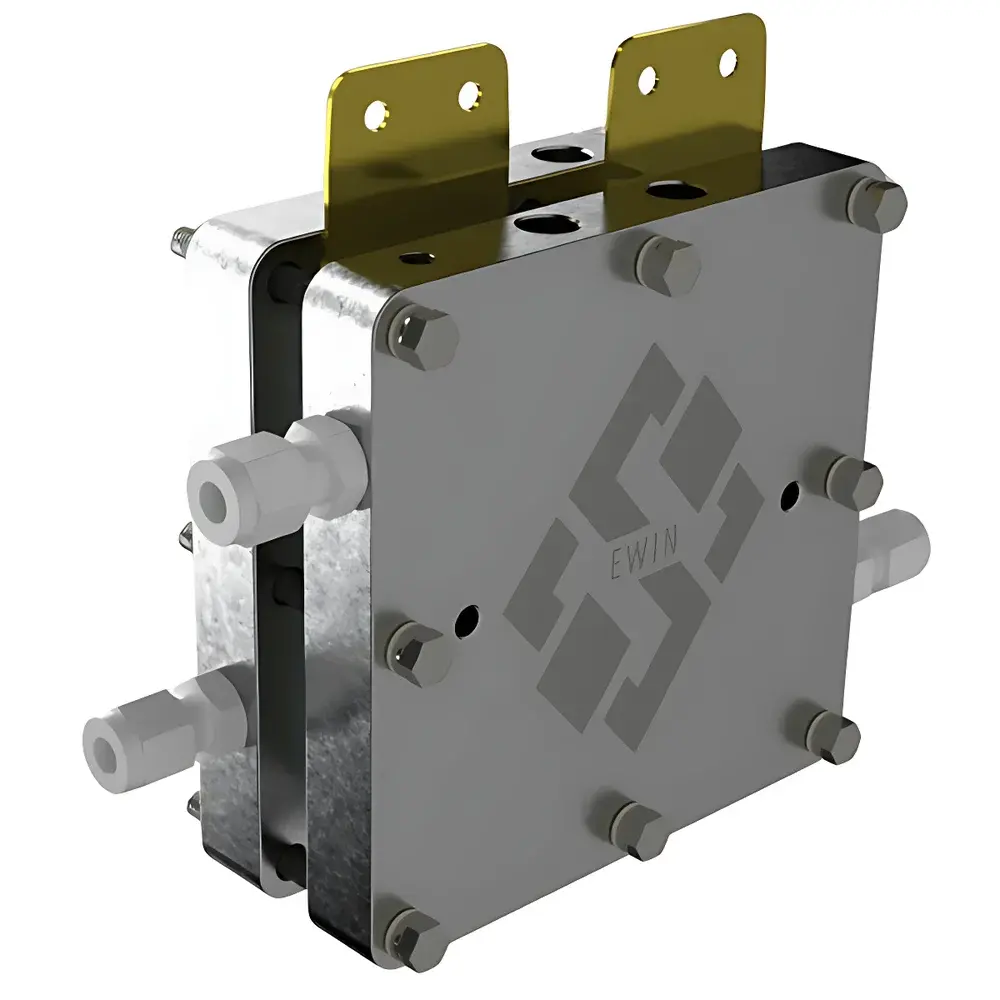
EWIN-TECH HP-300 PEM Water Electrolysis Test Fixture
| Brand | EWIN-TECH |
|---|---|
| Origin | Shanghai, China |
| Manufacturer Type | OEM/ODM Producer |
| Country of Origin | China |
| Model | HP-300 |
| Temperature Range | RT+5°C to 90°C |
| Maximum Operating Pressure | 3–5 MPa |
| Flow Configuration | Bottom-in/Top-out (single-sided) |
| Customization | Active Area, Flow Field Design, Core Material |
Overview
The EWIN-TECH HP-300 PEM Water Electrolysis Test Fixture is an engineered electrochemical cell assembly designed for laboratory-scale evaluation of proton exchange membrane (PEM) electrolyzer components—specifically membrane electrode assemblies (MEAs), catalyst layers, and bipolar plates. It operates on the principle of controlled galvanostatic/potentiostatic polarization under pressurized, temperature-regulated conditions, enabling quantitative measurement of key performance indicators including polarization curves (i–V), electrochemical impedance spectroscopy (EIS), and electrochemical active surface area (ECSA) via hydrogen underpotential deposition (H-UPD) or CO-stripping protocols. The fixture integrates mechanical clamping, thermal management interfaces, gas/liquid feed ports, and electrical busbar connections into a single robust platform compliant with standard PEM electrolysis test protocols defined in ASTM D7841-22 and ISO 22734-2.
Key Features
- High-Pressure & High-Temperature Compatibility: Engineered with stainless steel 316L endplates and fluoropolymer-sealed compression zones, the HP-300 supports continuous operation at pressures up to 5 MPa and temperatures from ambient +5°C to 90°C—enabling accelerated stress testing aligned with industrial PEM stack operating envelopes.
- Modular, Single-Sided Fluid Architecture: Implements a bottom-in/top-out flow configuration that ensures uniform reactant distribution across the active area while minimizing gas crossover and pressure drop asymmetry—critical for reproducible kinetic analysis and accurate mass transport correction.
- Customizable Electrochemical Interface: Standard active areas include 5 cm² and 25 cm² configurations; optional custom geometries (e.g., serpentine, interdigitated, or grid-based flow fields) and substrate materials (Ti-coated graphite, machined titanium, or porous transport layers) are available per client specification.
- Electrical Isolation & Safety Compliance: All current-collecting components feature double-insulated busbars and grounded shielding; the fixture meets IEC 61000-6-3 EMC emission limits and incorporates overpressure relief pathways certified to PED 2014/68/EU Annex I requirements.
- Instrumentation-Ready Integration: Equipped with standardized M6 threaded ports for integration with commercial potentiostats (e.g., BioLogic SP-300, Gamry Interface 5000P), mass flow controllers (MFCs), back-pressure regulators (BPRs), and temperature sensors (PT100 Class A).
Sample Compatibility & Compliance
The HP-300 accommodates standard 20–50 µm Nafion® membranes (e.g., N115, N117, N212), catalyst-coated membranes (CCMs), and gas diffusion layers (GDLs) with PTFE loading ≤10 wt%. It supports both liquid-fed (deionized water) and vapor-fed operation modes. All wetted components comply with USP Class VI biocompatibility standards and are compatible with hydrogen, oxygen, and humidified inert gas environments. The design conforms to GLP documentation requirements for traceable test cell assembly records and supports audit-ready calibration logs when paired with validated temperature and pressure transducers.
Software & Data Management
While the HP-300 is a hardware-only fixture, it is fully interoperable with industry-standard electrochemical data acquisition platforms—including EC-Lab (BioLogic), Framework (Gamry), and NOVA (Metrohm Autolab). When used with compliant potentiostats, the system enables automated sequence execution (e.g., cyclic voltammetry → EIS → chronoamperometry), real-time impedance modeling (Randles, transmission line), and export of raw data in .mpt, .z, or .txt formats. All acquired datasets support metadata tagging for experimental parameters (T, P, RH, flow rate), satisfying 21 CFR Part 11 requirements when deployed within validated LIMS or ELN environments.
Applications
- Accelerated durability testing (ADT) of low-iridium and iridium-free anode catalysts under dynamic load cycling (0.1–2.5 A/cm²)
- Mass transport resistance quantification via limiting current analysis in high-pressure differential conditions
- Interfacial contact resistance (ICR) mapping between MEA and bipolar plate using four-point probe configurations
- Validation of novel microporous layer (MPL) architectures for improved water management in zero-gap assemblies
- Correlation of in-situ ECSA decay with post-mortem TEM/XPS analysis of catalyst dissolution and support corrosion
FAQ
Is the HP-300 compatible with automated test stands?
Yes—the fixture’s standardized port layout and mechanical footprint allow seamless integration with robotic sample handlers and multi-cell test racks equipped with pneumatic clamping and digital pressure control.
Can the active area be scaled beyond 25 cm²?
Yes—custom versions supporting 100 cm² and larger active areas are available with reinforced torque-controlled clamping and distributed load compensation to ensure uniform gasket compression.
Does EWIN-TECH provide calibration certificates for pressure/temperature sensors?
Calibration services are offered separately per ISO/IEC 17025-accredited third-party labs; sensor mounting points are designed to accept traceable PT100 and piezoresistive transducers with NIST-traceable documentation.
What sealing materials are used for high-temperature operation?
Viton® AFLAS® and Kalrez® 6375 elastomers are standard for >80°C applications; metallic C-rings are available upon request for ultra-high-purity or fluoride-ion resistant environments.
Is the fixture suitable for anion exchange membrane (AEM) electrolysis testing?
Yes—with minor modifications to gasket chemistry and current collector passivation, the HP-300 has been successfully adapted for AEM MEA characterization under alkaline conditions (pH >13) and moderate pressure (≤2 MPa).



