
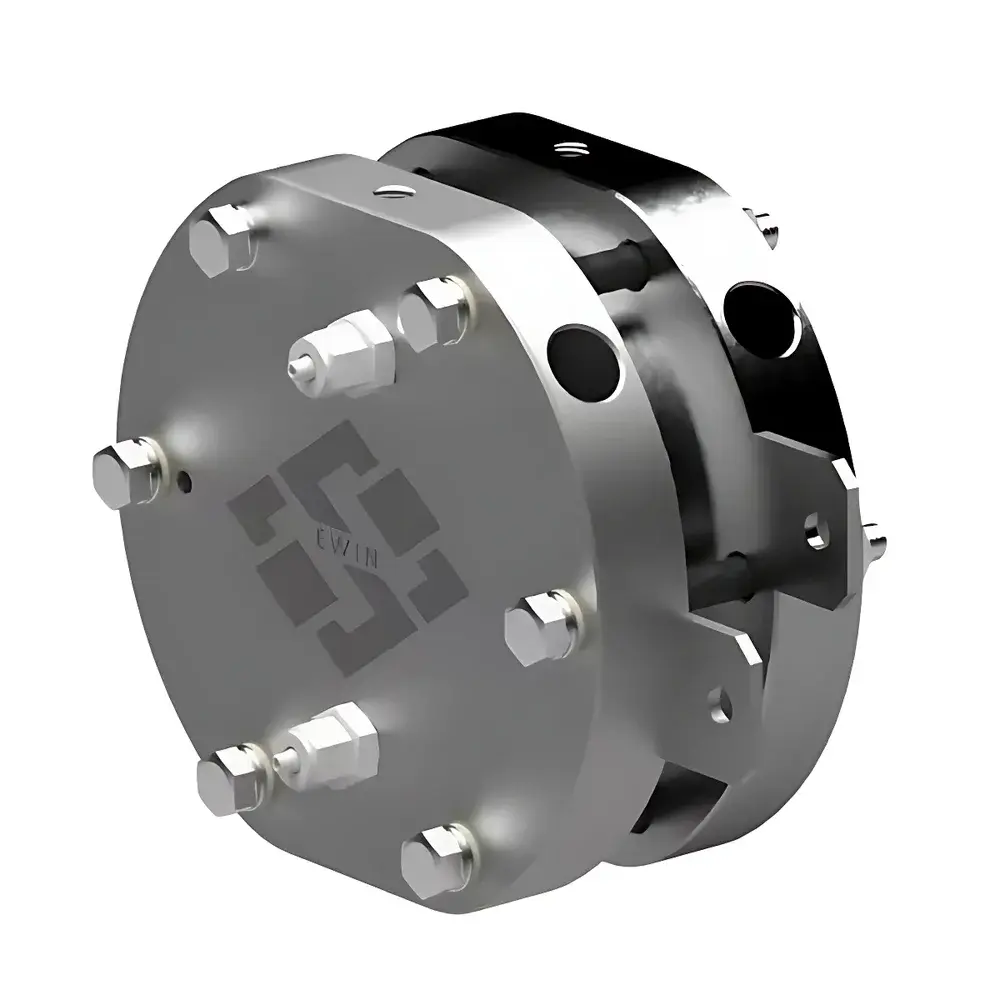
EWIN-TECH HA-300 Anion Exchange Membrane (AEM) Water Electrolysis Testing Fixture
| Brand | EWIN-TECH |
|---|---|
| Origin | Shanghai, China |
| Manufacturer Type | Original Equipment Manufacturer (OEM/ODM) |
| Country of Origin | China |
| Model | HA-300 |
| Pressure Rating | 3–5 MPa |
| Construction Material | 316L Stainless Steel Endplates, Nickel-Plated Flow Field Plates |
| Fluid Configuration | Single-Side Inlet/Outlet (Bottom-In/Top-Out) |
| Active Area | Customizable |
| Interface | Open Mechanical & Electrical Interface for User-Provided MEA/GDL |
| Compliance | Designed for ASTM D7284, ISO 22742, and IEC 62282-6-100-aligned test protocols |
Overview
The EWIN-TECH HA-300 Anion Exchange Membrane (AEM) Water Electrolysis Testing Fixture is a precision-engineered, modular hardware platform designed for controlled electrochemical characterization of AEM electrolyzer components under realistic operating conditions. It operates on the principle of galvanostatic/potentiostatic polarization in a sealed, pressure-regulated cell configuration, enabling quantitative assessment of membrane-electrode assembly (MEA) performance—including kinetic overpotentials, ohmic resistance, mass transport limitations, and long-term voltage stability. Unlike generic fuel cell fixtures, the HA-300 integrates structural and fluidic design features specific to AEM systems: low-catalyst-loading compatibility, hydroxide-ion-conductive membrane constraints, and asymmetric gas evolution environments (H₂ anode / O₂ cathode). Its mechanical architecture supports both laboratory-scale catalyst screening and pre-qualification testing aligned with DOE Hydrogen Program targets and EU Green Hydrogen Certification Framework requirements.
Key Features
- High-Pressure Structural Integrity: Dual 316L stainless steel endplates with CNC-machined sealing grooves and calibrated torque specifications ensure leak-tight operation up to 5 MPa—enabling evaluation of pressurized AEM stacks without compromising MEA integrity or interfacial contact resistance.
- Electrochemically Stable Flow Field Design: Nickel-plated bipolar plates feature laser-etched serpentine or interdigitated flow channels optimized for uniform current distribution and minimal pressure drop across customizable active areas (standard range: 5–50 cm²; scalable upon request).
- Modular Single-Side Fluid Architecture: Bottom-in/top-out flow orientation eliminates cross-contamination risks between anolyte and catholyte streams, simplifies gas–liquid separation, and ensures consistent wetting of the AEM layer during dynamic load cycling.
- Open Interface Standardization: 8-M6 threaded ports (4× electrical feedthroughs, 2× gas inlets, 2× liquid outlets) conform to DIN 32984 and PEM/AEM industry mounting conventions—allowing seamless integration with third-party potentiostats, gas chromatographs, dew point analyzers, and humidification modules.
- Thermal & Electrical Isolation: Integrated ceramic insulators and PTFE gasketing provide >10⁹ Ω insulation resistance at 80°C, supporting accurate four-terminal sensing and eliminating stray current paths during high-resolution impedance spectroscopy (EIS).
Sample Compatibility & Compliance
The HA-300 accommodates user-supplied AEM-based MEAs—including commercial and lab-fabricated variants—with thicknesses ranging from 120–350 µm and catalyst loadings as low as 0.1 mgₚₜ/cm². It supports both liquid-fed (alkaline KOH/K₂CO₃ electrolytes) and zero-gap membrane-fed configurations. All wetted surfaces comply with ASTM G155 (corrosion resistance in alkaline media) and ISO 15142-2 (electrochemical test cell safety). The fixture’s mechanical design facilitates GLP-compliant documentation per ISO/IEC 17025:2017—supporting traceable calibration of pressure transducers, temperature sensors, and current shunts used in conjunction with external instrumentation.
Software & Data Management
While the HA-300 is a hardware-only platform (no embedded firmware), its mechanical and interface design ensures full interoperability with industry-standard electrochemical software suites—including BioLogic EC-Lab, Gamry Framework, and Princeton Applied Research VersaStudio. When paired with compliant potentiostats, it enables automated execution of I–V sweeps, chronopotentiometry, accelerated stress tests (ASTs), and multi-step EIS protocols. All raw voltage, current, temperature, and pressure data are timestamped and exportable in .txt/.csv formats—compatible with MATLAB, Python (Pandas/SciPy), and LabVIEW for post-test analysis, uncertainty propagation modeling, and degradation rate quantification per US Department of Energy’s AEM durability protocol v2.1.
Applications
- Screening of non-precious metal catalysts (e.g., NiFe LDH, CoPi, MnOₓ) for oxygen evolution reaction (OER) kinetics in carbonate/bicarbonate electrolytes
- Evaluation of anion exchange membrane chemical stability under high-pH, elevated temperature (up to 80°C), and variable current density (0–2 A/cm²)
- Quantitative comparison of flow field geometries (serpentine vs. pin-type) on hydrogen crossover, bubble detachment efficiency, and local current density uniformity
- Accelerated lifetime testing (ALT) including open-circuit voltage decay, cyclic voltammetry aging, and hold-at-current stress sequences per IEC 62282-6-100 Annex B
- Integration into automated test benches for AI-driven materials discovery pipelines requiring high-throughput, reproducible polarization data
FAQ
Does the HA-300 include integrated sensors or electronics?
No—the HA-300 is a passive, sensor-free mechanical fixture. All instrumentation (potentiostat, pressure transducers, thermocouples, gas analyzers) must be externally supplied and interfaced via standard analog/digital I/O.
Can it be used for proton exchange membrane (PEM) electrolysis testing?
Not without modification. Its flow field geometry, sealing profile, and material selection are specifically validated for AEM systems; PEM applications require acid-resistant coatings and different gasket chemistries.
What is the recommended torque sequence for endplate assembly?
A star-pattern tightening sequence to 8.5 ± 0.3 N·m per M6 fastener is specified in the included mechanical installation guide to ensure uniform clamping force and prevent MEA delamination.
Is third-party calibration support available for the fixture’s pressure interface?
Yes—EWIN-TECH provides NIST-traceable calibration certificates for optional integrated pressure port adapters (0–10 MPa range), issued by CNAS-accredited laboratories in Shanghai.
How is gasket replacement handled during routine maintenance?
The fixture uses replaceable, pre-cut fluorosilicone gaskets (Shore A 60) with defined compression set limits; a gasket lifetime log template is provided for audit-ready maintenance tracking per ISO 9001:2015 clause 7.1.5.



