
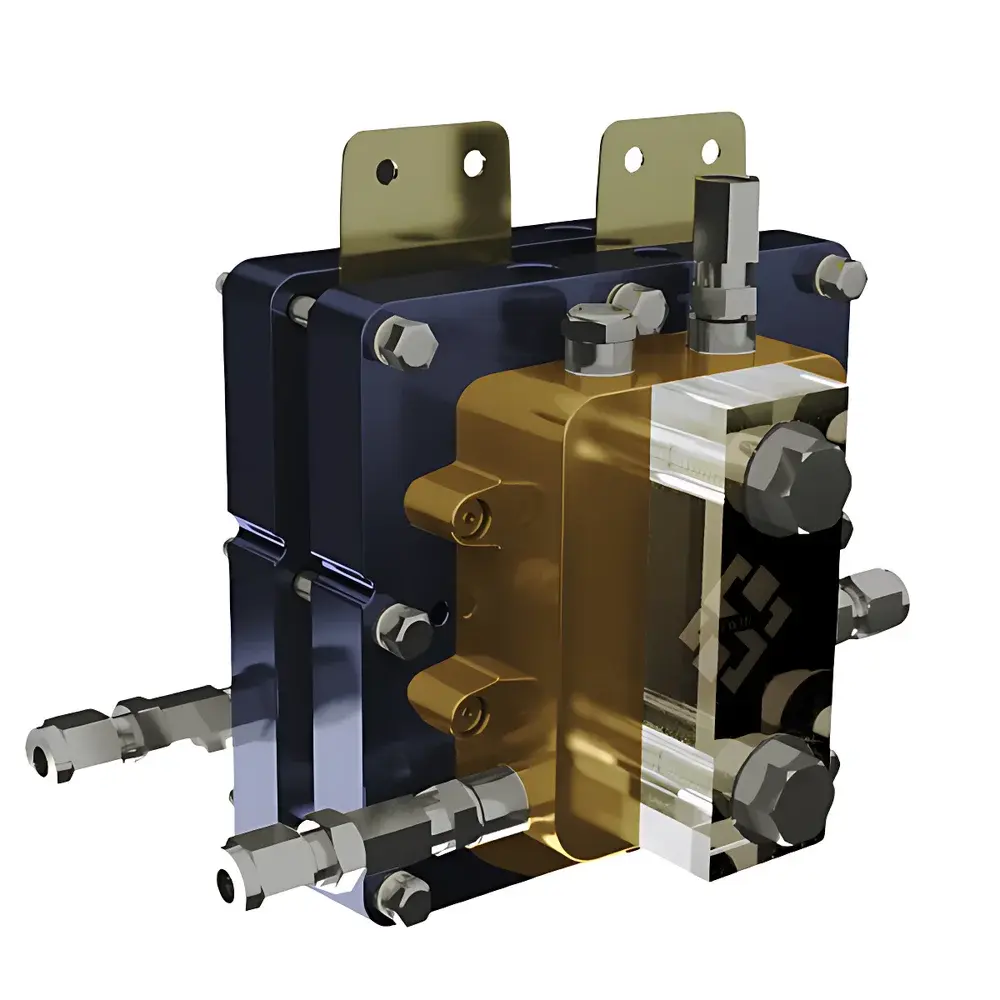
EWIN-TECH HM-200H Self-Humidifying PEM Fuel Cell Membrane Electrode Assembly (MEA) Test Fixture
| Brand | EWIN-TECH |
|---|---|
| Origin | Shanghai, China |
| Manufacturer Type | OEM/ODM Producer |
| Country of Origin | China |
| Model | HM-200H |
| Pricing | Available Upon Request |
| Humidity Control | Integrated 100% RH self-humidification module |
| MEA Active Area | 5 cm × 5 cm (standard) |
| Flow Field Options | Customizable (serpentine, interdigitated, parallel) |
| End Plate Material | 316L stainless steel |
| Current Collector | Gold-plated copper |
| Bipolar Plate Material | Graphite |
| Electrical Connection | Four-terminal Kelvin sensing compatible |
| Operating Temperature Range | 25–80 °C (ambient to mild thermal control support) |
Overview
The EWIN-TECH HM-200H Self-Humidifying PEM Fuel Cell Membrane Electrode Assembly (MEA) Test Fixture is an engineered solution for laboratory-scale electrochemical characterization of proton exchange membrane fuel cell components. Designed around the principle of integrated membrane hydration control, the fixture eliminates external humidification subsystems by incorporating a built-in water management system that maintains stoichiometric water vapor saturation (100% relative humidity) directly at the catalyst layer interface. This architecture enables stable, reproducible operation under fully hydrated conditions—critical for isolating kinetic and ohmic losses during polarization curve acquisition, electrochemical impedance spectroscopy (EIS), and hydrogen crossover current density measurement. Unlike conventional test fixtures requiring external bubbler systems, humidified gas lines, or complex dew-point controllers, the HM-200H achieves passive, self-regulated humidification through capillary-driven water transport and thermally balanced vapor diffusion pathways—reducing system complexity, gas consumption, and experimental variability.
Key Features
- Integrated 100% RH self-humidification: No external humidifiers, bubblers, or humidity controllers required—enables rapid setup and consistent hydration across repeated MEA evaluations.
- Four-terminal Kelvin sensing configuration: Minimizes contact resistance error during low-impedance ohmic overpotential measurements and high-current-density polarization analysis.
- Modular flow field compatibility: Supports interchangeable graphite bipolar plates with user-selectable channel geometries—including serpentine, interdigitated, and parallel designs—to assess mass transport effects on performance.
- Corrosion-resistant construction: 316L stainless steel end plates provide mechanical rigidity and long-term stability in acidic PEM environments; gold-plated copper current collectors ensure low-contact-resistance interfaces without oxidation-induced drift.
- Standardized 25 cm² active area (5 cm × 5 cm): Aligns with DOE-recommended MEA testing protocols and facilitates direct comparison with industry benchmark data.
- Thermally isolated design: Optimized gasketing and low-conductivity fasteners minimize parasitic heat loss, supporting reliable operation within 25–80 °C ambient-to-moderate-heating regimes.
Sample Compatibility & Compliance
The HM-200H accommodates standard 5 cm × 5 cm MEAs with Nafion-based membranes (e.g., N115, N117, N212) and Pt/C or PtCo catalyst layers. It is compatible with both hot-pressed and catalyst-coated membrane (CCM) configurations. The fixture meets mechanical and electrical requirements outlined in ASTM D7249–22 (Standard Practice for Testing Proton Exchange Membrane Fuel Cell Components) and supports test methodologies referenced in DOE Hydrogen and Fuel Cells Program guidelines. All wetted materials comply with USP Class VI biocompatibility standards for inertness, and the assembly is suitable for GLP-compliant lab documentation when paired with validated potentiostats and data acquisition systems.
Software & Data Management
While the HM-200H is a hardware-only fixture, it is fully interoperable with industry-standard electrochemical workstations (e.g., BioLogic SP-300, Gamry Interface 5000P, Princeton Applied Research VersaSTAT) and data acquisition platforms supporting IEEE 488 (GPIB), USB-TMC, or Ethernet-based SCPI command sets. When used with compliant software (e.g., EC-Lab, Framework, or custom Python/Matlab scripts), the fixture supports full audit trail generation, timestamped parameter logging, and export-ready datasets aligned with FAIR (Findable, Accessible, Interoperable, Reusable) principles. For regulated environments, integration with 21 CFR Part 11–compliant LIMS or ELN systems is achievable via standardized metadata tagging and digital signature workflows.
Applications
- Rapid screening of novel catalyst inks and ionomer dispersions under fully hydrated conditions.
- Quantification of hydrogen crossover current density (H₂ crossover) via linear sweep voltammetry (LSV) in nitrogen-purged cathode compartments.
- Electrochemical surface area (ECSA) determination using CO-stripping or hydrogen underpotential deposition (H-UPD) protocols.
- Ohmic resistance extraction from high-frequency resistance (HFR) values in EIS spectra collected at open-circuit voltage.
- Activation and concentration polarization deconvolution via segmented polarization curve analysis per DOE methodology.
- Accelerated stress testing (AST) of MEA durability under constant-current hold or cyclic load profiles with real-time hydration monitoring.
FAQ
Does the HM-200H require external humidification equipment?
No—the fixture contains a sealed, passive humidification chamber that sustains 100% RH at the membrane interface without external steam generators, bubblers, or humidified gas feeds.
Can it be used with non-standard MEA sizes?
The base configuration is optimized for 5 cm × 5 cm MEAs; custom end plate machining and gasket sets are available for 3 cm × 3 cm or 10 cm × 10 cm variants upon request.
Is the fixture compatible with automated test sequences?
Yes—it interfaces seamlessly with programmable potentiostats and scripting environments supporting sequential voltage/current ramping, EIS frequency sweeps, and multi-step AST protocols.
What maintenance is required for long-term reliability?
Routine inspection of graphite plate surface integrity, gold plating continuity, and silicone gasket elasticity is recommended every 200 operational hours; no consumables or recalibration are required.
How is temperature controlled during testing?
The fixture itself does not include active heating/cooling; it is designed for use with external climate chambers or heated/cold plates that maintain uniform stack temperature—typical operating range is 25–80 °C.



