
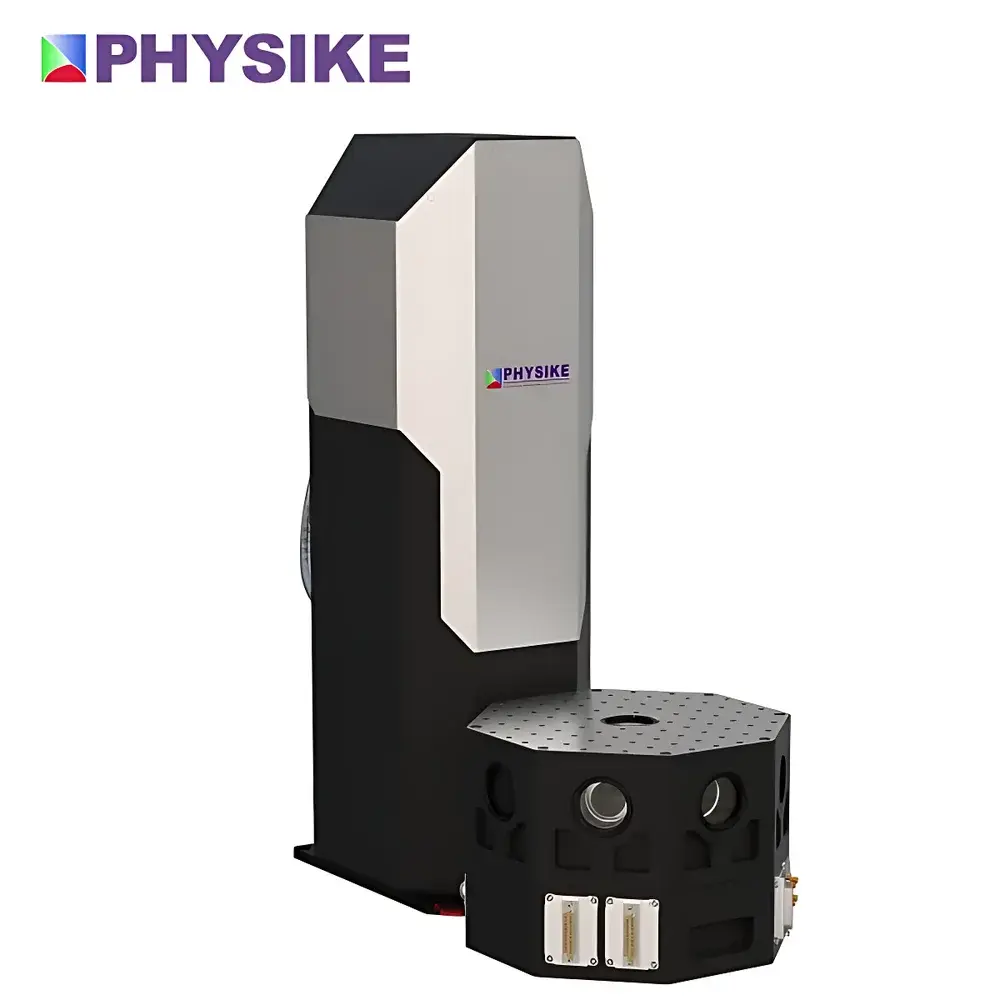
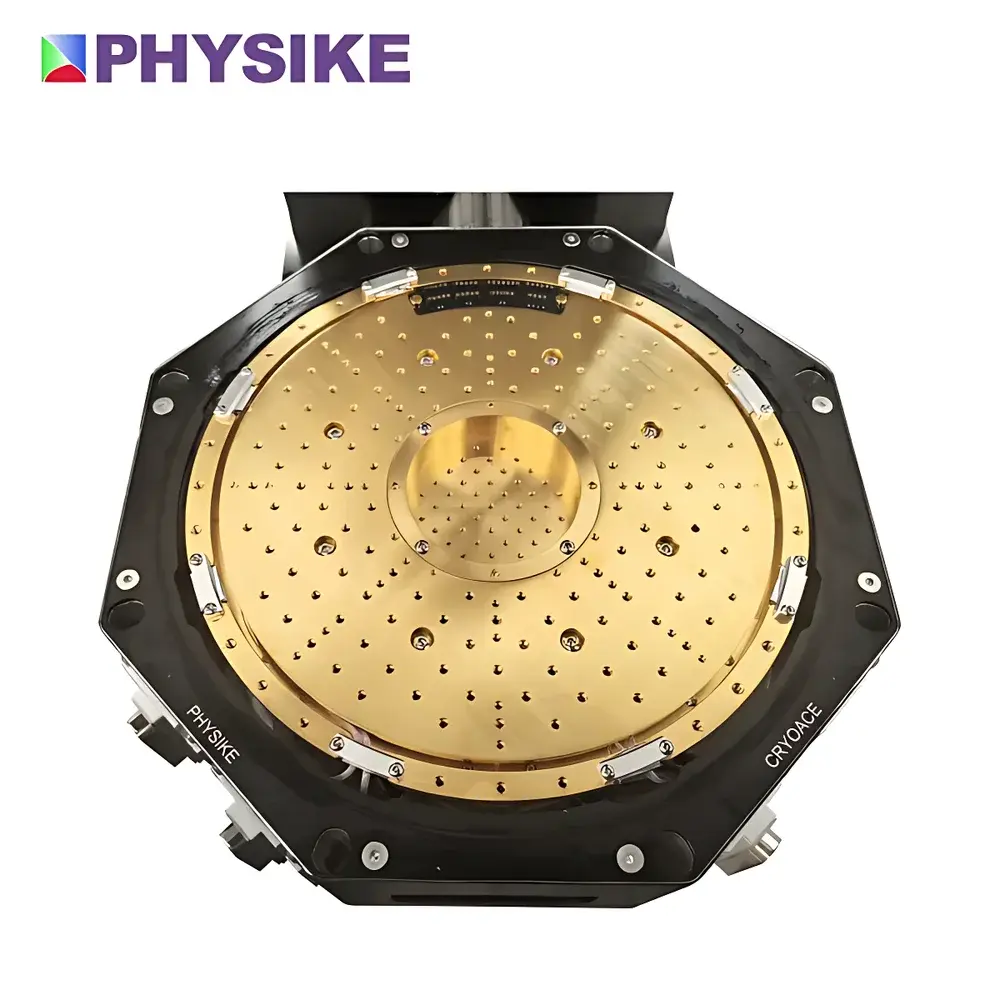
PHYSIKE CryoAce-200 Ultra-Stable Optical Microscopy Cryogenic Thermostat
| Brand | PHYSIKE |
|---|---|
| Origin | Beijing, China |
| Manufacturer Type | Direct Manufacturer |
| Model | CryoAce-200 |
| Vibration Stability | 12 nm (RMS) |
| Cooling Medium | Helium Gas |
| Baseplate Diameters Available | 5 cm, 10 cm, 15 cm, 20 cm |
| Base Temperature Range | 2.4 K – 3.2 K (dependent on configuration) |
| Standard Viewports | Top and/or Side |
| Power Supply | Single-Phase, Low Power Consumption |
| Footprint | Compact Desktop Form Factor |
Overview
The PHYSIKE CryoAce-200 is an ultra-stable, cryogen-free optical microscopy cryogenic thermostat engineered for high-resolution quantum and nanoscale optical experiments requiring both sub-kelvin temperatures and atomic-scale mechanical stability. It operates on a closed-cycle helium refrigeration principle, utilizing a high-efficiency pulse-tube or Gifford-McMahon cold head coupled with PHYSIKE’s proprietary suspended cold head vibration isolation architecture. This multi-stage mechanical decoupling—comprising active suspension mounts, low-resonance composite support struts, and vacuum-integrated damping elements—reduces transmitted mechanical noise to ≤12 nm RMS at base temperature (2.4–3.2 K), enabling stable optical alignment and long-term interferometric coherence in confocal, widefield, and super-resolution microscopy setups. Unlike conventional cryostats requiring deep-pit optical tables or external water-cooled compressors, the CryoAce-200 adopts a self-contained desktop form factor with integrated air-cooled helium compression, eliminating dependency on facility water lines or three-phase power. Its vacuum integrity is maintained autonomously via built-in cryosorption pumps, ensuring sustained high vacuum (<1×10⁻⁷ mbar) without continuous operation of external roughing or turbomolecular pumps.
Key Features
- Sub-15 nm RMS vibration stability at operating temperatures (2.4–3.2 K), validated by time-domain and frequency-domain laser Doppler vibrometry
- Modular baseplate options: 5 cm, 10 cm, 15 cm, and 20 cm diameters—each optimized for thermal uniformity and mechanical rigidity
- Integrated top and side optical viewports (fused silica, AR-coated, ≥90% transmission from 200 nm to 2.5 µm)
- Factory-calibrated platinum resistance thermometer (PT100/Pt1000) traceable to NIST standards, with ±5 mK absolute accuracy over full range
- Onboard capacitance-based vacuum gauge with digital readout and RS-232/USB interface
- Self-sustaining ultra-high vacuum system incorporating dual-stage 4 K cryosorption panels; achieves and maintains <5×10⁻⁸ mbar after initial pump-down
- Air-cooled helium compressor unit with <1.2 kW peak power draw and acoustic noise <58 dB(A) at 1 m
- Compatible with commercial nanopositioning stages (e.g., Attocube, Mad City Labs) and standard microscope objectives (including 100× NA 0.9 objective lenses)
Sample Compatibility & Compliance
The CryoAce-200 supports diverse sample geometries and experimental configurations typical of quantum optics and condensed matter physics laboratories. Its open-access design permits integration with scanning probe modules, fiber-coupled excitation/detection paths, and magnetic field coils (up to ±7 T with compatible bore adapters). The system complies with ISO 14644-1 Class 5 cleanroom handling protocols for internal components and adheres to IEC 61000-6-3 (EMC emission) and IEC 61000-6-2 (immunity) standards. All electrical interfaces meet UL 61010-1 safety requirements for laboratory equipment. For regulated environments—including GLP-compliant quantum sensing validation or FDA-regulated cryo-optical assay development—the system supports optional 21 CFR Part 11–compliant audit trail logging when paired with PHYSIKE’s CryoControl v3.2 software suite.
Software & Data Management
CryoControl v3.2 provides deterministic real-time temperature regulation (PID + feedforward control), synchronized vacuum monitoring, and automated cooldown/warm-up sequencing. The software features timestamped parameter logging (temperature, pressure, compressor status, vibration proxy metrics) at user-defined intervals (10 ms–10 s resolution), exportable in HDF5 and CSV formats for post-acquisition analysis in Python (NumPy, SciPy), MATLAB, or Igor Pro. Remote operation is supported via Ethernet (TCP/IP) or USB CDC, enabling integration into LabVIEW-based instrument control frameworks or Python-driven automation pipelines (e.g., QCoDeS). Audit trails include operator ID, parameter change history, and system event timestamps—fully compliant with ALCOA+ data integrity principles.
Applications
- Single-emitter spectroscopy of quantum dots, NV⁻ centers in diamond, and WSe₂ monolayers
- Cryogenic photoluminescence and resonance Raman mapping under magnetic fields
- Low-temperature single-molecule fluorescence imaging with TIRF or HILO illumination
- Optomechanical coupling experiments using high-Q microresonators or photonic crystal cavities
- Calibration-grade blackbody reference sources for IR detector characterization
- In situ cryo-optical trapping and manipulation of dielectric nanoparticles
FAQ
What is the minimum base temperature achievable with the CryoAce-200?
The system reaches 2.4 K under optimal vacuum and thermal anchoring conditions; actual base temperature depends on installed baseplate size, thermal load, and ambient room temperature.
Can the CryoAce-200 be operated continuously for >72 hours without intervention?
Yes—its integrated cryosorption pumps maintain high vacuum for >120 hours after initial pump-down, and the compressor duty cycle is dynamically managed to ensure uninterrupted operation.
Is third-party nanopositioner integration supported?
All standard piezoelectric and electrostatic nanopositioners with XYZ travel ≤25 µm and mounting hole patterns matching ANSI/ISO 801 are mechanically and electrically compatible.
Does the system require liquid cryogens or external chillers?
No—CryoAce-200 is fully cryogen-free and uses only gaseous helium circulated via its integrated air-cooled compressor.
How is vibration performance verified and documented?
Each unit undergoes factory metrology using a calibrated Polytec MSA-500 laser scanning vibrometer; full vibration spectral density (VSD) reports and time-domain displacement histograms are supplied with delivery documentation.



