


COMECAUSE IN-ZS300 Portable Soil Heavy Metal Analyzer
| Brand | COMECAUSE |
|---|---|
| Origin | Shandong, China |
| Manufacturer Type | Direct Manufacturer |
| Country of Origin | China |
| Model | IN-ZS300 |
| Instrument Type | Portable |
| Detection Principle | Colorimetric Chemistry |
| Number of Detection Channels | 4 |
| Test Matrices | Soil, Fertilizer, Food, Vegetables, Fruits |
| Target Elements | Pb, As, Cr, Cd, Hg, Ni, Al, F, Ti, Se, Fe, Zn, Mn, Cu |
| Measurement Range | 0.001–9999 (unitless absorbance-based scale) |
| Repeatability | ≤0.03% (as CV, using K₂Cr₂O₇ solution) |
Overview
The COMECAUSE IN-ZS300 is a field-deployable, multi-channel portable analyzer engineered for rapid, on-site quantification of heavy metals and essential trace elements in soil, agricultural inputs, and food matrices. It operates on standardized colorimetric reaction principles—specifically, chromogenic complexation assays validated against established environmental and food safety protocols (e.g., EPA Method 7063 for As, ISO 11047 for Cd/Pb in soils, and AOAC 985.27 for Fe/Zn/Cu in plant tissues). Unlike laboratory-bound atomic absorption or ICP-MS systems, the IN-ZS300 delivers semi-quantitative to quantitative results within minutes by measuring absorbance at four precisely stabilized optical wavelengths (680 nm red, 420 nm blue, 510 nm green, 590 nm orange), each matched to analyte-specific reagent chemistry. Its design targets regulatory screening workflows in agro-environmental monitoring, where rapid triage, spatial mapping, and longitudinal trend analysis are prioritized over ultra-trace detection limits.
Key Features
- Four independent, solid-state optical channels with fixed-wavelength LED sources (±2 nm tolerance), rated for >100,000 hours lifetime and <0.3% photometric drift over two hours.
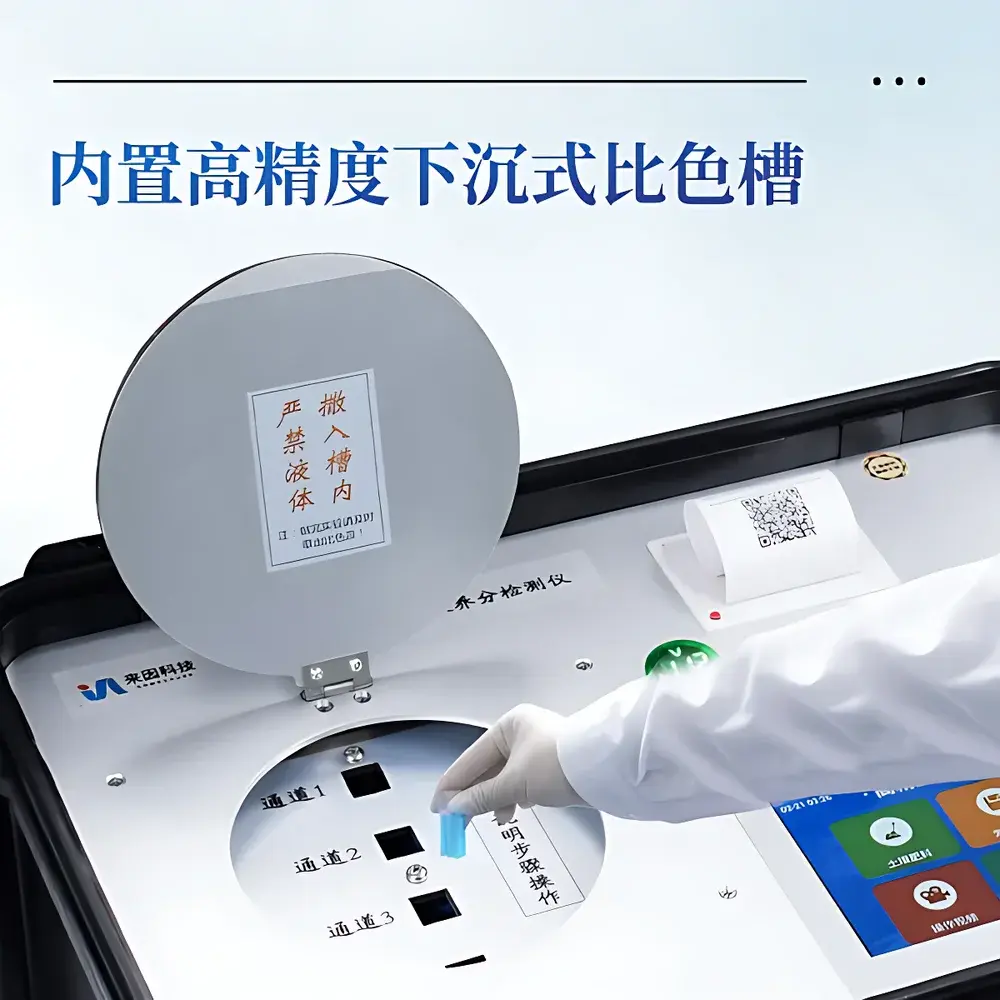
- Integrated, recessed cuvette chamber with 15.7 cm diameter light-shielding disc—ensuring complete optical isolation during measurement and eliminating stray-light-induced bias.
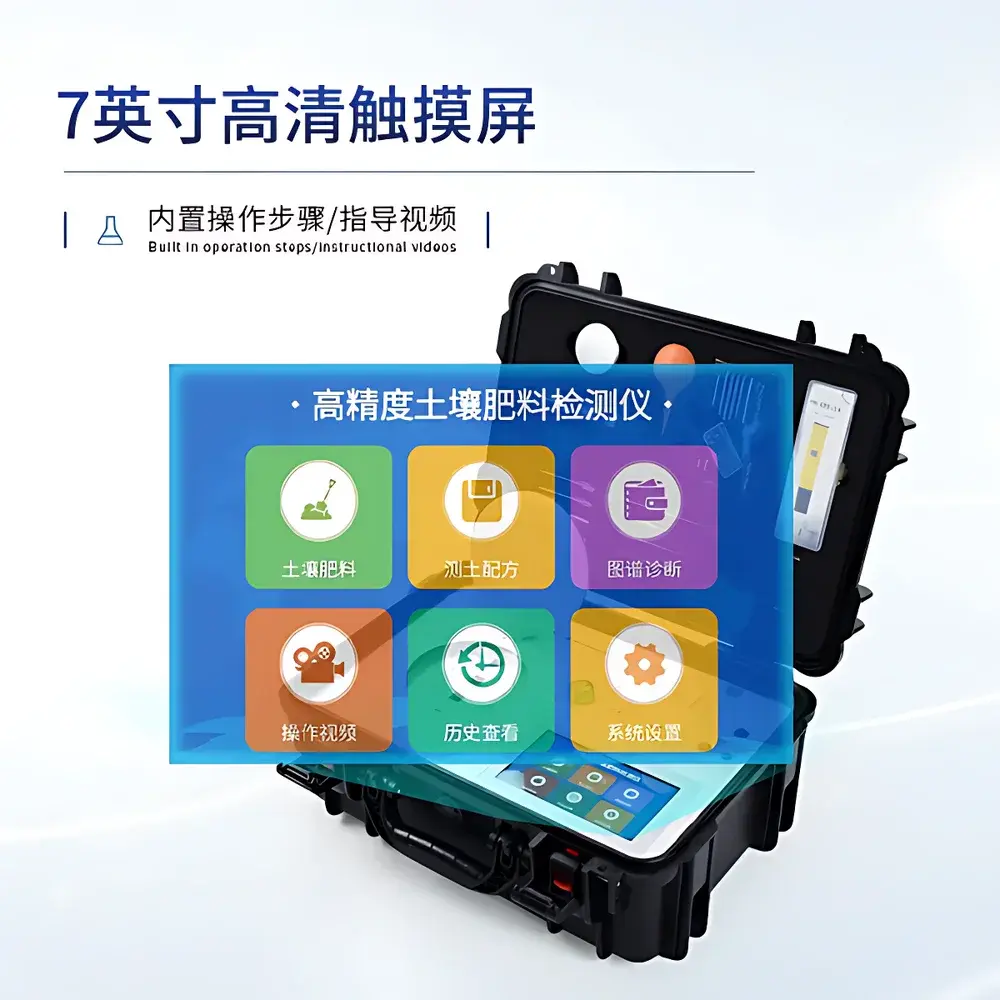
- Android 5.1 operating system powered by quad-core CPU (≥1.8 GHz) and 16 GB internal storage; supports real-time data acquisition, onboard calibration routines, and guided step-by-step assay execution without reference manuals.
- Dual-user authentication via password + fingerprint biometrics; role-based account management for multi-operator field teams with audit-trail-capable session logging.
- Onboard GPS module providing geotagged metadata (latitude/longitude/timestamp) for every result—enabling GIS-integrated contamination mapping and compliance reporting.
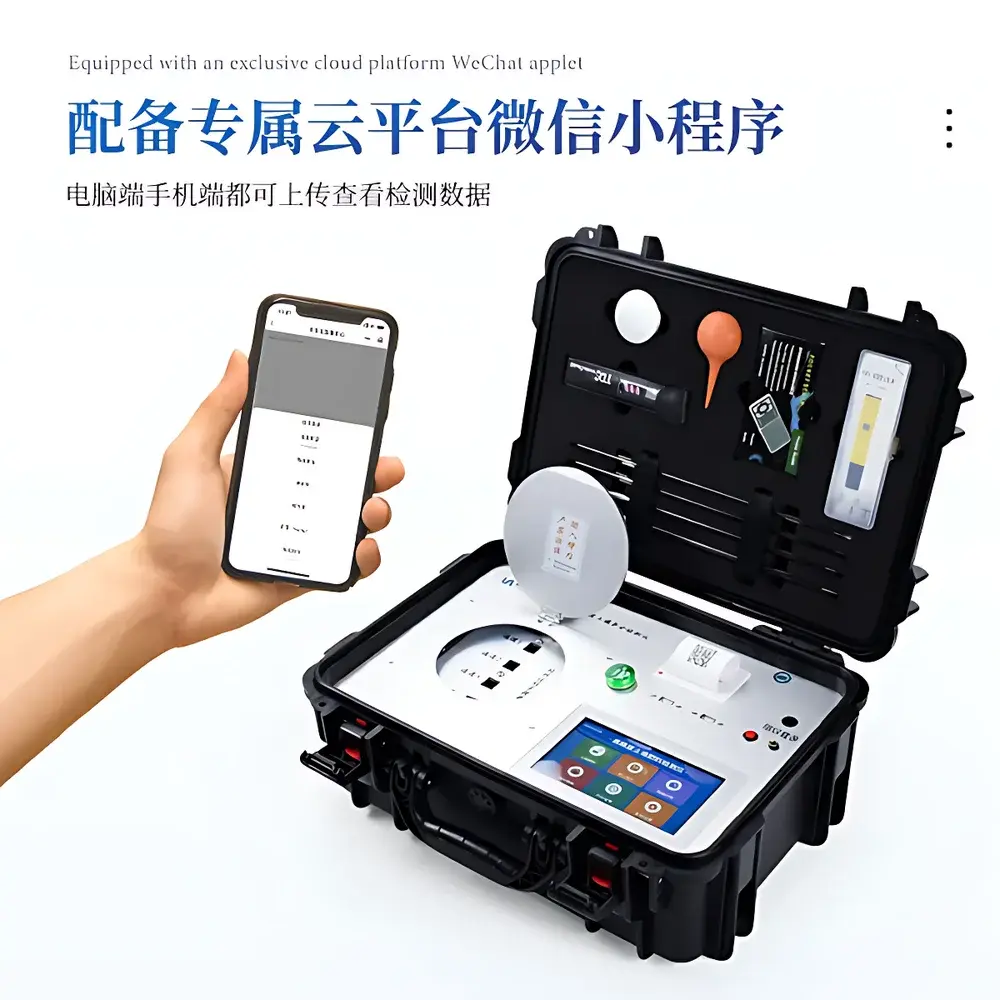
- Embedded thermal printer (ribbon-free) generating traceable reports including sample ID, operator, channel number, absorbance value, calculated concentration, QR code, and geo-coordinates.
- IP65-rated rugged housing with shock-absorbing PVC engineering plastic carry case—designed for sustained operation in humid, dusty, or rain-exposed field conditions.
- Hybrid power architecture: AC 220 V ±22 V / DC 12 V +5 V input, plus integrated 4800 mAh Li-ion battery supporting ≥10 hours continuous use; includes voltage monitor display and auto-save memory with brownout protection.
Sample Compatibility & Compliance
The IN-ZS300 is validated for extraction-based analysis of solid and semi-solid samples following standard pretreatment protocols: acid digestion (HNO₃/HF for total metal content), chelation-based leaching (e.g., DTPA for phytoavailable fractions), or direct aqueous extraction for soluble ions. It accommodates regulated testing of Pb, As, Cd, Cr, Hg, Ni, Cu, Zn, Mn, Fe, Al, F, Ti, Se—covering key contaminants listed in EU Soil Framework Directive Annex I, China’s GB 15618-2018, and US EPA Region IV soil screening levels. While not a primary reference method, its performance meets repeatability (≤0.03% CV) and linearity (≤0.1% error vs. certified reference materials) requirements for Tier 1 field screening under ISO/IEC 17025-accredited quality management systems. Data integrity complies with ALCOA+ principles: attributable, legible, contemporaneous, original, accurate—and supports GLP-aligned documentation when paired with cloud audit logs.
Software & Data Management
Data generated by the IN-ZS300 is structured, timestamped, and georeferenced at point-of-collection. All measurements sync automatically via Wi-Fi to a dedicated cloud-based Agricultural Environmental Data Center—provisioned with enterprise-level encryption (AES-256) and role-based access control. Users receive individual login credentials, enabling hierarchical review of datasets across field technicians, lab supervisors, and regulatory auditors. Historical records are searchable by location, date range, element, or operator ID; exportable in CSV or Excel format for statistical analysis (e.g., spatial kriging, temporal trend modeling). The platform integrates a built-in soil nutrient recommendation engine compliant with regional fertilizer guidelines (e.g., China’s National Standard NY/T 395-2023), allowing formulation adjustments based on measured deficiencies—even in absence of concurrent test data. A companion WeChat Mini Program enables remote dashboard access and push notifications for out-of-spec alerts.
Applications
- Field-scale soil health assessment prior to crop planting or land-use change.
- Rapid verification of remediation efficacy at brownfield sites and mining-affected farmland.
- Quality assurance of organic fertilizers, composts, and biochar amendments.
- Pre-harvest screening of vegetables, fruits, and staple crops for market compliance (e.g., GB 2762-2022 limits).
- Extension service support for smallholder farmers implementing precision nutrient management.
- Academic and NGO-led environmental justice surveys tracking heavy metal dispersion near industrial corridors.
FAQ
What detection principle does the IN-ZS300 use, and how does it ensure accuracy?
It employs validated colorimetric reactions—where target metals form stable, stoichiometric complexes with chromogenic ligands. Absorbance is measured at four discrete wavelengths optimized for spectral separation of overlapping signals. Accuracy is maintained through factory-calibrated optics, onboard zero/reference checks, and algorithmic correction for matrix interferences derived from empirical calibration curves.
Is the instrument suitable for regulatory reporting?
Yes—for screening-level compliance under national soil quality standards (e.g., China GB 15618, India IS 10157). For definitive regulatory submission, confirm alignment with local method validation requirements; many agencies accept IN-ZS300 data as part of tiered investigation strategies when supported by QC/QA documentation.
How is data security managed during cloud transmission?
All data transfers use TLS 1.2+ encryption. The cloud backend adheres to ISO 27001 information security controls, with immutable audit logs recording user actions, device IDs, timestamps, and geo-metadata—fully traceable for GLP/GMP or FDA 21 CFR Part 11 readiness.
Can the instrument be used without internet connectivity?
Yes. All core functions—including assay execution, calibration, printing, and local data storage—operate offline. Wi-Fi is required only for cloud synchronization, remote software updates, or accessing the online recommendation engine.
What maintenance is required for long-term reliability?
No routine optical recalibration is needed due to solid-state LED stability and embedded self-diagnostic routines. Annual verification against NIST-traceable standards (e.g., SRM 2710a) is recommended. The unit carries a three-year manufacturer warranty covering parts and labor, with lifetime technical support.
Related Products







