
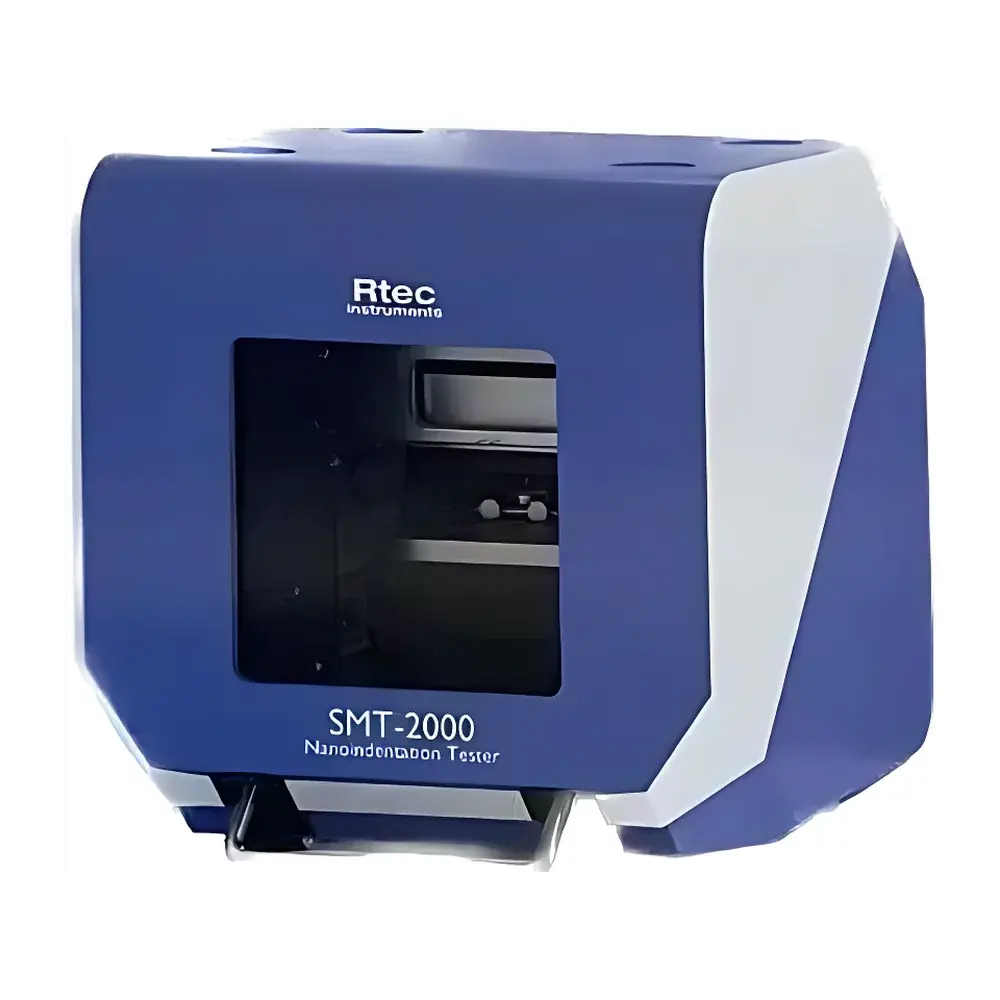
Rtec SMT-2000 Nanoindentation and Scratch Tester
| Brand | Rtec |
|---|---|
| Origin | Switzerland |
| Model | SMT-2000 |
| Instrument Type | Nanoindentation and Scratch Tester |
| Compliance Standards | ASTM E2546, ASTM B933, ASTM D785, ASTM E140, ISO 14577, ISO 6508, ISO 6507, ISO 4516, DIN 50359, DIN 55676, JIS B7734 |
| Actuation | Piezoelectric ceramic drive |
| Sensing Technology | Capacitive displacement sensing |
| Load Range | Nanonewton to 10 N (full-scale) |
| Vertical Resolution | Sub-nanometer |
| Lateral Sample Dimensions | Up to 500 mm × 500 mm |
| Maximum Sample Weight | 10 kg |
| Tip Options | Berkovich, Vickers, spherical, cube-corner, Knoop |
| In-situ 3D topography mapping | Yes |
| Active vibration isolation | Integrated platform |
Overview
The Rtec SMT-2000 Nanoindentation and Scratch Tester is a high-precision, modular instrument engineered for quantitative mechanical characterization of surfaces and thin films at the nanoscale. Based on quasi-static and dynamic depth-sensing indentation principles—compliant with ISO 14577 and ASTM E2546—the system applies controlled normal and lateral forces while simultaneously measuring real-time displacement with sub-nanometer resolution. Its piezoelectric actuation enables precise load control across six orders of magnitude (from <100 nN to 10 N), while integrated capacitive sensors deliver exceptional signal-to-noise ratio and long-term stability. Unlike conventional microhardness testers, the SMT-2000 operates within a fully calibrated force–displacement framework, allowing extraction of contact stiffness, reduced modulus, hardness, creep compliance, strain-rate sensitivity, and plastic work ratios directly from load–displacement curves. The system supports both nanoindentation and linear scratch testing in a single platform, making it suitable for evaluating adhesion, cohesive strength, wear resistance, and interfacial failure mechanisms in multilayered systems.
Key Features
- Modular tip exchange system supporting standardized indenter geometries: Berkovich (for hardness/modulus), Vickers (for comparative microhardness), spherical (for stress–strain reconstruction), cube-corner (for fracture toughness), and Knoop (for anisotropic materials).
- Capacitive displacement sensing with active feedback loop ensures traceable vertical resolution better than 0.05 nm and minimal thermal drift during extended tests.
- In-situ 3D surface topography mapping via integrated white-light interferometry or optional confocal imaging—enabling post-test residual impression analysis and scratch groove profiling without sample relocation.
- Active vibration isolation platform compliant with ISO 25316 Class A specifications, minimizing environmental noise in non-dedicated lab environments.
- Large-format stage accommodating specimens up to 500 mm × 500 mm in footprint and 10 kg in mass—ideal for industrial-grade components such as turbine blades, coated automotive panels, or semiconductor wafers.
- Full compliance with international indentation standards including ISO 14577 (metallic and non-metallic coatings), ASTM E2546 (instrumented indentation testing), and ISO 6507 (Vickers hardness), ensuring data interoperability and audit readiness.
Sample Compatibility & Compliance
The SMT-2000 accommodates diverse material classes—including amorphous polymers, crystalline ceramics, metallic alloys, biomaterials (e.g., hydroxyapatite coatings), optical thin films (e.g., AR/HR stacks), and nanocomposites—without requiring conductive coating or vacuum environment. Its open-stage architecture allows direct integration with environmental chambers (humidity, temperature, inert gas) for in-situ mechanical testing under service-relevant conditions. All test protocols adhere to GLP-aligned data integrity requirements: full electronic audit trail, user-access controls, and timestamped raw force–displacement datasets stored in vendor-neutral HDF5 format. System validation documentation satisfies FDA 21 CFR Part 11 criteria for regulated environments in biomedical device development and pharmaceutical packaging qualification.
Software & Data Management
Rtec’s proprietary MTS (Mechanical Testing Suite) software provides unified control for indentation, scratch, fatigue cycling, and creep hold sequences. It includes automated tip calibration routines, Oliver–Pharr modulus/hardness calculation with optional pile-up/sink-in correction models, and statistical analysis modules for Weibull distribution fitting of hardness scatter. Raw data export supports MATLAB, Python (via h5py), and Excel-compatible CSV formats. For enterprise deployment, optional LIMS integration (via REST API) enables centralized test scheduling, result archiving, and cross-instrument trending—critical for quality assurance labs operating under ISO/IEC 17025 accreditation.
Applications
- Aerospace: Quantifying interfacial toughness of thermal barrier coatings (TBCs) on Ni-based superalloys; evaluating oxidation-induced modulus degradation in bond coats.
- Automotive: Measuring scratch resistance of clearcoats and polymer composites per ISO 1518 and ASTM D7027; characterizing hardness gradients in case-hardened gears.
- Semiconductor: Mapping elastic modulus variation across SiC epitaxial layers; assessing mechanical integrity of low-k dielectrics after CMP.
- Biomedical: Determining viscoelastic recovery of hydrogel-based tissue scaffolds; validating adhesion strength of PVD-coated orthopedic implants.
- Optics: Evaluating mechanical robustness of anti-reflective and laser-damage-resistant coatings on fused silica substrates.
FAQ
Does the SMT-2000 support dynamic mechanical analysis (DMA) modes such as continuous stiffness measurement (CSM)?
Yes—the system implements CSM using high-frequency small-amplitude oscillations superimposed on quasi-static loading, enabling real-time modulus mapping during indentation depth increase.
Can test data be exported in formats compatible with third-party statistical or finite-element analysis tools?
All raw load–displacement curves and topography maps are saved in HDF5 format; ASCII CSV exports are available for force, displacement, acoustic emission, and lateral friction channels.
Is the instrument qualified for use in GMP-regulated environments?
Yes—full IQ/OQ documentation, electronic signature support, and 21 CFR Part 11-compliant audit trails are provided as standard configuration options.
What maintenance intervals are recommended for the capacitive sensor and piezoelectric actuator?
Capacitive sensors require no scheduled recalibration; piezoelectric actuators are rated for >10⁹ cycles with annual verification against NIST-traceable reference standards.
How is tip geometry verified prior to critical measurements?
Each indenter undergoes SEM-based tip radius and facet angle certification; Rtec supplies certified reference materials (CRMs) including fused quartz and sapphire for routine tip shape validation.



