



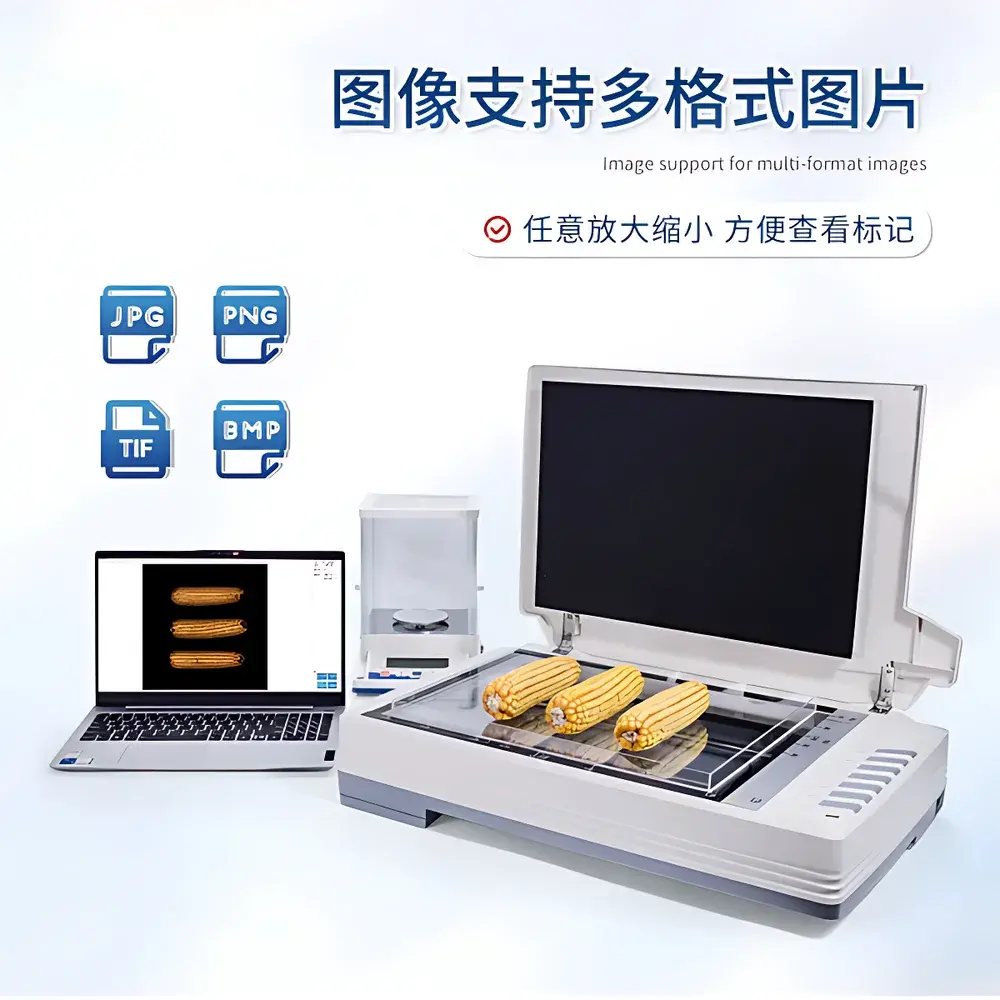
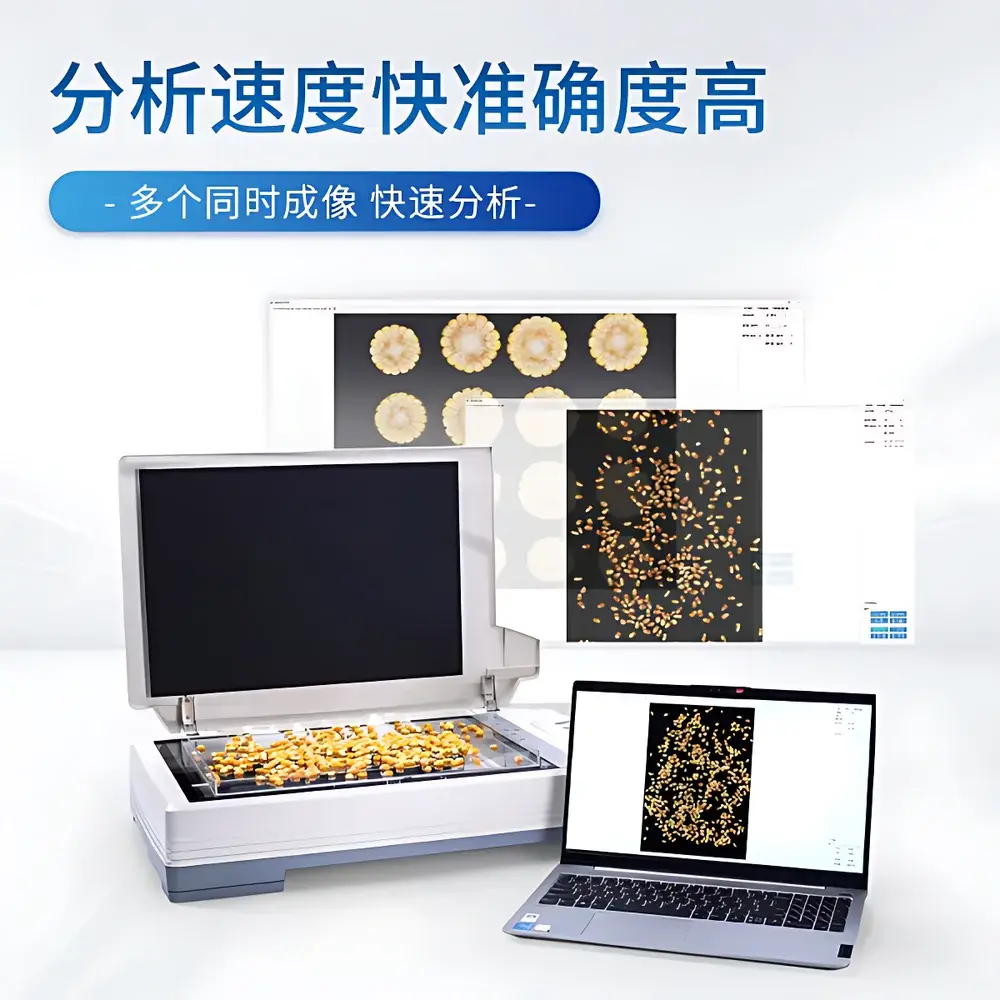
COMECAUSE IN-KZ04 Corn Ear and Kernel Analysis System
| Brand | COMECAUSE |
|---|---|
| Origin | Shandong, China |
| Manufacturer Type | Direct Manufacturer |
| Model | IN-KZ04 |
| Imaging Resolution | Up to 1600 dpi (A3 format) |
| Sample Throughput | 10 whole ears / 35 cross-sections / ~1000 kernels per scan |
| Counting Speed | 1500–4000 kernels/min |
| Counting Accuracy | ≤ ±0.5% (manual verification enables 100% correction) |
| Dimensional Measurement Accuracy | ≤ ±0.3% |
| 1000-Kernel Weight Accuracy | ≤ ±0.5% |
| Weight Integration | RS232-enabled precision balance |
| Image Formats Supported | JPG, TIF, BMP, PNG |
| Software OS Compatibility | Windows 10 or later |
| Data Export | Auto-generated Excel (.xlsx), customizable save path & append mode |
| Cloud Sync | Device-ID-bound encrypted cloud storage with remote access |
| UI Language | Switchable bilingual (English/Chinese) |
| Compliance | Designed for GLP-aligned seed phenotyping workflows |
Overview
The COMECAUSE IN-KZ04 Corn Ear and Kernel Analysis System is a high-precision, vision-based phenotyping platform engineered for objective, non-destructive quantification of morphological and physical traits in maize (Zea mays) and other small-grain crops. It operates on the principle of calibrated digital image acquisition combined with deterministic computer vision algorithms—specifically optimized for segmentation, feature extraction, and statistical aggregation of biological objects under controlled illumination. Unlike manual caliper- or scale-based methods, the IN-KZ04 eliminates observer bias, inter-operator variability, and throughput bottlenecks by automating measurements across three complementary sample types: intact ears, transverse ear sections, and bulk kernels. Its optical architecture integrates an A3-format high-resolution color scanner (1600 × 1600 dpi) housed within a light-diffused imaging chamber, ensuring consistent contrast, minimal shadow artifacts, and reproducible grayscale/color fidelity. Integrated RS232 communication with a precision balance enables synchronized mass acquisition—critical for deriving accurate 1000-kernel weight (TKW) and kernel density metrics without post-hoc manual entry.
Key Features
- Multi-modal sample support: Simultaneous analysis of whole ears, cross-sectional slices (minimum 35 per batch), and loose kernels (up to ~1000 per scan)
- Automated trait extraction: Measures >20 standardized morphometric parameters—including ear length, ear diameter, cob diameter, row number, kernels per row, tip barrenness length, kernel count, kernel length/width/thickness, area, perimeter, circularity, aspect ratio, and RGB-based color indices
- Deterministic image segmentation: Robust separation of adhered or overlapping kernels using adaptive thresholding, watershed refinement, and contour-based topology validation
- Integrated gravimetric calibration: Real-time TKW and HKW calculation via synchronized weight capture and kernel count, with configurable unit conversion (g/1000 seeds or g/100 seeds)
- Batch processing & statistical reporting: Generates summary statistics (mean, SD, CV%, histograms) across all measured traits per sample group, with export-ready Excel output including metadata timestamps and operator ID fields
- Cloud-enabled data governance: Encrypted, device-locked cloud repository supporting version-controlled datasets, remote audit access, and longitudinal cohort tracking
- Regulatory-aware software architecture: Supports ALCOA+ principles (Attributable, Legible, Contemporaneous, Original, Accurate); maintains full audit trail of image processing steps, parameter edits, and user actions
Sample Compatibility & Compliance
The IN-KZ04 is validated for maize (dent, flint, sweet, and popcorn types), rice (Oryza sativa), wheat (Triticum aestivum), soybean (Glycine max), rapeseed (Brassica napus), peanut (Arachis hypogaea), sesame (Sesamum indicum), and other dicot and monocot species with similar grain dimensions (0.5–25 mm). Its measurement framework aligns with internationally referenced seed testing protocols—including ISTA Rules (International Seed Testing Association), ISO 9678-1:2021 (Cereal grains — Determination of thousand-kernel mass), and GB/T 3543.7–1995 (Chinese national standard for seed quality testing). While not FDA-cleared medical equipment, its data integrity features—including electronic signature readiness, user-access controls, and immutable log files—facilitate compliance with GLP (Good Laboratory Practice) and GMP-adjacent seed certification requirements. All image and metadata exports conform to FAIR principles (Findable, Accessible, Interoperable, Reusable) for integration into breeding management systems (BMS) or phenomics databases.
Software & Data Management
The proprietary COMECAUSE PhenotypeStudio™ software (v4.2+) runs exclusively on Windows 10 or newer x64 platforms and provides a modular interface for acquisition, annotation, batch processing, and report generation. Raw images are stored losslessly in TIFF format with embedded EXIF metadata (timestamp, scanner settings, balance reading). Each analysis session generates a structured XML manifest linking image files to quantitative outputs, enabling programmatic parsing. Excel exports include worksheet tabs for raw measurements, descriptive statistics, and trait correlation matrices. The system supports custom field definitions for experimental design (e.g., plot ID, treatment code, replication number), allowing direct ingestion into R, Python (pandas), or SAS environments. Cloud synchronization occurs over TLS 1.3-encrypted HTTPS; no data is processed server-side—only encrypted binary and metadata payloads are transmitted and stored. Audit logs record every user-initiated action, including image reprocessing with modified thresholds, ensuring full traceability for regulatory review.
Applications
- Maize breeding programs: High-throughput screening of yield-component traits (e.g., kernel row number, ear taper index, kernel plumpness) across F₂, BC₁, or RIL populations to accelerate marker-assisted selection
- Seed certification & quality control: Objective assessment of uniformity (CV% of kernel dimensions), purity (foreign material detection via color/shape outlier filtering), and viability proxies (kernel density vs. TKW deviation)
- Varietal fingerprinting: Construction of morphological trait libraries for DUS (Distinctness, Uniformity, Stability) testing and PVP (Plant Variety Protection) enforcement
- Crop physiology studies: Quantifying phenotypic plasticity under abiotic stress (e.g., drought-induced kernel shriveling, nitrogen-responsive ear elongation) via time-series trait mapping
- Post-harvest research: Correlating kernel surface texture (derived from grayscale gradient variance) with milling yield or mycotoxin susceptibility
- Education & extension: Standardized teaching tool for seed morphology labs and agronomy field courses requiring repeatable, instrument-based trait scoring
FAQ
What operating systems does the IN-KZ04 software support?
Windows 10 (64-bit) and Windows 11 (64-bit) only. Legacy OS versions (e.g., Windows 7/8) are not supported due to driver and security protocol requirements.
Can the system analyze damaged or immature kernels?
Yes—the segmentation algorithm includes optional morphological filters to flag and exclude fragmented, shriveled, or germinated kernels based on area-to-perimeter ratio, convexity defects, or grayscale heterogeneity thresholds.
Is calibration required before each use?
A one-time geometric calibration (using supplied reference grid) ensures pixel-to-mm conversion accuracy; routine verification is recommended weekly using certified dimension standards. Weight calibration follows balance manufacturer guidelines.
How is data security handled in cloud mode?
All data is encrypted at rest (AES-256) and in transit (TLS 1.3); cloud access requires two-factor authentication and role-based permissions. No third-party analytics or AI training occurs on uploaded datasets.
Does the system comply with 21 CFR Part 11?
It supports core elements (electronic signatures, audit trails, data integrity controls) but requires site-specific validation documentation to achieve formal Part 11 compliance in regulated environments.
Can I import external images for analysis?
Yes—JPG, PNG, BMP, and TIFF files captured under consistent lighting and scale can be loaded and analyzed, provided resolution meets minimum 300 dpi requirement for sub-millimeter trait resolution.





