
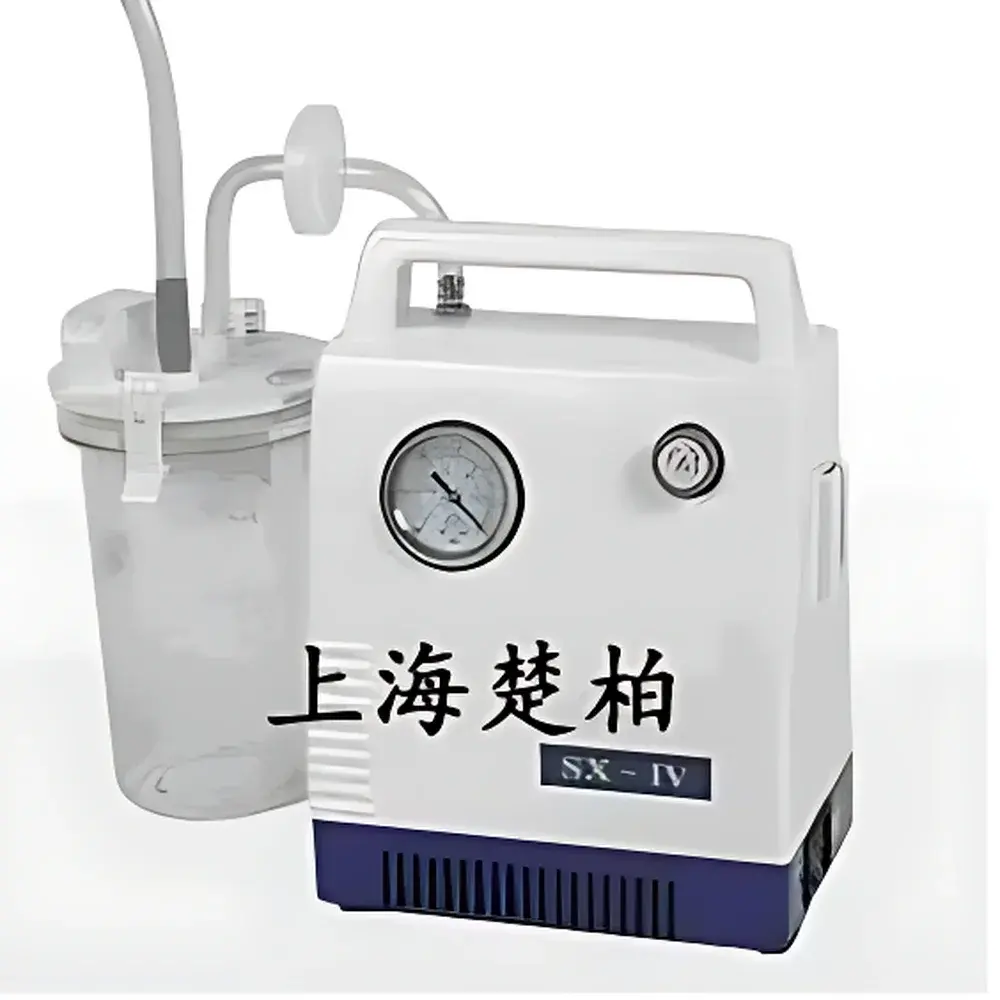
Truelab SX-IV Economical Portable Waste Liquid Aspiration System (Piston Pump)
| Brand | Truelab |
|---|---|
| Origin | Shanghai, China |
| Manufacturer Type | Authorized Distributor |
| Country of Origin | China |
| Model | SX-IV |
| Instrument Type | Diaphragm Pump |
| Product Type | Oil-Free Pump |
| Vacuum Level | ≥80 kPa (ultimate vacuum: 20 kPa) |
| Air Displacement Rate | ≥20 L/min |
| Bottle Capacity | 1000 mL |
| Noise Level | ≤60 dB(A) |
| Rated Power | 110 VA |
| Dimensions (L×W×H) | 210 × 140 × 300 mm |
| Net Weight | 4 kg |
Overview
The Truelab SX-IV Economical Portable Waste Liquid Aspiration System is a compact, oil-free piston-type vacuum pump engineered for reliable liquid aspiration and controlled vacuum generation in routine laboratory environments. Unlike rotary vane or scroll pumps, the SX-IV employs a precision-machined, dry-running piston mechanism with self-lubricating polymer components—eliminating oil carryover, vapor contamination, and maintenance associated with lubricated systems. Its core function centers on generating adjustable negative pressure (–20 to –80 kPa) to aspirate aqueous, mildly corrosive, or viscous biological fluids—including cell culture supernatants, centrifuged lysates, buffer waste, and spent reagents—while simultaneously enabling container evacuation for degassing or filtration support. Designed for benchtop mobility and rapid deployment, the system integrates seamlessly into biosafety cabinets, laminar flow hoods, and mobile lab carts without requiring external cooling or exhaust ducting.
Key Features
- Oil-free piston pump architecture ensures zero hydrocarbon contamination—critical for sensitive assays, cell culture workflows, and GLP-compliant sample handling.
- Adjustable vacuum control via integrated pressure regulator with analog vacuum gauge (0 to –100 kPa scale), enabling precise optimization of aspiration force across fluid viscosities and container geometries.
- Integrated overflow protection valve prevents liquid ingress into the pump head, safeguarding internal mechanics during accidental overfilling or sudden pressure differentials.
- Durable polycarbonate (PC) waste collection bottle (1000 mL capacity) withstands repeated autoclaving at 121°C for 20 minutes—supporting ISO 13485-aligned sterilization protocols and reducing cross-contamination risk between batches.
- Lightweight ABS housing (210 × 140 × 300 mm; 4 kg net weight) features ergonomic carrying handle and non-slip rubber feet for stable operation on uneven surfaces or within confined biosafety enclosures.
- Acoustically damped motor assembly maintains sound pressure ≤60 dB(A) at 1 m distance—meeting WHO-recommended ambient noise thresholds for shared laboratory spaces.
Sample Compatibility & Compliance
The SX-IV is validated for aspiration of water-based solutions, saline buffers (e.g., PBS, Tris-HCl), ethanol/water mixtures (500 mPa·s at 25°C). The polycarbonate bottle complies with USP Class VI biocompatibility standards for short-term liquid contact. While not certified to IEC 61000-6-3 (EMC) or UL 61010-1 as a standalone medical device, the system meets general laboratory safety requirements per EN 61326-1 for electromagnetic compatibility in industrial/scientific environments and conforms to RoHS 2011/65/EU restrictions on hazardous substances.
Software & Data Management
The SX-IV operates as a manually controlled analog instrument with no embedded firmware, touchscreen interface, or digital connectivity (USB/Ethernet/Wi-Fi). This design prioritizes operational simplicity, electrical safety, and long-term reliability—eliminating software obsolescence, cybersecurity vulnerabilities, and calibration drift associated with microprocessor-dependent vacuum controllers. All pressure settings and operational status are observable in real time via the front-panel analog vacuum gauge. For laboratories requiring audit-ready documentation, optional external data loggers (e.g., Omega OM-DAQPRO-5300 series) may be connected via 4–20 mA or 0–5 V analog output adapters (sold separately) to record vacuum profiles against ISO/IEC 17025 traceable timestamps.
Applications
- Routine aspiration of spent media from tissue culture flasks and multiwell plates under laminar flow conditions.
- Pre-filtration degassing of HPLC mobile phases and spectroscopic solvents prior to membrane filtration.
- Vacuum-assisted rinsing of glassware and reusable pipette tips in QC/QA cleanrooms.
- Controlled vacuum application during gel electrophoresis blotting or vacuum manifold-based nucleic acid purification.
- Field-deployable liquid waste management in mobile diagnostic labs, veterinary clinics, and educational outreach programs.
FAQ
Is the SX-IV suitable for aspiration of organic solvents such as acetone or chloroform?
No. The polycarbonate bottle and internal elastomer seals are chemically incompatible with halogenated and ketonic solvents. Only aqueous, low-polarity, and alcohol-diluted solutions are recommended.
Can the vacuum level be maintained stably during continuous aspiration?
Yes—the piston pump delivers consistent air displacement ≥20 L/min at setpoints between –20 and –80 kPa, with pressure stability ±2.5 kPa over 60-minute operation under nominal load.
Does the system include tubing and connectors?
Standard configuration includes one 1.5 m silicone suction tube (6 mm ID), one PC bottle with integrated lid/filter assembly, and one universal bottle-to-pump adapter. Additional tubing kits and sterile vent filters (0.22 µm PTFE) are available as accessories.
What maintenance intervals are recommended?
No scheduled lubrication is required. Users should inspect the inlet filter monthly and replace the activated carbon pre-filter every 6 months under typical usage (≤4 hr/day). Piston seal replacement is recommended after 10,000 operating cycles or 18 months—whichever occurs first.
Is the SX-IV compliant with FDA 21 CFR Part 11 for electronic records?
Not applicable—the device contains no electronic data storage, user authentication, or audit trail functionality. It functions strictly as an analog mechanical tool, exempt from Part 11 requirements per FDA guidance for “non-electronic record” instrumentation.



