
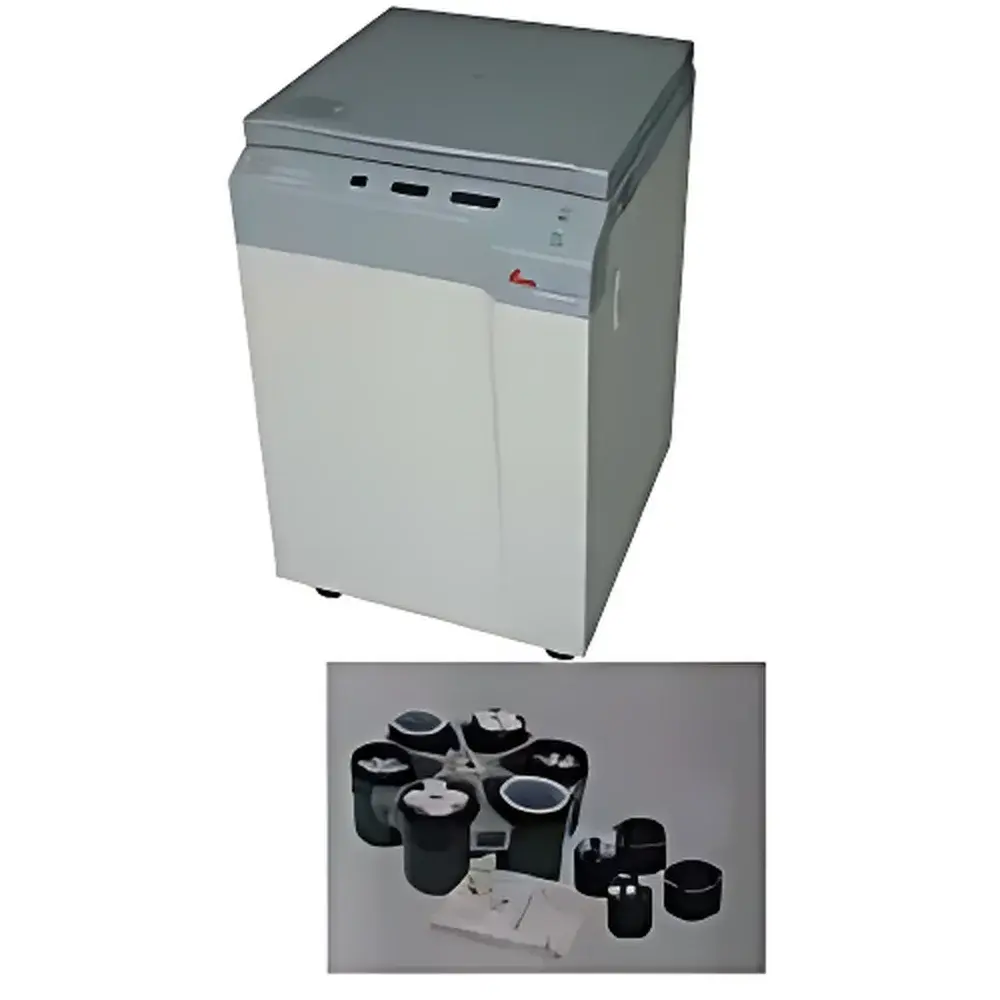
AnTing FeiGe LXJ-IIB Benchtop Low-Speed High-Capacity Multi-Rotor Centrifuge
| Brand | AnTing FeiGe |
|---|---|
| Origin | Shanghai, China |
| Model | LXJ-IIB |
| Type | Benchtop Centrifuge |
| Max Speed | 5000 rpm |
| Max RCF | 6000 ×g |
| Max Capacity | 500 mL × 6 (swinging-bucket rotor) |
| Rotor Configurations | 500 mL × 6 / 50 mL × 24 / 10 mL × 72 (at 6000 rpm) |
| Timer Range | 0–99 min |
| Power Supply | 220 V, 50 Hz, 400 W |
| Dimensions (L×W×H) | 610 × 650 × 795 mm |
| Weight | 100 kg |
| Control System | Microprocessor-based digital control with auto-balance algorithm |
| Safety | Electromagnetic door lock, rotor recognition logic, overspeed/overheat/imbalanced load protection |
Overview
The AnTing FeiGe LXJ-IIB is a robust benchtop low-speed centrifuge engineered for high-capacity, routine separation tasks in clinical, biopharmaceutical, and academic laboratories. Designed around the principle of sedimentation under controlled gravitational force (RCF), it delivers precise, reproducible separation of biological suspensions—including whole blood, cell cultures, serum, plasma, and microbial pellets—without inducing shear-induced denaturation or aggregation commonly associated with high-speed or ultracentrifugation. Its operational envelope (up to 5000 rpm and 6000 ×g) positions it optimally for applications requiring gentle yet efficient phase separation, such as blood banking, diagnostic sample preparation, and bulk buffer clarification. The unit complies with IEC 61010-1:2010 safety standards for laboratory electrical equipment and incorporates mechanical and electronic safeguards aligned with GLP-compliant workflows.
Key Features
- Microprocessor-controlled digital interface with intuitive LED display and real-time parameter monitoring (speed, time, RCF, remaining time)
- Automatic rotor imbalance detection and dynamic compensation algorithm ensuring stable operation across variable load distributions
- Electromagnetically interlocked safety lid with dual-sensor verification—prevents start-up if lid is unlatched or improperly seated
- Three interchangeable swinging-bucket rotors pre-calibrated for specific applications: standard high-volume (500 mL × 6), radioimmunoassay (6 mL × 186), and 192-well microplate handling (3500 rpm)
- Brushless DC motor with frequency conversion drive—ensures smooth acceleration/deceleration, extended service life, and minimal thermal drift during prolonged runs
- Integrated aerodynamic shield reduces noise (<65 dB(A)) and contains aerosol dispersion during high-volume spins
- Thermal management system maintains ambient temperature stability within ±2°C over 99-minute continuous operation
Sample Compatibility & Compliance
The LXJ-IIB accommodates a broad spectrum of primary and secondary containment formats—including polypropylene conical tubes (10–500 mL), glass serum bottles, and standardized 96-/192-well plates—making it suitable for hematology, immunology, and upstream bioprocessing workflows. All rotors are certified for autoclaving (121°C, 20 min) and compatible with common disinfectants (e.g., 70% ethanol, 0.5% sodium hypochlorite). The centrifuge meets ISO 13485-aligned manufacturing controls and supports traceability via rotor-specific calibration records. It is routinely deployed in environments adhering to CLIA, CAP, and ISO/IEC 17025 requirements for clinical testing laboratories.
Software & Data Management
While the LXJ-IIB operates via embedded firmware without external PC dependency, its control architecture logs critical run metadata—including date/time stamp, rotor ID, speed, RCF, duration, and fault codes—in non-volatile memory (retention ≥10 years). Audit trails comply with FDA 21 CFR Part 11 principles when paired with optional USB data export modules (sold separately), enabling integration into LIMS environments. Protocol storage supports up to 12 user-defined programs with password-protected access levels for operator and administrator roles.
Applications
- Blood bank processing: Separation of packed red blood cells, platelet-rich plasma, and cryoprecipitate from whole blood units
- Biomanufacturing: Clarification of mammalian cell culture harvests prior to filtration or chromatography
- Clinical diagnostics: Preparation of serum/plasma specimens for ELISA, RIA, and immunoassay platforms
- Microbiology: Pellet recovery of yeast, fungi, and large bacterial aggregates (e.g., Mycobacterium, Actinomyces)
- Vaccine development: Downstream processing of adjuvant-emulsion formulations and antigen concentrates
- Academic research: Routine fractionation of tissue homogenates, organelle isolation (nuclei, mitochondria), and extracellular vesicle enrichment
FAQ
What is the maximum relative centrifugal force (RCF) achievable with the standard 500 mL rotor?
The LXJ-IIB achieves 6000 ×g at 5000 rpm when using the 500 mL × 6 swinging-bucket rotor.
Does the centrifuge support rotor recognition to prevent mismatched speed settings?
Yes—each rotor carries an embedded identification chip; the control system cross-references rotor type against safe operating parameters before initiating spin.
Is the unit compliant with electromagnetic compatibility (EMC) directives for laboratory use?
It conforms to IEC 61326-1:2013 for EMC performance in industrial and laboratory environments.
Can the 192-well plate rotor be used for PCR plate centrifugation prior to thermal cycling?
Yes—the 192-well rotor operates at 3500 rpm (1500 ×g), sufficient for condensate removal and reagent settling without compromising seal integrity or well geometry.
What maintenance intervals are recommended for optimal long-term reliability?
We recommend biannual inspection of rotor threads, lid gasket integrity, and brake pad wear; annual calibration of speed and timer accuracy per ISO/IEC 17025 guidelines.



